
Product
Product Facts
- Product Name
- Selleys Araldite Ultimate Bond
- Brand
- Selleys
- Category
- Hardware & Tools > Adhesives & Glues
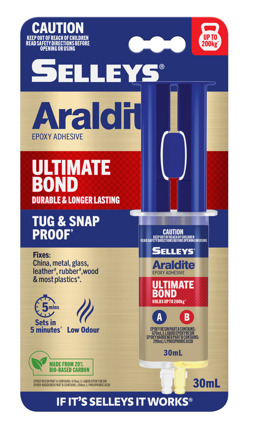
Selleys Araldite Ultimate Bond
Our two-part epoxy adhesive gives you a durable bond for repairs and general assembly. The dual-cartridge syringe dispenses the components at a 2:1 ratio for mixing. Allow for its 3–4 minute open time and 72-hour full cure at 23°C; a five-minute set is not full strength.
Check product range and availability with your retailer.
Product details
| Technology | Epoxy |
|---|
Selleys Araldite Ultimate Bond: technical details
| Features | |
|---|---|
| • Tug and snap proof after full cure • Very strong with ultimate bond strength that holds up to 200kg/cm2 + • Fast setting in 5 minutes | • Adheres to a wide variety of substrates • Easy adhesive dispensing packaging • Durable and long-lasting • Low odour |
| Product and Technical Information | |||
|---|---|---|---|
| Product Data | Technical Performance | ||
| Technology | 2-component epoxy | Open Time | 3-4 minutes |
| Cure Mechanism | Chemical curing | Full Cure | 72 hours @ 23 °C |
| Specific Gravity (A+B) | 1.2 | Tensile Strength | 8-12 MPa |
| Mixing Ratio | 2:1 | Lap Shear Strength+ | 16-20 MPa |
| Colour (Part A) | White | Peel Strength+ | 5-7 N/mm |
| Colour (Part B) | Black | Application Temperature | +5 °C to +40 °C |
| Colour (A+B) | Grey | Service Temperature | -20 °C to +60 °C |
| Storage Temperature | +5 °C to +25 °C | ||
| Shelf life | 24 months | ||
| The table results are based on current product material data, quality test methods, and testing conditions, such as temperature, moisture, and substrate. | |||
| Size | Available colour | Item Code |
|---|---|---|
| 30 mL | Part A – White Part B - Black | 104058 |
What it does
- Tug and snap proof after full cure
- Very strong with ultimate bond strength that holds up to 200kg/cm2 +
- Fast setting in 5 minutes
- Adheres to a wide variety of substrates
- Easy adhesive dispensing packaging
- Durable and long-lasting
- Low odour
Conditions and compatibility
- Not for use on polyethylene, polypropylene or PTFE (Teflon®).
- Pre-test compatibility with substrates before use.
- Do not apply if the ambient or substrate surface temperature is below +5 °C or above +40 °C. Optimal application temperature is between +5 °C and +25 °C.
- Do not use for applications exceeding the temperature requirements above +60 °C. Bond can weaken when the temperature exceeds +60 °C. Strength recovers to optimal once the temperature decreases.
- At low temperatures, curing speed slows.
- Selleys® recommends users conduct their own risk assessment before use to determine the product's suitability. A sample should be applied to the intended area to ensure acceptable appearance, finish, and performance on the substrate.
Where to use it
- Bonding and fixing similar or dissimilar substrates
- Bonding and fixing non-porous substrates that do not require moisture
- Bonding parts and general assembly
- Bonding materials for arts and crafts
Source: Technical data sheet, page 1.
Compatibility limits
- Not for use on polyethylene, polypropylene or PTFE (Teflon®).
- Pre-test compatibility with substrates before use.
Source: Technical data sheet, page 1.
Application method
Surface
- Ensure all surfaces to be bonded are clean, sound, and free of dust, oil, rust, and other contaminants.
- Clean non-porous surfaces with a clean cloth dampened with IPA or white spirit, wiping in one direction only, then immediately followed by wiping with a clean, dry cloth.
- Surface abrasion can improve bond strength for substrates such as composite material, plastics and metals. Remove all existing adhesives or sealants before use on remedial work. Packaging
- Snap out the cap from the plunger and carefully cut the sealed tips at the end of the container nozzle.
- Apply even pressure to the plunger to dispense parts A and B onto a clean disposable container.
- Mix parts A and B thoroughly with a spatula until a homogeneous colour appears.
- Only mix parts A and B that can be consumed for up to 4 minutes. Discard any excess mixed glue that has exceeded its open time.
Source: Technical data sheet, page 1.
How to apply
- Apply mixed glue to both surfaces to bond, then bring them together.
- Hold in place with tapes or a weight to provide temporary support. Do not disturb the bond for at least 60 minutes. Allow the adhesive to cure completely before applying any load.
Source: Technical data sheet, page 2.
Clean up
- Excess adhesive on tools and equipment can be removed with an all-purpose thinner.
- Cured adhesive can be removed mechanically or by applying heat.
Source: Technical data sheet, page 2.
Where not to use it
- Do not apply if the ambient or substrate surface temperature is below +5 °C or above +40 °C. Optimal application temperature is between +5 °C and +25 °C.
- Do not use for applications exceeding the temperature requirements above +60 °C. Bond can weaken when the temperature exceeds +60 °C. Strength recovers to optimal once the temperature decreases.
- At low temperatures, curing speed slows.
- Selleys® recommends users conduct their own risk assessment before use to determine the product's suitability. A sample should be applied to the intended area to ensure acceptable appearance, finish, and performance on the substrate.
Source: Technical data sheet, page 2.
Storage
- Store unopened packaging below 27 °C in a cool, dry place away from direct sunlight.
- Avoid freezing the product.
- Long-term exposure to elevated temperature can decrease material mechanical performance.
- Unopened packaging is best used within 24 months from the date of manufacture. Packaging Size Available colour Item Code 30 mL Part A – White Part B - Black 104058
Source: Technical data sheet, page 2.
Safety before you start
Use the Australian SDS for the exact product, component and colour on your pack. For a two-part product, read both component sheets before mixing.
SELLEYS ARALDITE ULTIMATE BOND Part A
SDS signal word: Warning.
- Causes skin irritation. (H315)
- May cause an allergic skin reaction. (H317)
- Causes serious eye irritation. (H319)
Handling: Avoid eye contact and skin contact. Avoid inhalation of vapour, mist or aerosols.
Protective equipment and ventilation
Wear safety shoes, overalls, gloves, safety glasses. Available information suggests that gloves made from nitrile rubber should be suitable for intermittent contact. However, due to variations in glove construction and local conditions, the user should make a final assessment. Always wash hands before smoking, eating, drinking or using the toilet. Wash contaminated clothing and other protective equipment before storing or re-using.
Australian safety data sheet · issued 10 October 2025 · sections 2, 7 and 8. Read the full SDS for first aid, spill response, incompatibilities and disposal.
SELLEYS ARALDITE ULTIMATE BOND Part B
SDS signal word: Danger.
- May be corrosive to metals. (H290)
- Causes severe skin burns and eye damage. (H314)
- May cause an allergic skin reaction. (H317)
Handling: Avoid eye contact and skin contact. Avoid inhalation of vapour, mist or aerosols.
Protective equipment and ventilation
Wear rubber boots, overalls, gloves, apron, face shield. Available information suggests that gloves made from nitrile rubber should be suitable for intermittent contact. However, due to variations in glove construction and local conditions, the user should make a final assessment. Always wash hands before smoking, eating, drinking or using the toilet. Wash contaminated clothing and other protective equipment before storing or re-using.
Ventilation: Ensure ventilation is adequate to maintain air concentrations below Exposure Standards. Use only in well ventilated areas. Use with local exhaust ventilation or while wearing appropriate respirator. Vapour heavier than air - prevent concentration in hollows or sumps. Do NOT enter confined spaces where vapour may have collected.
Australian safety data sheet · issued 10 October 2025 · sections 2, 7 and 8. Read the full SDS for first aid, spill response, incompatibilities and disposal.
SELLEYS ARALDITE ULTIMATE BOND Part A: storage and product data
| Pack named in this SDS | Product code | Barcode |
|---|---|---|
| Selleys Araldite Ultimate Bond 30mL | 104058 | 9300697134301 |
Store between jobs
Store in a cool, dry, well-ventilated place and out of direct sunlight. Store away from foodstuffs. Store away from incompatible materials described in Section 10. Store away from sources of heat and/or ignition. Keep container standing upright. Keep containers closed when not in use - check regularly for leaks.
This material is classified as a Class 9 Miscellaneous Dangerous Good as per the criteria of the "Australian Code for the Transport of Dangerous Goods by Road & Rail" and/or the "New Zealand NZS5433: Transport of Dangerous Goods on Land" and must be stored in accordance with the relevant regulations.
This material is a Scheduled Poison Schedule 5 (Caution) and must be stored, maintained and used in accordance with the relevant regulations.
| Form | Liquid |
|---|---|
| Colour | White |
| Odour | Characteristic |
| Solubility | N Av |
| Specific Gravity | 1.28 |
| Relative Vapour Density (air=1) | >1 |
| Vapour Pressure | N Av |
| Flash Point (°C) | >93 |
| Explosion/Flammability Limits | N App |
| Autoignition Temperature (°C) | N Av |
| Melting/Freezing Point/Range (°C) | N Av |
| Boiling Point/Range (°C) | N Av |
| pH | N App |
| Viscosity | N Av |
| Total VOC (g/Litre) | N Av |
Typical values describe the material in this safety data sheet. They are not application instructions or performance guarantees. N Av means not available; N App means not applicable.
Ingredients disclosed in the SDS
CHEMICAL ENTITY CAS NO PROPORTION
Bisphenol A diglycidyl ether 1675-54-3 10 - 30 % (w/w)
Bisphenol-A epoxy resin 25068-38-6 10 - 30 % (w/w)
Bisphenol F epoxy resin 9003-36-5 10 - 30 % (w/w)
9-Octadecenoic acid, 12-(oxiranylmethoxy)-, 1,2,3-propanetriyl ester,
homopolymer
74398-71-3 1 - 10 % (w/w)
Phenol, polymer with formaldehyde, glycidyl ether 28064-14-4 1 - 10 % (w/w)
Zinc phosphate 7779-90-0 1 - 10 % (w/w)
Hydrozincite (Zn5(CO3)2(OH)6) 12122-17-7 <1 % (w/w)
Zinc Oxide 1314-13-2 <1 % (w/w)
Ingredients determined to be non-hazardous or below reporting limits Balance
____________
100%
These are the ingredients disclosed for hazard communication, not the complete formulation. Use the application instructions to decide suitability for your project.
First aid from the matching SDS
If poisoning occurs, contact a doctor or Poisons Information Centre (Phone Australia 131 126, New Zealand 0800 764 766).
Inhalation: Remove victim from exposure - avoid becoming a casualty. Remove contaminated clothing and loosen remaining clothing. Allow patient to assume most comfortable position and keep warm. Keep at rest until fully recovered. Seek medical advice if effects persist.
Skin Contact: Effects may be delayed. If skin or hair contact occurs, immediately remove contaminated clothing and flush skin and hair with running water. Continue flushing with water until advised to stop by the Poisons Information Centre or a Doctor; or for 15 minutes and transport to Doctor or Hospital. Eye Contact: If in eyes, hold eyelids apart and flush the eyes continuously with running water. Continue flushing until advised to stop by the Poisons Information Centre or a Doctor; or for at least 15 minutes and transport to Doctor or Hospital.
Ingestion: Rinse mouth with water. If swallowed, do NOT induce vomiting. Give a glass of water to drink. Never give anything by the mouth to an unconscious patient. If vomiting occurs give further water. Seek medical advice.
PPE for First Aiders: Wear safety shoes, overalls, gloves, safety glasses. Available information suggests that gloves made from nitrile rubber should be suitable for intermittent contact. However, due to variations in glove construction and local conditions, the user should make a final assessment. Always wash hands before smoking, eating, drinking or using the toilet. Wash contaminated clothing and other protective equipment before storing or re-using. Notes to Physician: Treat symptomatically. Effects may be delayed.
Disposal
Persons conducting disposal, recycling or reclamation activities should ensure that appropriate personal protection equipment is used, see "Section 8. Exposure Controls and Personal Protection" of this SDS. If possible material and its container should be recycled. If material or container cannot be recycled, dispose in accordance with local, regional, national and international Regulations.
Australian SDS · sections 1, 3, 4, 7, 9 and 13 · 10 October 2025
SELLEYS ARALDITE ULTIMATE BOND Part B: storage and product data
| Pack named in this SDS | Product code | Barcode |
|---|---|---|
| Selleys Araldite Ultimate Bond 30mL | 104058 | 9300697134301 |
Store between jobs
Store in a cool, dry, well-ventilated place and out of direct sunlight. Store away from foodstuffs. Store away from incompatible materials described in Section 10. Store away from sources of heat and/or ignition. Store locked up. Store in corrosive resistant container with a resistant inner liner. Keep container standing upright. Keep containers closed when not in use - check regularly for leaks.
This material is classified as a Class 8 Corrosive as per the criteria of the "Australian Code for the Transport of Dangerous Goods by Road & Rail" and/or the "New Zealand NZS5433: Transport of Dangerous Goods on Land" and must be stored in accordance with the relevant regulations.
This material is a Scheduled Poison Schedule 5 (Caution) and must be stored, maintained and used in accordance with the relevant regulations.
| Form | Liquid |
|---|---|
| Colour | Tan |
| Odour | Characteristic |
| Solubility | N Av |
| Specific Gravity | 1.16 |
| Relative Vapour Density (air=1) | >1 |
| Vapour Pressure | N Av |
| Flash Point (°C) | >93 |
| Explosion/Flammability Limits | N App |
| Autoignition Temperature (°C) | N Av |
| Melting/Freezing Point/Range (°C) | N Av |
| Boiling Point/Range (°C) | N Av |
| pH | N App |
| Viscosity | N Av |
| Total VOC (g/Litre) | N Av |
Others in this range
Alongside this product:
- Araldite Extra Time Epoxy Adhesive
- Araldite Rapid Epoxy Adhesive
- Araldite Super Strong Epoxy Adhesive
- Fix & Go Araldite 5 Minute Epoxy Adhesive
Browse from here
Where this page sits:
Typical values describe the material in this safety data sheet. They are not application instructions or performance guarantees. N Av means not available; N App means not applicable.
Ingredients disclosed in the SDS
CHEMICAL ENTITY CAS NO PROPORTION
9-Octadecenoic acid, 12-(oxiranylmethoxy)-, 1,2,3-propanetriyl ester,
homopolymer
74398-71-3 30 - 60 % (w/w)
Phosphoric acid 7664-38-2 10 - 30 % (w/w)
Oxirane, [[4-(1,1-dimethylethyl)phenoxy]methyl]- 3101-60-8 1 - 10 % (w/w)
Phosphoric acid, butyl ester 12788-93-1 1 - 10 % (w/w)
Phosphoric acid, 2-ethylhexyl ester 12645-31-7 1 - 10 % (w/w)
Polyphosphoric acids 8017-16-1 1 - 10 % (w/w)
Ingredients determined to be non-hazardous or below reporting limits Balance
____________
100%
These are the ingredients disclosed for hazard communication, not the complete formulation. Use the application instructions to decide suitability for your project.
First aid from the matching SDS
If poisoning occurs, contact a doctor or Poisons Information Centre (Phone Australia 131 126, New Zealand 0800 764 766).
Inhalation: Remove victim from exposure - avoid becoming a casualty. Remove contaminated clothing and loosen remaining clothing. Allow patient to assume most comfortable position and keep warm. Keep at rest until fully recovered. Seek medical advice if effects persist.
Skin Contact: Effects may be delayed. If skin or hair contact occurs, remove contaminated clothing and flush skin and hair with running water. If swelling, redness, blistering or irritation occurs seek medical assistance. For gross contamination, immediately drench with water and remove clothing. Continue to flush skin and hair with plenty of water (and soap if material is insoluble). For skin burns, cover with a clean, dry dressing until medical help is available. If blistering occurs, do NOT break blisters. If swelling, redness, blistering, or irritation occurs seek medical assistance. Eye Contact: Immediately irrigate with copious quantities of water for 15 minutes. Eyelids to be held open. Remove clothing if contaminated and wash skin. Urgently seek medical assistance. Transport to hospital or medical centre.
Ingestion: Rinse mouth with water. If swallowed, do NOT induce vomiting. Give a glass of water to drink. Never give anything by the mouth to an unconscious patient. If vomiting occurs give further water. Seek medical advice.
PPE for First Aiders: Wear rubber boots, overalls, gloves, apron, face shield. Available information suggests that gloves made from nitrile rubber should be suitable for intermittent contact. However, due to variations in glove construction and local conditions, the user should make a final assessment. Always wash hands before smoking, eating, drinking or using the toilet. Wash contaminated clothing and other protective equipment before storing or re-using. Notes to Physician: Treat symptomatically. Effects may be delayed. Can cause corneal burns.
Disposal
Persons conducting disposal, recycling or reclamation activities should ensure that appropriate personal protection equipment is used, see "Section 8. Exposure Controls and Personal Protection" of this SDS. If possible material and its container should be recycled. If material or container cannot be recycled, dispose in accordance with local, regional, national and international Regulations.
Australian SDS · sections 1, 3, 4, 7, 9 and 13 · 10 October 2025
Technical and safety documents
The technical data sheet covers application and performance conditions. The safety data sheet covers hazards and safe handling. Use both alongside the pack instructions.
- Technical data sheet — Selleys Araldite Ultimate Bond
- Australian SDS — SELLEYS ARALDITE ULTIMATE BOND Part A · 10 October 2025
- Australian SDS — SELLEYS ARALDITE ULTIMATE BOND Part B · 10 October 2025
Need a hand choosing the right document or checking your application? Contact our team with the product name, pack code, surfaces and intended use.
Do I mix equal parts?
No. Ultimate Bond uses a 2:1 ratio, dispensed by its dual syringe. Mix thoroughly until the colour is uniform; do not substitute another epoxy’s ratio.
How long is the mixed glue usable?
The technical sheet gives 3–4 minutes open time. Only mix what you can use in that period and discard mixed adhesive that has exceeded it.
Does a five-minute set mean I can load the repair?
No. Keep the bond undisturbed for at least 60 minutes and allow complete cure before any load. The May 2026 technical sheet gives 72 hours at 23°C for full cure; cold conditions slow it.
What does the 200kg claim mean?
It is up to 200kg/cm² for a fully cured bond on stainless steel, with strength depending on surface preparation, material and bond size. It is not five-minute handling strength or a universal working load.
What is the minimum bond area?
Our product page says maximise the area, with a minimum 2.25cm² for best performance. That minimum alone does not establish the load capacity of your repair.
Can I mix it on the blister packaging?
No. Use a clean disposable mixing surface. Apply the mixed adhesive to both prepared faces, then join and support them.
Is Part B black or tan?
The May 2026 technical sheet says black, while the October 2025 Part B SDS says tan. Match your pack and confirm any discrepancy with our team before use; do not identify components by colour alone.
How should I store it?
Keep unopened packs at 5–25°C in a cool dry place out of sunlight; this also meets the separate below 27°C instruction. Avoid freezing, keep Part B locked in its original corrosion-resistant packaging, and best use unopened packs within 24 months of manufacture.
Will it bond rubber and leather?
Pre-test both for compatibility, as the product page instructs. Pre-test other intended substrates too. Polyethylene, polypropylene and PTFE/Teflon are excluded.
Are the two components equally hazardous?
No. Part A irritates skin and eyes and may cause a skin allergy. Part B is corrosive, can cause severe skin burns and eye damage, and requires its own PPE, storage and first-aid instructions.
Will sunlight or heat affect the repair?
UV exposure may cause discolouration. Do not use above 60°C service temperature; the bond weakens above that point and recovers strength as temperature decreases.
What are the key product details?
Tug and snap proof after full cure; Very strong with ultimate bond strength that holds up to 200kg/cm2 +; Fast setting in 5 minutes; Adheres to a wide variety of substrates; Easy adhesive dispensing packaging; Durable and long-lasting; Not for use on polyethylene, polypropylene or PTFE (Teflon®); Pre-test compatibility with substrates before use; Do not apply if the ambient or substrate surface temperature is below +5 °C or above +40 °C. Optimal application temperature is between +5 °C and +25 °C; Do not use for applications exceeding the temperature requirements above +60 °C. Bond can weaken when the temperature exceeds +60 °C. Strength recovers to optimal once the temperature decreases.