
Product
Product Facts
- Product Name
- Selleys Knead It Multipurpose
- Brand
- Selleys
- Category
- Home & Garden > Hardware & Building Supplies
Knead It Multipurpose
Discover the versatility and durability of Selleys Knead It Multipurpose from our putty range. Perfect for all your DIY projects and repairs, making sure they last for years to come.
Check the pack details below, then find a retailer near you. Range and availability vary by store.
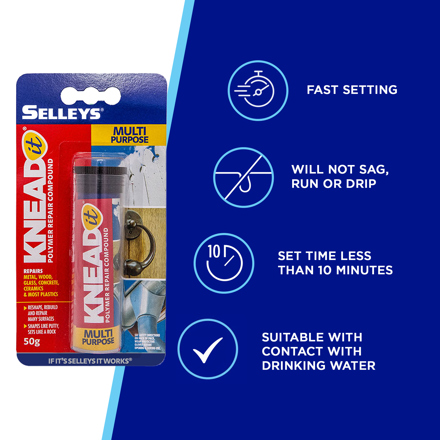
Product details
| Technology | Epoxy |
|---|
Knead It Multipurpose: technical details
| Product and Technical Information | |||
|---|---|---|---|
| Product Data | Technical Performance | ||
| Technology | Epoxy + Hardener | Working Time @ 25 °C | 5 - 10 minutes |
| Cure Mechanism | Chemical curing | Initial Cure | 60 minutes |
| Specific Gravity (A+B) | Approx. 2.0 | Full Cure | 24 hours |
| Shore D Hardness1 | 73 | Lap Shear Strength2 | 4.5 MPa |
| Non-Volatile Content | 100% | Compressive Strength | 45.9 – 82.7 MPa |
| Colour (Part A) | White | Dielectric Strength | 300 V/mil |
| Colour (Part B) | Grey-beige | Electrical Resistance | 30,000 MΩ |
| Colour (A+B) | Grey | Application Temperature | +5 °C to +40 °C |
| Shelf life | 24 months | Service Temperature | -40 °C to +120 °C |
| Storage Temperature | +5 °C to +25 °C | ||
| The table results are based on current product material data, quality test methods, and testing conditions, such as temperature, moisture, and substrate. | |||
| Size | Available colour | Item Code |
|---|---|---|
| Plastic tube - 110 g Blister – 50 g | Part A – White Part B – Grey-beige |
What it does
- Easy to use - no mess
- Non-sag, run and drip
- Heat Resistant up to 120 °C
- Excellent anchoring properties
- Can be used under fresh or salt water
- Adheres to most substrates
- Can be machined, drilled, sawed, sanded, filed, and painted once cured.
Conditions and compatibility
- 3 Not for use on polyethylene, polypropylene or PTFE (Teflon®).
- Pre-test compatibility with substrates before use.
- Do not apply if the ambient or substrate surface temperature is below +5 °C or above +40 °C. Optimal application temperature is between +5 °C and +25 °C.
- Do not use for applications exceeding the temperature requirements above +120 °C continuously.
- At low temperatures, curing speed slows.
- Not recommended for filling joints and cracks subject to movement as the cured product is extremely hard and not flexible.
- Not intended for use in structural applications.
- Selleys® recommends users conduct their own risk assessment before use to determine the product's suitability. A sample should be applied to the intended area to ensure acceptable appearance, finish, and performance on the substrate.
Where to use it
Suitable for:
- Repairing or replacing broken timber, metal, masonry, plastic, or ceramic parts.
- Sealing leaks in gutters and downpipes
- Attaching fixtures and machine tags
- Moulding to reform or reshape damaged timber, metal, masonry, plastic, or ceramic components
- Mending toys, appliances, lawn mowers, and sports equipment
- Patching chipped concrete, floors, bricks, and blocks
- Anchoring bolts, screws, and housings
- Patching dings, scratches, cuts, gouges and holes on fibreglass, metal, wooden boat decks and hulls.
- Filling rust holes and small dents
- Balancing - table legs, etc.
Source: Technical data sheet, page 1.
Compatibility limits
- 3 Not for use on polyethylene, polypropylene or PTFE (Teflon®).
- Pre-test compatibility with substrates before use.
Source: Technical data sheet, page 2.
Application method
Surface
- Ensure all surfaces to be bonded are clean, sound, and free of dust, oil, rust, and other contaminants.
- Surface abrasion can improve bond strength for substrates such as composite materials, plastics and metals. Remove all existing adhesives or sealants before use on remedial work. Packaging
- Remove the cap from the container and take out the compound.
- Remove the disc and cut off the required amount.
- Replace the disc and return the remaining compound to storage.
Source: Technical data sheet, page 2.
How to apply
- Wear gloves when handling the product.
- Knead the material by hand until the colour is uniform.
- If mixing is difficult, let the material reach room temperature.
- Mix the compound above water, then apply underwater.
- Apply the compound to the surface within 3 - 5 minutes after mixing.
- Press the compound into the surface until adhesion starts.
- Shape as needed. Use a clean plastic wrapper to assist application and press firmly into place.
- For a smooth finish, remove excess compound and wipe the surface with clean water or a damp cloth before hardening. Knead It Multipurpose will harden in 60 minutes and form a strong bond. Allow extra curing time if the temperature is below 20°C.
- After 60 minutes, Knead It Multipurpose can be drilled, sanded, machined, filed, sawed, and painted. Chemical Resistance
- Resistant to water, hydrocarbons, aqueous salt solutions, and dilute acids and bases.
- Prolonged exposure to some organic solvents (esters, ketones, alcohols, halogenated solvents) may affect performance.
- For suitability, pre-test a small, cured sample
Source: Technical data sheet, page 2.
Clean up
- Excess compound on tools and equipment can be removed with damp cloth before curing.
- Cured compound can be removed mechanically.
Source: Technical data sheet, page 2.
Where not to use it
- Do not apply if the ambient or substrate surface temperature is below +5 °C or above +40 °C. Optimal application temperature is between +5 °C and +25 °C.
- Do not use for applications exceeding the temperature requirements above +120 °C continuously.
- At low temperatures, curing speed slows.
- Not recommended for filling joints and cracks subject to movement as the cured product is extremely hard and not flexible.
- Not intended for use in structural applications.
- Selleys® recommends users conduct their own risk assessment before use to determine the product's suitability. A sample should be applied to the intended area to ensure acceptable appearance, finish, and performance on the substrate.
Source: Technical data sheet, page 2.
Storage
- Store unopened packaging in a cool, dry place and away from direct sunlight.
- Avoid freezing the product.
- Unopened packaging is best used within 24 months from the date of manufacture.
Source: Technical data sheet, page 2.
Safety before you start
Check the product name on your pack against the Australian SDS below before use.
KNEAD IT MULTIPURPOSE
SDS signal word: Warning.
- Causes skin irritation. (H315)
- May cause an allergic skin reaction. (H317)
- Causes serious eye irritation. (H319)
Handling: Avoid eye contact and skin contact. Avoid inhalation of dust.
Protective equipment and ventilation
Wear safety shoes, overalls, gloves, safety glasses. Available information suggests that gloves made from nitrile rubber should be suitable for intermittent contact. However, due to variations in glove construction and local conditions, the user should make a final assessment. Always wash hands before smoking, eating, drinking or using the toilet. Wash contaminated clothing and other protective equipment before storing or re-using.
Ventilation: Natural ventilation should be adequate under normal use conditions.
Australian safety data sheet · issued 11 February 2026 · sections 2, 7 and 8. Read the full SDS for first aid, spill response, incompatibilities and disposal.
KNEAD IT MULTIPURPOSE: storage and product data
| Pack named in this SDS | Product code | Barcode |
|---|---|---|
| Knead It Multipurpose 50g | 104243 | 9300697118271 |
| Knead It Multipurpose 110g | 104244 | 9300697130396 |
Store between jobs
Store in a cool, dry, well-ventilated place and out of direct sunlight. Store away from foodstuffs. Store away from incompatible materials described in Section 10. Store away from sources of heat and/or ignition. Keep container standing upright. Keep containers closed when not in use - check regularly for spills.
| Form | Paste |
|---|---|
| Colour | Off-white |
| Odour | Characteristic |
| Solubility | Insoluble in water |
| Specific Gravity | Approx. 2.18 |
| Relative Vapour Density (air=1) | >1 |
| Vapour Pressure | N Av |
| Flash Point (°C) | N App |
| Explosion/Flammability Limits | N App |
| Autoignition Temperature (°C) | N Av |
| Melting/Freezing Point/Range (°C) | N Av |
| Boiling Point/Range (°C) | N Av |
| pH | N App |
| Viscosity | N Av |
| Total VOC (g/Litre) | N Av |
Others in this range
Alongside this product:
- Fireproof Cement
- Knead It Aqua
- Knead It Autofix
- Knead It Steel
- N Mastic
- Plasti-Bond Heavy Duty
- Tradie's Bog
Browse from here
Where this page sits:
Typical values describe the material in this safety data sheet. They are not application instructions or performance guarantees. N Av means not available; N App means not applicable.
Ingredients disclosed in the SDS
CHEMICAL ENTITY CAS NO PROPORTION
Bisphenol A diglycidyl ether 1675-54-3 10 - 30 % (w/w)
Ingredients determined to be non-hazardous or below reporting limits Balance
____________
100%
These are the ingredients disclosed for hazard communication, not the complete formulation. Use the application instructions to decide suitability for your project.
First aid from the matching SDS
If poisoning occurs, contact a doctor or Poisons Information Centre (Phone Australia 131 126, New Zealand 0800 764 766).
Inhalation: Remove victim from exposure - avoid becoming a casualty. Remove contaminated clothing and loosen remaining clothing. Allow patient to assume most comfortable position and keep warm. Keep at rest until fully recovered. Seek medical advice if effects persist.
Skin Contact: Effects may be delayed. If skin or hair contact occurs, immediately remove contaminated clothing and flush skin and hair with running water. Continue flushing with water until advised to stop by the Poisons Information Centre or a Doctor; or for 15 minutes and transport to Doctor or Hospital. Eye Contact: If in eyes, hold eyelids apart and flush the eyes continuously with running water. Continue flushing until advised to stop by the Poisons Information Centre or a Doctor; or for at least 15 minutes and transport to Doctor or Hospital.
Ingestion: Rinse mouth with water. If swallowed, do NOT induce vomiting. Give a glass of water to drink. Never give anything by the mouth to an unconscious patient. If vomiting occurs give further water. Seek medical advice.
PPE for First Aiders: Wear safety shoes, overalls, gloves, safety glasses. Available information suggests that gloves made from nitrile rubber should be suitable for intermittent contact. However, due to variations in glove construction and local conditions, the user should make a final assessment. Always wash hands before smoking, eating, drinking or using the toilet. Wash contaminated clothing and other protective equipment before storing or re-using. Notes to Physician: Treat symptomatically. Effects may be delayed.
Disposal
Persons conducting disposal, recycling or reclamation activities should ensure that appropriate personal protection equipment is used, see "Section 8. Exposure Controls and Personal Protection" of this SDS. If possible material and its container should be recycled. If material or container cannot be recycled, dispose in accordance with local, regional, national and international Regulations.
Australian SDS · sections 1, 3, 4, 7, 9 and 13 · 11 February 2026
Technical and safety documents
The technical data sheet covers application and performance conditions. The safety data sheet covers hazards and safe handling. Use both alongside the pack instructions.
- Technical data sheet — Knead It Multipurpose
- Australian SDS — KNEAD IT MULTIPURPOSE · 11 February 2026
Need a hand choosing the right document or checking your application? Contact our team with the product name, pack code, surfaces and intended use.
What can I repair with Knead It Multipurpose?
It suits compatible timber, metal, masonry, ceramics, glass, fibreglass and plastics for non-structural repairs, reshaping, gutter and downpipe leaks, fixtures, chipped concrete, rust holes and small dents. Test the actual surface and repair first. Do not use on polyethylene, polypropylene or PTFE, or in moving joints.
How do I mix and apply it?
Prepare clean, sound surfaces free of oil, rust, dust and old adhesive. Wearing gloves, cut off the required amount and knead until the colour is uniform. Apply within 3–5 minutes after mixing, pressing until adhesion starts, then shape. A clean plastic wrapper can help. Smooth excess with water or a damp cloth before hardening.
Why are both 3–5 and 5–10 minutes listed?
The TDS gives a working-time test of 5–10 minutes at 25°C, but its application method says to apply within 3–5 minutes after mixing. Follow the shorter application instruction; do not wait until the end of the test range.
When can I drill or paint the repair?
Initial hardening is 60 minutes and full cure is 24 hours. The TDS permits drilling, sanding, machining, filing, sawing and painting after 60 minutes, allowing extra curing time below 20°C. Hardening and full cure are different stages.
Can I apply it underwater?
Yes. Our September 2026 TDS permits fresh- or salt-water use: mix the compound above water first, then apply underwater within the specified application time. Pre-test compatibility and assess the repair; it is not for structural applications.
What temperatures and chemicals can it withstand?
Apply only when air and surface are +5°C to +40°C, ideally +5°C to +25°C. Service range is −40°C to +120°C; do not exceed +120°C continuously. It resists water, hydrocarbons, salt solutions and dilute acids/bases. Some organic solvents can affect it over prolonged exposure; test a small cured sample.
How do I clean up and store it?
Wipe uncured excess with a damp cloth and remove cured compound mechanically while avoiding dust exposure. Store closed, upright, dry and ventilated at +5°C to +25°C, away from sunlight, food, oxidising agents and ignition sources. Avoid freezing. Unopened packs are best used within 24 months of manufacture.
What safety precautions apply?
Warning: H315 causes skin irritation; H317 may cause an allergic skin reaction; H319 causes serious eye irritation. Wear gloves for kneading, plus safety shoes, overalls and safety glasses. Avoid contact and breathing dust or spray. Natural ventilation is normally adequate. Skin effects may be delayed; follow the detailed first-aid instructions for exposure.
Which pack and documents should I use?
The 50 g pack is code 104243/barcode 9300697118271; 110 g is code 104244/barcode 9300697130396. Read TDS version 2601, September 2026, and Australian SDS SELGHSEN001786 version 1.1, issued 11 February 2026, in the product documents. Find a store at https://www.selleys.com.au/find-a-store/.
What are the key product details?
Easy to use - no mess; Non-sag, run and drip; Heat Resistant up to 120 °C; Excellent anchoring properties; Can be used under fresh or salt water; Adheres to most substrates; Can be machined, drilled, sawed, sanded, filed, and painted once cured; 3 Not for use on polyethylene, polypropylene or PTFE (Teflon®); Pre-test compatibility with substrates before use; Do not apply if the ambient or substrate surface temperature is below +5 °C or above +40 °C. Optimal application temperature is between +5 °C and +25 °C; Do not use for applications exceeding the temperature requirements above +120 °C continuously; At low temperatures, curing speed slows.
Where can I use it?
Repairing or replacing broken timber, metal, masonry, plastic, or ceramic parts; Sealing leaks in gutters and downpipes; Attaching fixtures and machine tags; Moulding to reform or reshape damaged timber, metal, masonry, plastic, or ceramic components; Mending toys, appliances, lawn mowers, and sports equipment; Patching chipped concrete, floors, bricks, and blocks; Anchoring bolts, screws, and housings; Patching dings, scratches, cuts, gouges and holes on fibreglass, metal, wooden boat decks and hulls; Filling rust holes and small dents; Balancing - table legs, etc.
What should I know about application method?
Ensure all surfaces to be bonded are clean, sound, and free of dust, oil, rust, and other contaminants; Surface abrasion can improve bond strength for substrates such as composite materials, plastics and metals. Remove all existing adhesives or sealants before use on remedial work. Packaging; Remove the cap from the container and take out the compound; Remove the disc and cut off the required amount; Replace the disc and return the remaining compound to storage.