Manufacturer source check
Manufacturer sources checked 24 September 2026.
- Application Temperature: Unresolved source label: the TDS calls −40°C to 140°C both temperature resistance and application temperature. Do not treat that as a verified installation range; confirm application conditions with Selleys.
- Skin Time: The TDS technical table lists 70-minute skin time and 35-minute tooling, but its directions say cleanup before skinning in 5–10 minutes. Confirm the matching label; do not assume a 70-minute working window.
- Cure Time: The TDS gives 2 mm per 24 hours and mentions 72 hours in its directions. Full cure depends on joint depth and conditions; do not extrapolate a linear schedule or treat 72 hours as universal.
What is Selleys Brick & Concrete Silicone, and where should you use it?
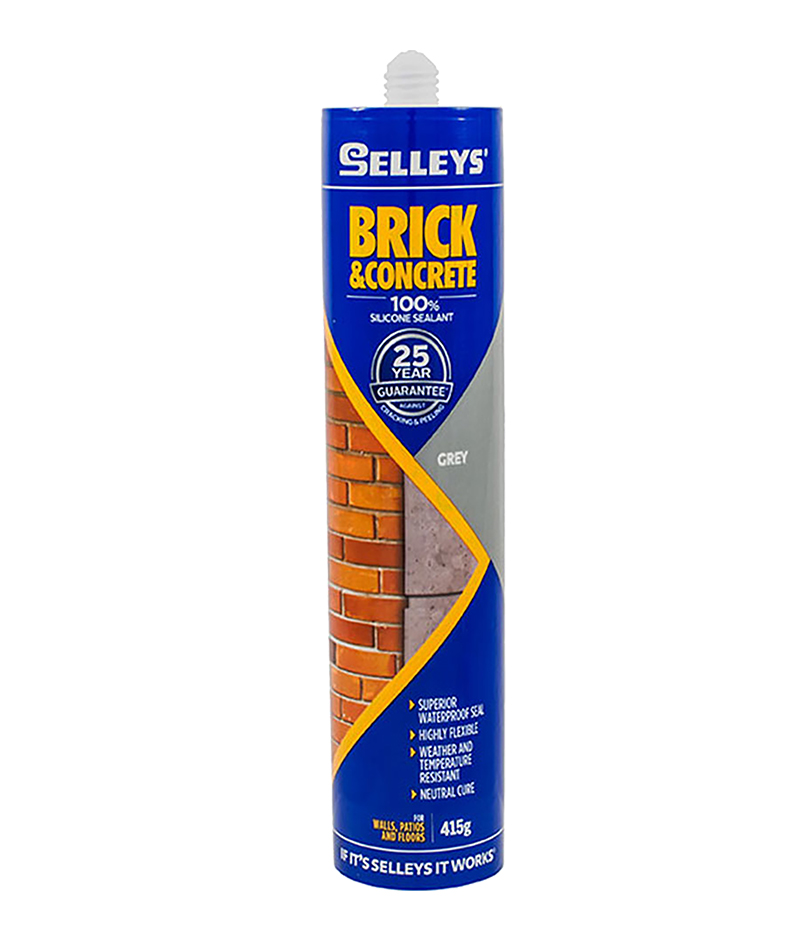
Selleys Brick & Concrete Silicone is a neutral cure silicone sealant that provides a superior waterproof seal and high flexibility. It is intended for joints in walls, patios, floors, fencing, windows and expansion joints in concrete around the home, and it is formulated for superior adhesion to concrete and fibre cement surfaces.
The number that defines it is ±50% joint movement capability. That is a high-movement sealant, and it is the reason to choose it over a general-purpose silicone for a masonry expansion joint — a concrete slab or a brick wall moves seasonally by more than a rigid filler can absorb. The other thing to settle before you buy: it is not paintable, and it must not be used below ground or below the waterline.
Technical specification
| Property | Typical result |
|---|---|
| Technology | Oxime (neutral cure, non-corrosive) |
| Colour | Grey |
| Density | 1.4 g/mL |
| Application temperature | Unresolved source label: the TDS calls −40°C to 140°C both temperature resistance and application temperature. Do not treat that as a verified installation range; confirm application conditions with Selleys. |
| Tooling time | 35 minutes |
| Skin time | 70 minutes |
| Tack-free time | 90 minutes |
| Cure rate | 2mm per 24 hours |
| Full cure | 72 hours |
| Tensile strength (ASTM D412) | 1.2 MPa |
| Shore A hardness (ASTM D2240) | 16 |
| Elongation at break (ASTM D412) | 960% |
| Modulus at 100% elongation (ASTM D412) | 0.26 MPa |
| Elastic recovery (ISO 7389, Method B, 100%) | 89% |
| Movement capability (ISO 9047, Method B) | ±50% |
| Classification | ISO 11600 Type F Class 25LM |
| Temperature resistance | Approximately −40°C to 140°C |
| Packaging | 415g cartridge |
These are indicative data only, not intended for the preparation of specifications. Selleys also offers a 25-year guarantee against cracking, crumbling or peeling away; refer to the product label for the full conditions. That guarantee does not limit and may not necessarily exceed your rights under the Competition and Consumer Act 2010.
What the key numbers mean in practice
±50% movement capability with 960% elongation at break is the pairing that makes this a masonry joint sealant. Movement capability describes how far the joint itself can open and close relative to its width — half again either way — without the seal failing. Elongation at break describes how far the material stretches before it tears. A 10mm expansion joint in a concrete patio can realistically move several millimetres between a February afternoon and a July morning, and a sealant with less capability than that will split along one edge.
Shore A hardness of 16 and a modulus at 100% elongation of 0.26 MPa mean this is a low-modulus sealant. Low modulus matters on masonry: a stiff sealant resists movement and pulls at the substrate, and on brick or aged concrete it will take the surface off with it rather than stretching. A soft, low-modulus bead moves and leaves the masonry alone. Elastic recovery of 89% means the bead returns to close to its original shape after being stretched, so it keeps working across repeated cycles rather than deforming permanently.
The TDS gives 2 mm per 24 hours and mentions 72 hours in its directions. Full cure depends on joint depth and conditions; do not extrapolate a linear schedule or treat 72 hours as universal.
The three working times describe a comfortable window. Tooling time is 35 minutes, skin time 70 minutes, tack-free time 90 minutes. That is far more generous than a fast-skinning sealant, but the manufacturer's own advice is still to work in sections that can be completed before the sealant skins — on a long fence line or patio joint, run and tool a manageable length at a time rather than the whole run at once.
Where to use it
The manufacturer describes it as ideal for:
- Joints in walls
- Patios and floors
- Fencing
- Windows
- Expansion joints in concrete around the home
It is suitable for materials such as bricks and mortar, fibre cement, metal, ceramics, porcelain, concrete, marble and stone, wood, and plastics including polystyrene. The neutral cure chemistry is non-corrosive, which is what allows it to be used against metal without the risk an acetic cure silicone brings. See the rest of the construction silicone range for related products.
How to apply it
- Thoroughly clean and dry the surface, removing oil, dirt and grease with mineral turps. Masonry in particular holds dust that will stop the seal bonding.
- Cut the tip off the cartridge and cut the nozzle at a 45° angle, then fit the nozzle to the cartridge. Size the opening to the joint — you can widen it later, but not narrow it.
- Place the cartridge into a caulking gun. Before you start on the joint, extrude a small amount onto a piece of scrap material to ensure a smooth continuous flow of sealant.
- Hold the caulking gun at a 45° angle and gun the sealant ahead of the nozzle, ensuring product is pushed into the joint rather than laid across it. A bead that only bridges the surface has no depth to move with.
- Tool with a spatula dipped in soapy water for a smooth finish. A spatula dipped in mineral turps, or detergent and water, gives a better finish.
- Clean up with a cloth dampened in mineral turps before the sealant skins.
- Allow 72 hours to cure. At that point any unneeded sealant can be removed by trimming with a sharp blade — but avoid under-cutting the seal, which weakens the bead at exactly the point that carries the movement.
For neater joints, mask the sides before applying the sealant and remove the tape before the sealant skins.
Limitations — where it should NOT be used
- Not paintable. Complete any painting seven days prior to applying the sealant.
- Not suitable for use in below waterline applications.
- Do not use in below ground applications.
- Not for use on polyethylene, polypropylene or Teflon. Pre-test plastics before use.
The below-ground restriction is the one most likely to catch people out on a masonry job, because a retaining wall or a slab edge often continues below the surface. Constant contact with wet soil is a different exposure from weather, and this sealant is not rated for it.
The "pre-test plastics" instruction is worth acting on rather than reading past. Plastics vary enormously in surface energy and in what is moulded into them, and a small test bead on an offcut left to cure is a few minutes' work against redoing a whole run.
Clean up and removal
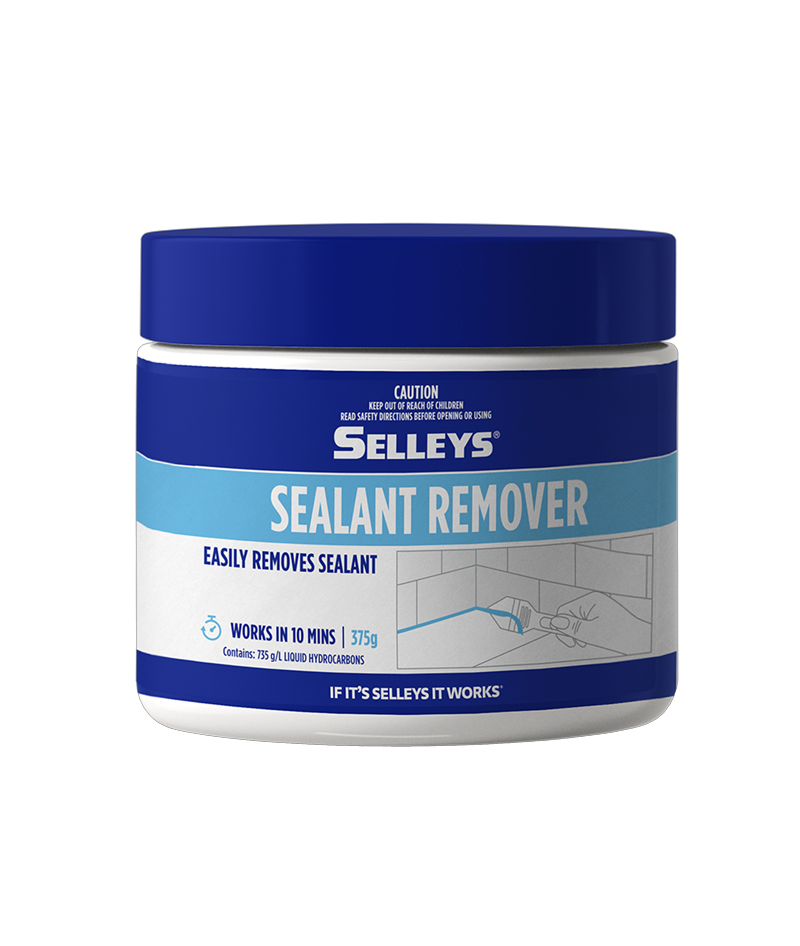
Uncured product may be removed with mineral turps. Cured product can be removed with Selleys Sealant Remover, or by cutting and scraping. As with any silicone, cleaning up while the bead is still workable saves a mechanical job later — cured silicone on porous masonry is particularly hard to lift cleanly.
Hazard classification
Classified as hazardous under Safe Work Australia GHS 7, with the signal word Warning.
- Flammable liquids — Category 4. H227: combustible liquid.
- Skin irritation — Category 2. H315: causes skin irritation.
- Sensitisation — skin — Category 1. H317: may cause an allergic skin reaction.
It is not classified as Dangerous Goods by the criteria of the Australian Code for the Transport of Dangerous Goods by Road & Rail or New Zealand NZS5433. It is, however, classified as a C1 combustible liquid for the purposes of storage and handling under AS 1940, and state regulations apply to how it is stored. For a homeowner with one cartridge in the shed that is academic; for a trade store or a site container holding a carton of it, it is not.
What is in it
| Chemical entity | CAS number | Proportion (w/w) |
|---|---|---|
| 2-Butanone-O,O',O″-(phenylsilylidyne)trioxime | 34036-80-1 | 1–10% |
| 2-Butanone, O,O',O″-(methylsilylidyne)trioxime | 22984-54-9 | 1–10% |
| N-[3-(Trimethoxysilyl)propyl]ethylenediamine | 1760-24-3 | <1% |
| Methyl ethyl ketoxime | 96-29-7 | <1% |
| Ingredients determined to be non-hazardous or below reporting limits | — | Balance |
This product carries three classifications where most sealants in the range carry one or none, so it is worth unpicking which part of the formulation does what. The oxime silanes at 1–10% each are the crosslinkers that make this a neutral cure — the same chemistry the page describes as non-corrosive, and the reason the sealant can be run against metal. Oximes are also the component class conventionally associated with skin sensitisation in neutral cure silicones; that is the chemically obvious reading of H317 and not something the safety data sheet states outright.
H227 is the one people miss. Combustible liquid is the mildest flammability category there is — it means a flash point high enough that the product will not catch from a spark in normal handling, which is why it is not a dangerous good in transport. It is not nothing, though, and it is the reason for the AS 1940 storage classification. Keep cartridges out of direct sun in a vehicle, away from heat sources, and do not gun this sealant next to hot work. The page already tells you to clean up with a cloth dampened in mineral turps, which brings its own flammable rag into the same job — that rag, not the cartridge, is usually the higher risk.
The skin combination — H315 irritation plus H317 sensitisation — matters because of the way this product is used. A patio, a fence line or a run of expansion joints is a long job with many metres of bead, and this is a generous sealant to work with: tooling time is 35 minutes and the skin time 70, which is an invitation to keep going bare-handed. Irritation is the immediate discomfort and it stops when you wash. Sensitisation is the immune system learning to react, generally permanent once acquired, triggered thereafter by much smaller exposures, and acquired precisely through repeated casual contact of the kind a long tooling session delivers. Wear the gloves for the whole run, not just the first cartridge.
Protection
- Eye protection — safety glasses.
- Gloves — nitrile rubber is suitable for intermittent contact. Tool the bead with a tool or a gloved finger, not a bare one.
- Ventilation — natural ventilation is adequate under normal use conditions, and no occupational exposure limit has been assigned by Safe Work Australia for this material. Ventilate anyway when working in a confined space.
- Fire — keep away from heat and ignition sources, and store in a cool, dry place away from direct sunlight.
- Overalls and safety shoes; wash hands before eating, drinking or smoking; wash contaminated clothing before reuse.
First aid
| Exposure | What to do |
|---|---|
| Eyes | Wash out immediately with water. Seek medical advice in all cases of eye contamination, as a precaution. |
| Skin | Effects may be delayed. Remove contaminated clothing immediately and flush the area with running water. For gross contamination, drench with water and remove all clothing, then keep flushing with water and soap. Do not break any blisters. If swelling, redness, blistering or irritation occurs, seek medical assistance. |
| Inhalation | Remove the person from exposure without becoming a casualty yourself. Loosen tight clothing, keep them comfortable, warm and at rest until recovered. Seek medical advice if effects persist. |
| Swallowed | Rinse the mouth with water. Do NOT induce vomiting. Give a glass of water. Never give anything by mouth to an unconscious person. Seek medical advice. |
If poisoning occurs, contact a doctor or the Poisons Information Centre — 131 126 in Australia, 0800 764 766 in New Zealand — with the container to hand. Selleys emergency line: 1800 220 770 in Australia, 0800 220 770 in New Zealand.
What is Selleys Brick & Concrete Silicone used for?
Selleys Brick & Concrete Silicone is a construction silicone sealant designed to seal brick and concrete surfaces, particularly in high-movement areas, providing a water-tight seal. It is suitable for joints in walls, patios, floors, fencing, windows, and expansion joints in concrete.
What size does Selleys Brick & Concrete Silicone come in and what colour is it?
Selleys Brick & Concrete Silicone comes in a 415g cartridge and is grey in colour.
What technology does Selleys Brick & Concrete Silicone use?
Selleys Brick & Concrete Silicone uses Oxime technology.
What movement capability does this sealant have?
Selleys Brick & Concrete Silicone has a movement capability of ±50%, allowing it to accommodate structural shifts and thermal expansion and contraction.
What temperature range can this sealant withstand?
Selleys Brick & Concrete Silicone can withstand temperatures from -40°C to 140°C.
Is Selleys Brick & Concrete Silicone paintable and can it be used below ground?
No, Selleys Brick & Concrete Silicone is not paintable, and it is not suitable for below waterline or below ground applications. It is also not suitable for use on polyethylene, polypropylene, or Teflon.
What guarantee comes with Selleys Brick & Concrete Silicone?
Selleys Brick & Concrete Silicone comes with a 25-year guarantee against cracking, crumbling, or peeling away.
How do you apply Selleys Brick & Concrete Silicone?
To apply, ensure the surface is clean and dry, cut the nozzle at a 45° angle, gun the sealant into the joint, tool it with a spatula dipped in soapy water, clean any uncured product with mineral turps, and allow it to cure in approximately 72 hours.
What are the skin time and tooling time for this sealant?
The TDS technical table lists 70-minute skin time and 35-minute tooling, but its directions say cleanup before skinning in 5–10 minutes. Confirm the matching label; do not assume a 70-minute working window.
What is the cure rate and density of Selleys Brick & Concrete Silicone?
The TDS gives 2 mm per 24 hours and mentions 72 hours in its directions. Full cure depends on joint depth and conditions; do not extrapolate a linear schedule or treat 72 hours as universal.
Images on This Page
-
https://www.selleys.com.au/media/cseezadf/selleys-logo-tagline_752x360.png?rmode=boxpad&ranchor=center&width=188&height=90&format=webp&quality=90
Selleys: Adhesives | Sealants | Putty Fillers | Glues | Cleaning Products - Australia
-
https://www.selleys.com.au/images/productpagev2/loading.gif
(no alt text)
-
https://www.selleys.com.au/media/products/sealants/selleys-brick-and-concrete-product.jpg?rmode=max&ranchor=center&width=440&height=440&format=webp&quality=90
https://www.selleys.com.au/media/products/sealants/selleys-brick-and-concrete-product.jpg?rmode=max&ranchor=center&width=800&height=800&format=webp&quality=90
-
https://www.selleys.com.au/images/productpagev2/pdp-share-icon.png
Share
-
https://www.selleys.com.au/media/3psd4cfm/white-for-life-silicone-sealant.jpg
White For Life Silicone Sealant
-
https://www.selleys.com.au/media/tducz2ti/fix-go-bathroom-and-kitchen.jpg
Fix & Go Bathroom & Kitchen
-
https://www.selleys.com.au/media/0lqk5bd5/all-clear.jpg
All Clear
-
https://www.selleys.com.au/media/voikg0io/paint-over.jpg
Paint Over Sealant
-
https://www.selleys.com.au/media/rrpnpvfy/401-silicone.jpg
401 Silicone
-
https://www.selleys.com.au/media/402hf3h1/brick-concrete.jpg
Brick & Concrete Silicone
-
https://www.selleys.com.au/media/i3hbypls/flame-flex.jpg
Flame Flex
-
https://www.selleys.com.au/media/4ivd3z3w/glass.jpg
Glass Silicone
-
https://www.selleys.com.au/media/qzgn4gis/sealant-remover.jpg
Sealant Remover