
Product
Product Facts
- Product Name
- Polyglaze Exterior Car Care Kit
- Brand
- Selleys
- Category
- Automotive > Car Care & Maintenance
Polyglaze Exterior Car Care Kit
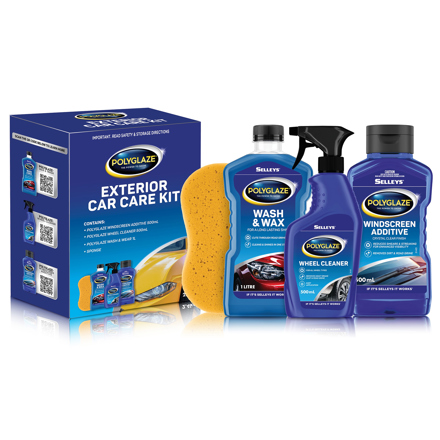
Polyglaze Exterior Car Care Kit gives the best clean for your exteriors, it’s the perfect gift pack with a combination of products specifically tailored to clean and shine the exterior of your car.
Check product range and availability with your retailer.
Product details
Polyglaze Exterior Car Care Kit gives the best clean for your exteriors, it’s the perfect gift pack with a combination of products specifically tailored to clean and shine the exterior of your car.
Polyglaze Exterior Car Care Kit — Polyglaze Wash & Wax; Polyglaze Exterior Car Care Kit: technical details
What it does
- Cleans & shines in 1 step
- Cuts through dirt & road grime
- Powerful wetting & cleaning action
- Mild pH, so at the same time gentle on paintwork and hands
- Spotless, streak free finish
Polyglaze Exterior Car Care Kit — Polyglaze Wheel Cleaner; Polyglaze Exterior Car Care Kit: technical details
What it does
- Simply spray on and wipe off
- Effortlessly removes brake dust, road grime and dirt
- Leaves wheels sparkling clean
- Non acid formula
Polyglaze Exterior Car Care Kit — Polyglaze Windscreen Additive; Polyglaze Exterior Car Care Kit: technical details
What it does
- Reduces smears & streaking for enhanced visibility
- Cleans and lubricates wipers to increase working life
- Helps to prevent glare
- Crystal clear finish
- Enhances visibility
Wash the exterior
Hose off loose dirt. Mix approximately 30 mL of Wash & Wax into a 10 L bucket and fill with water. Wash one section at a time with a sponge, working from the top down, then rinse before the solution dries. Do not use the concentrate undiluted. Work in shade and dry with a chamois for the best finish.
Source: Technical data sheet, page 1.
Clean the wheels
Do not apply to hot wheels. Spray Wheel Cleaner onto the wheel, wipe with a sponge to lift grime, and hose off immediately. Follow the cleaner’s own safety sheet.
Source: Technical data sheet, page 1.
Fill the windscreen washer reservoir
Add 75 mL of Windscreen Additive concentrate to the washer reservoir, then top up with clean water. For reservoirs larger than 4 L, the TDS specifies approximately 150 mL. Clean up concentrated spills immediately because they can stain.
Source: Technical data sheet, page 1.
Check the contents of your kit
The Selleys product page lists Wash & Wax, Windscreen Additive, Wheel Cleaner and a sponge. Each liquid has its own directions and SDS; the wash dilution above does not apply to the other products. Check the labels in your kit before use.
Source: Our product directions.
Safety before you start
This kit contains three different chemical products. Read the separate Australian SDS for each liquid and match it to the bottle in your kit.
SELLEYS POLYGLAZE WASH WAX
The Australian SDS does not classify this material as hazardous under its stated classification criteria. Follow the handling and protective measures in the SDS.
Handling: Avoid eye contact and repeated or prolonged skin contact. Avoid inhalation of vapour, mist or aerosols.
Protective equipment and ventilation
Wear safety shoes, overalls, gloves, safety glasses. Available information suggests that gloves made from nitrile rubber should be suitable for intermittent contact. However, due to variations in glove construction and local conditions, the user should make a final assessment. Always wash hands before smoking, eating, drinking or using the toilet. Wash contaminated clothing and other protective equipment before storing or re-using.
Ventilation: Natural ventilation should be adequate under normal use conditions.
Australian safety data sheet · issued 22 September 2022 · sections 2, 7 and 8. Read the full SDS for first aid, spill response, incompatibilities and disposal.
SELLEYS POLYGLAZE WHEEL CLEANER
SDS signal word: Danger.
- Causes skin irritation. (H315)
- Causes serious eye damage. (H318)
Handling: Avoid eye contact and skin contact. Avoid inhalation of vapour, mist or aerosols.
Protective equipment and ventilation
Wear safety shoes, overalls, gloves, safety glasses. Available information suggests that gloves made from nitrile rubber should be suitable for intermittent contact. However, due to variations in glove construction and local conditions, the user should make a final assessment. Always wash hands before smoking, eating, drinking or using the toilet. Wash contaminated clothing and other protective equipment before storing or re-using.
Ventilation: Ensure ventilation is adequate to maintain air concentrations below Exposure Standards. Use only in well ventilated areas. Use with local exhaust ventilation or while wearing appropriate respirator. Vapour heavier than air - prevent concentration in hollows or sumps. Do NOT enter confined spaces where vapour may have collected.
Australian safety data sheet · issued 1 December 2022 · sections 2, 7 and 8. Read the full SDS for first aid, spill response, incompatibilities and disposal.
SELLEYS POLYGLAZE WINDSCREEN ADDITIVE
SDS signal word: Warning.
- Causes skin irritation. (H315)
- Causes serious eye irritation. (H319)
Handling: Avoid eye contact and skin contact. Avoid inhalation of vapour, mist or aerosols.
Protective equipment and ventilation
Wear safety shoes, overalls, gloves, safety glasses. Available information suggests that gloves made from nitrile rubber should be suitable for intermittent contact. However, due to variations in glove construction and local conditions, the user should make a final assessment. Always wash hands before smoking, eating, drinking or using the toilet. Wash contaminated clothing and other protective equipment before storing or re-using.
Ventilation: Ensure ventilation is adequate to maintain air concentrations below Exposure Standards. Use only in well ventilated areas. Use with local exhaust ventilation or while wearing appropriate respirator. Vapour heavier than air - prevent concentration in hollows or sumps. Do NOT enter confined spaces where vapour may have collected.
Australian safety data sheet · issued 13 August 2024 · sections 2, 7 and 8. Read the full SDS for first aid, spill response, incompatibilities and disposal.
Storage precautions
SELLEYS POLYGLAZE WASH WAX: Store in a cool, dry, well-ventilated place and out of direct sunlight. Store away from foodstuffs. Store away from incompatible materials described in Section 10. Store away from sources of heat and/or ignition. Keep container standing upright. Keep containers closed when not in use - check regularly for leaks.
SELLEYS POLYGLAZE WHEEL CLEANER: Store in a cool, dry, well-ventilated place and out of direct sunlight. Store away from foodstuffs. Store away from incompatible materials described in Section 10. Store away from sources of heat and/or ignition. Keep container standing upright. Keep containers closed when not in use - check regularly for leaks.
SELLEYS POLYGLAZE WINDSCREEN ADDITIVE: Store in a cool, dry, well-ventilated place and out of direct sunlight. Store away from foodstuffs. Store away from incompatible materials described in Section 10. Store away from sources of heat and/or ignition. Keep container standing upright. Keep containers closed when not in use - check regularly for leaks.
POLYGLAZE WASH & WAX: storage and product data
Store between jobs
Store in a cool, dry, well-ventilated place and out of direct sunlight. Store away from foodstuffs. Store away from incompatible materials described in Section 10. Store away from sources of heat and/or ignition. Keep container standing upright. Keep containers closed when not in use - check regularly for leaks.
| Form | Liquid |
|---|---|
| Colour | Blue |
| Odour | Lemon |
| Solubility | Soluble in water |
| Specific Gravity | 0.99 - 1.01 |
| Relative Vapour Density (air=1) | >1 |
| Vapour Pressure | 18mm Hg @ 20 °C |
| Flash Point (°C) | N App |
| Flammability Limits (%) | N App |
| Autoignition Temperature (°C) | N Av |
| Melting Point/Range (°C) | <0 |
| Boiling Point/Range (°C) | Approx. 100 |
| pH | 7.0 - 8.5 |
| Viscosity | N Av |
| Total VOC (g/Litre) | N Av |
Typical values describe the material in this safety data sheet. They are not application instructions or performance guarantees. N Av means not available; N App means not applicable.
Ingredients disclosed in the SDS
CHEMICAL ENTITY CAS NO PROPORTION
Ingredients determined to be non-hazardous or below reporting limits 100 % (w/w)
____________
100%
These are the ingredients disclosed for hazard communication, not the complete formulation. Use the application instructions to decide suitability for your project.
First aid from the matching SDS
If poisoning occurs, contact a doctor or Poisons Information Centre (Phone Australia 131 126, New Zealand 0800 764 766).
Inhalation: Remove victim from exposure - avoid becoming a casualty. Remove contaminated clothing and loosen remaining clothing. Allow patient to assume most comfortable position and keep warm. Keep at rest until fully recovered. Seek medical advice if effects persist.
Skin Contact: If skin or hair contact occurs, remove contaminated clothing and flush skin and hair with running water. If swelling, redness, blistering or irritation occurs seek medical assistance.
Eye contact: If in eyes wash out immediately with water. In all cases of eye contamination it is a sensible precaution to seek medical advice.
Ingestion: Rinse mouth with water. If swallowed, do NOT induce vomiting. Give a glass of water to drink. Never give anything by the mouth to an unconscious patient. If vomiting occurs give further water. Seek medical advice.
PPE for First Aiders: Wear safety shoes, overalls, gloves, safety glasses. Available information suggests that gloves made from nitrile rubber should be suitable for intermittent contact. However, due to variations in glove construction and local conditions, the user should make a final assessment. Always wash hands before smoking, eating, drinking or using the toilet. Wash contaminated clothing and other protective equipment before storing or re-using.
Notes to physician: Treat symptomatically.
Disposal
Persons conducting disposal, recycling or reclamation activities should ensure that appropriate personal protection equipment is used, see "Section 8. Exposure Controls and Personal Protection" of this SDS. If possible material and its container should be recycled. If material or container cannot be recycled, dispose in accordance with local, regional, national and international Regulations.
Australian SDS · sections 1, 3, 4, 7, 9 and 13 · 22 September 2022
SELLEYS POLYGLAZE WHEEL CLEANER: storage and product data
Store between jobs
Store in a cool, dry, well-ventilated place and out of direct sunlight. Store away from foodstuffs. Store away from incompatible materials described in Section 10. Store away from sources of heat and/or ignition. Keep container standing upright. Keep containers closed when not in use - check regularly for leaks.
| Form | Liquid |
|---|---|
| Colour | Colourless |
| Odour | Odourless |
| Solubility | Soluble in water |
| Specific Gravity | 1.00 - 1.03 |
| Relative Vapour Density (air=1) | >1 |
| Vapour Pressure | N Av |
| Flash Point (°C) | N App |
| Flammability Limits (%) | N App |
| Autoignition Temperature (°C) | N Av |
| Melting Point/Range (°C) | N Av |
| Boiling Point/Range (°C) | N Av |
| pH | 12.4 - 13.1 |
| Viscosity | N Av |
| Total VOC (g/Litre) | N Av |
Typical values describe the material in this safety data sheet. They are not application instructions or performance guarantees. N Av means not available; N App means not applicable.
Ingredients disclosed in the SDS
CHEMICAL ENTITY CAS NO PROPORTION
Alcohols, C12-15, ethoxylated 68131-39-5 1 - 10 % (w/w)
Sodium hydroxide 1310-73-2 <1 % (w/w)
Sodium tripolyphosphate 7758-29-4 <1 % (w/w)
Ingredients determined to be non-hazardous or below reporting limits Balance
____________
100%
These are the ingredients disclosed for hazard communication, not the complete formulation. Use the application instructions to decide suitability for your project.
First aid from the matching SDS
If poisoning occurs, contact a doctor or Poisons Information Centre (Phone Australia 131 126, New Zealand 0800 764 766).
Inhalation: Remove victim from exposure - avoid becoming a casualty. Remove contaminated clothing and loosen remaining clothing. Allow patient to assume most comfortable position and keep warm. Keep at rest until fully recovered. Seek medical advice if effects persist.
Skin Contact: If skin or hair contact occurs, immediately remove contaminated clothing and flush skin and hair with running water. Continue flushing with water until advised to stop by the Poisons Information Centre or a Doctor; or for 15 minutes and transport to Doctor or Hospital.
Eye contact: Immediately irrigate with copious quantities of water for 15 minutes. Eyelids to be held open. Remove clothing if contaminated and wash skin. Urgently seek medical assistance. Transport to hospital or medical centre.
Ingestion: Rinse mouth with water. If swallowed, do NOT induce vomiting. Give a glass of water to drink. Never give anything by the mouth to an unconscious patient. If vomiting occurs give further water. Seek medical advice.
PPE for First Aiders: Wear safety shoes, overalls, gloves, safety glasses. Available information suggests that gloves made from nitrile rubber should be suitable for intermittent contact. However, due to variations in glove construction and local conditions, the user should make a final assessment. Always wash hands before smoking, eating, drinking or using the toilet. Wash contaminated clothing and other protective equipment before storing or re-using.
Notes to physician: Treat symptomatically. Can cause corneal burns.
Disposal
Persons conducting disposal, recycling or reclamation activities should ensure that appropriate personal protection equipment is used, see "Section 8. Exposure Controls and Personal Protection" of this SDS. If possible material and its container should be recycled. If material or container cannot be recycled, dispose in accordance with local, regional, national and international Regulations.
Australian SDS · sections 1, 3, 4, 7, 9 and 13 · 1 December 2022
SELLEYS POLYGLAZE WINDSCREEN ADDITIVE: storage and product data
| Pack named in this SDS | Product code | Barcode |
|---|---|---|
| Polyglaze Windscreen Additive 500mL | 103209 | 9300697132512 |
Store between jobs
Store in a cool, dry, well-ventilated place and out of direct sunlight. Store away from foodstuffs. Store away from incompatible materials described in Section 10. Store away from sources of heat and/or ignition. Keep container standing upright. Keep containers closed when not in use - check regularly for leaks.
| Form | Liquid |
|---|---|
| Colour | Clear blue |
| Odour | Slight |
| Solubility | Soluble in water |
| Specific Gravity | 0.99 - 1.01 |
| Relative Vapour Density (air=1) | >1 |
| Vapour Pressure | 2.37 kPa @ 20 °C |
| Flash Point (°C) | N App |
| Explosion/Flammability Limits | N App |
| Autoignition Temperature (°C) | N Av |
| Melting Point/Range (°C) | <0 |
| Boiling Point/Range (°C) | Approx. 100 |
| pH | 7.0 - 11.5 |
| Viscosity | N Av |
| Total VOC (g/Litre) | N Av |
Others in this range
Alongside this product:
- Engine Degreasers & Lubricants
- Polyglaze Auto Protectant Wipes
- Polyglaze Drying Towel
- Polyglaze Glass Cleaner
- Polyglaze Heavy Duty Wash & Wax Hose On
- Polyglaze Interior Protectant
- Polyglaze Liquid Polish
- Polyglaze Microfibre Cloth
- Polyglaze Plush Pile Mitt
- Polyglaze Spray Wax
- Polyglaze Tyre Shine
- Polyglaze Universal Wheel Brush
- Polyglaze Wash & Wax
- Polyglaze Wheel Cleaner
Browse from here
Where this page sits:
Typical values describe the material in this safety data sheet. They are not application instructions or performance guarantees. N Av means not available; N App means not applicable.
Ingredients disclosed in the SDS
CHEMICAL ENTITY CAS NO PROPORTION
Ethylene glycol mono butylether 111-76-2 1 - 10 % (w/w)
Ethanolamine 141-43-5 <1 % (w/w)
Glycine, N-methyl-N-(1-oxododecyl)-, sodium salt 137-16-6 <1 % (w/w)
Ingredients determined to be non-hazardous or below reporting limits Balance
____________
100%
These are the ingredients disclosed for hazard communication, not the complete formulation. Use the application instructions to decide suitability for your project.
First aid from the matching SDS
If poisoning occurs, contact a doctor or Poisons Information Centre (Phone Australia 131 126, New Zealand 0800 764 766).
Inhalation: Remove victim from exposure - avoid becoming a casualty. Remove contaminated clothing and loosen remaining clothing. Allow patient to assume most comfortable position and keep warm. Keep at rest until fully recovered. Seek medical advice if effects persist.
Skin Contact: If skin or hair contact occurs, immediately remove contaminated clothing and flush skin and hair with running water. Continue flushing with water until advised to stop by the Poisons Information Centre or a Doctor; or for 15 minutes and transport to Doctor or Hospital.
Eye contact: If in eyes, hold eyelids apart and flush the eyes continuously with running water. Continue flushing until advised to stop by the Poisons Information Centre or a Doctor; or for at least 15 minutes and transport to Doctor or Hospital.
Ingestion: Rinse mouth with water. If swallowed, do NOT induce vomiting. Give a glass of water to drink. Never give anything by the mouth to an unconscious patient. If vomiting occurs give further water. Seek medical advice.
PPE for First Aiders: Wear safety shoes, overalls, gloves, safety glasses. Available information suggests that gloves made from nitrile rubber should be suitable for intermittent contact. However, due to variations in glove construction and local conditions, the user should make a final assessment. Always wash hands before smoking, eating, drinking or using the toilet. Wash contaminated clothing and other protective equipment before storing or re-using.
Notes to physician: Treat symptomatically.
Disposal
Persons conducting disposal, recycling or reclamation activities should ensure that appropriate personal protection equipment is used, see "Section 8. Exposure Controls and Personal Protection" of this SDS. If possible material and its container should be recycled. If material or container cannot be recycled, dispose in accordance with local, regional, national and international Regulations.
Australian SDS · sections 1, 3, 4, 7, 9 and 13 · 13 August 2024
Technical and safety documents
The technical data sheet covers application and performance conditions. The safety data sheet covers hazards and safe handling. Use both alongside the pack instructions.
- Technical data sheet — Polyglaze Wash & Wax
- Technical data sheet — Polyglaze Wheel Cleaner
- Technical data sheet — Polyglaze Windscreen Additive
- Australian SDS — SELLEYS POLYGLAZE WASH WAX · 22 September 2022
- Australian SDS — SELLEYS POLYGLAZE WHEEL CLEANER · 1 December 2022
- Australian SDS — SELLEYS POLYGLAZE WINDSCREEN ADDITIVE · 13 August 2024
Need a hand choosing the right document or checking your application? Contact our team with the product name, pack code, surfaces and intended use.
What does the kit contain?
Our kit contains 1 L Wash & Wax, 500 mL Wheel Cleaner trigger spray, 500 mL Windscreen Additive and a sponge. The products are also sold separately.
How do I dilute Wash & Wax?
Add approximately 30 mL to a 10 L bucket and fill with water. Do not use it undiluted. Wash one section at a time from the top down and hose off before the solution dries.
How do I clean the wheels?
Do not apply Wheel Cleaner to hot surfaces. Spray on cool wheels, wipe with a sponge and immediately hose off with water. Follow its Danger/H315/H318 safety precautions.
How much Windscreen Additive should I use?
Add 75 mL to the washer reservoir and top up with clean water. For reservoirs over 4 L, use approximately 150 mL. Immediately clean up concentrate spills because staining will occur.
How should I store the kit?
Protect all three liquids from freezing. Keep containers upright, tightly closed, cool, dry and ventilated, away from direct sunlight, food, heat, ignition sources and oxidising agents. Keep out of reach of children.
Do all three liquids have the same safety information?
No. Wheel Cleaner is Danger/H315/H318; Windscreen Additive is Warning/H315/H319; Wash & Wax is not classified as hazardous under its SDS criteria. Use the separate matching instructions, protection and first-aid sheet for each liquid.
Where are the application instructions?
Use all three March 2023 technical sheets linked on this page: Wash & Wax for body washing, Wheel Cleaner for immediate-rinse wheel cleaning, and Windscreen Additive for reservoir dosing. Each also has its own safety data sheet.
What are the key product details?
Polyglaze Exterior Car Care Kit gives the best clean for your exteriors, it’s the perfect gift pack with a combination of products specifically tailored to clean and shine the exterior of your car. Cleans & shines in 1 step; Cuts through dirt & road grime; Powerful wetting & cleaning action; Mild pH, so at the same time gentle on paintwork and hands; Spotless, streak free finish; Simply spray on and wipe off; Effortlessly removes brake dust, road grime and dirt; Leaves wheels sparkling clean; Non acid formula; Reduces smears & streaking for enhanced visibility; Cleans and lubricates wipers to increase working life; Helps to prevent glare; Crystal clear finish.
What should I know about wash the exterior?
Hose off loose dirt. Mix approximately 30 mL of Wash & Wax into a 10 L bucket and fill with water. Wash one section at a time with a sponge, working from the top down, then rinse before the solution dries. Do not use the concentrate undiluted.
How do I fill the windscreen washer reservoir?
Add 75 mL of Windscreen Additive concentrate to the washer reservoir, then top up with clean water. For reservoirs larger than 4 L, the TDS specifies approximately 150 mL. Clean up concentrated spills immediately because they can stain.
How do I check the contents of your kit?
The Selleys product page lists Wash & Wax, Windscreen Additive, Wheel Cleaner and a sponge. Each liquid has its own directions and SDS; the wash dilution above does not apply to the other products. Check the labels in your kit before use.
What should I know about safety before I start?
This kit contains three different chemical products. Read the separate Australian SDS for each liquid and match it to the bottle in your kit. The Australian SDS does not classify this material as hazardous under its stated classification criteria. Follow the handling and protective measures in the SDS.