Manufacturer source check
TDS v1.1, 16 January 2023: The TDS v1.1 (16 January 2023) lists 20-minute skin time and cure of at least 2.5 mm per 24 hours at 23°C/50% RH. The retail page gives 24 hours to full strength, but the TDS does not establish a universal 24-hour full cure. Joint depth and conditions matter. The TDS gives −40°C to +70°C with brief excursions to 100°C. The retail page says −20°C to 100°C without separating continuous and brief exposure. Confirm the applicable rating for temperature-critical work.
What is Selleys 650 FC Fast Cure Adhesive Sealant, and where should you use it?
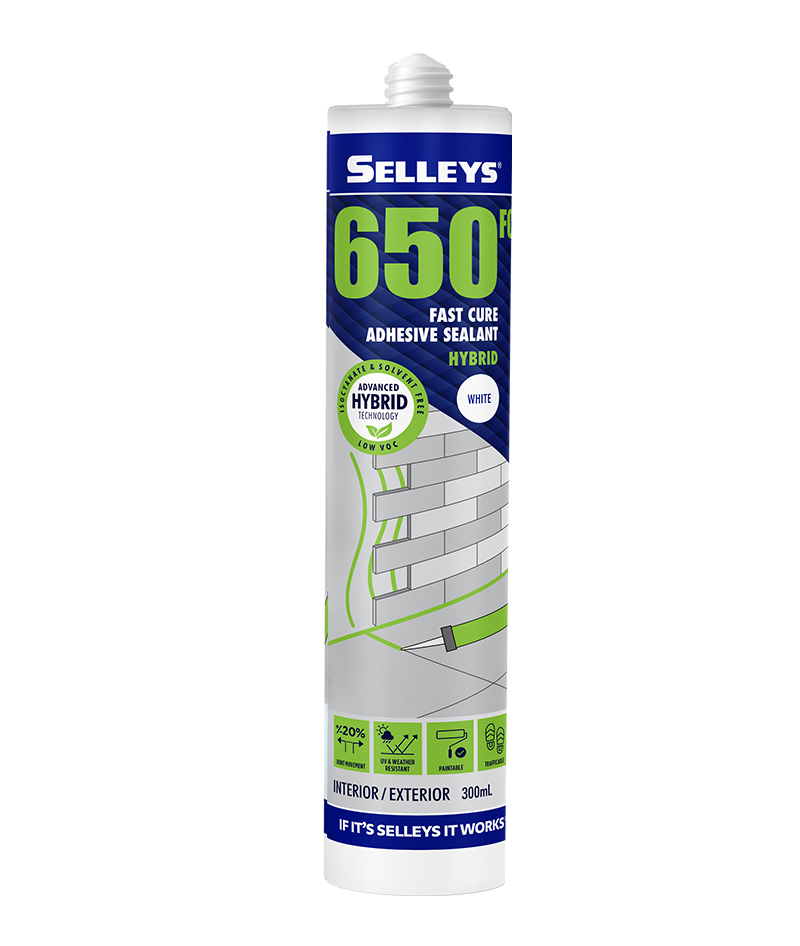
Selleys 650FC is a premium fast cure multipurpose high modulus flexible adhesive and sealant based on advanced hybrid technology — a silane modified polymer. It offers very broad primerless adhesion and ±20% joint movement capability, and it is a low VOC product described by the TDS as solvent- and isocyanate-free. Once cured it can be used for both sealing and bonding, including bonding and sealing wall cladding panels and trafficable joint sealing.
The characteristic that decides most purchases is that it is high modulus and rated for trafficable joints — parking decks, car parks and floor joints. That is a different product from a soft, low-modulus facade sealant. If your joint is walked or driven over, this is the reason to choose it; if the joint moves a lot and the substrate is fragile, look at a low-modulus option in the 600 Series instead.
Technical specification
| Property | Typical result |
|---|---|
| Technology | Silane modified polymer |
| Colour | Grey, black, white |
| Density | 1.61 |
| Application temperature | 5–35°C |
| Skin time (23°C, 50% r.h.) | 20 minutes |
| Curing (23°C, 50% r.h.) | 2.5mm per 24 hours |
| Shore A hardness (DIN 53505) | 40 ±5 |
| Joint movement capability | ±20% |
| Elongation at break (ASTM D412) | >500% |
| Elastic modulus @ 100% (ISO 8339) | 0.7 MPa |
| Tensile strength (ASTM D412) | 2 MPa |
| Bond strength on timber (7 days cure) | >1.4 MPa |
| Service temperature | −40°C to +70°C, with brief points at 100°C |
| Shelf life | 12 months |
| Packaging | 300mL cartridge or 600mL sausage, in a range of colours |
Selleys asks that you contact Selleys before using this data for the setting of specifications. The page also states that the product meets AS 2329-1999 construction adhesive standards.
What the key numbers mean in practice
The TDS v1.1 (16 January 2023) lists 20-minute skin time and cure of at least 2.5 mm per 24 hours at 23°C/50% RH. The retail page gives 24 hours to full strength, but the TDS does not establish a universal 24-hour full cure. Joint depth and conditions matter. Do not extrapolate a guaranteed completion time by dividing joint depth by the indicative daily cure value.
Shore A 40 ±5 with an elastic modulus at 100% of 0.7 MPa is genuinely high modulus. It resists deformation, which is what a trafficable joint needs — a soft bead under a car tyre gets pushed out of the joint. The trade-off is that it puts more stress back into the joint faces than a low-modulus sealant, so the substrate has to be sound.
Elongation at break above 500% with ±20% movement capability means the material itself stretches far more than the joint is rated for. The ±20% is the design figure — the movement the seal is warranted to survive in a correctly proportioned joint, cycle after cycle.
The service temperature deserves a careful read: −40°C to +70°C, with brief points at 100°C. Seventy degrees is the continuous ceiling. The 100°C figure is for brief excursions only, not a working condition — relevant if you are sealing a dark-surfaced deck that gets very hot in summer.
It requires atmospheric moisture to cure. In very dry conditions the cure will be slower, and a bead sandwiched between two impermeable faces has little air to work with.
Joint design
- The optimum width to depth ratio for joint sealing is 2:1.
- Minimum joint width and depth is 6mm.
- For joint widths up to 12mm, use a width to depth ratio of 1:1.
- For joint widths greater than 12mm, use a width to depth ratio of 2:1.
The manufacturer adds three notes. Wider joints can accommodate more total movement than narrow joints. Always install a suitable diameter backing rod — polyethylene or polyurethane foam — to control sealant depth and ensure free movement. And the sealant must adhere to the sides of the joints only and NOT to the back, so that it is free to stretch. Three-surface adhesion is the most common cause of premature failure in an otherwise correct joint.
Coverage per 600mL sausage
| Joint width (mm) | Joint depth (mm) | Litres per lineal metre | Metres of coverage |
|---|---|---|---|
| 6 | 6 | 0.036 | 16.7 |
| 8 | 8 | 0.064 | 9.4 |
| 10 | 10 | 0.100 | 6.0 |
| 12 | 12 | 0.140 | 4.2 |
| 14 | 7 | 0.098 | 6.3 |
| 16 | 8 | 0.128 | 4.7 |
| 18 | 9 | 0.162 | 3.7 |
| 20 | 10 | 0.200 | 3.0 |
| 22 | 11 | 0.242 | 2.5 |
| 24 | 12 | 0.288 | 2.1 |
| 26 | 13 | 0.338 | 1.8 |
| 28 | 14 | 0.392 | 1.5 |
| 30 | 15 | 0.450 | 1.3 |
| 40 | 20 | 0.800 | 0.8 |
Note the jump between the 12 × 12 row and the 14 × 7 row: moving to the 2:1 ratio above 12mm width halves the depth and buys back half the material. Designing the joint to the correct ratio is not just about performance — it materially changes how many sausages the job takes.
Where to use it
- External wall and cladding joints
- Weatherproofing joints between brickwork, masonry, wood, concrete or metal frames
- Joints in walls, balconies, and around window or door frames
- Joints in bridge and balcony parapets
- Retaining walls
- Indoor and outdoor applications for pedestrian and traffic areas, including parking decks and car parks
- Movement and connection joints in floors
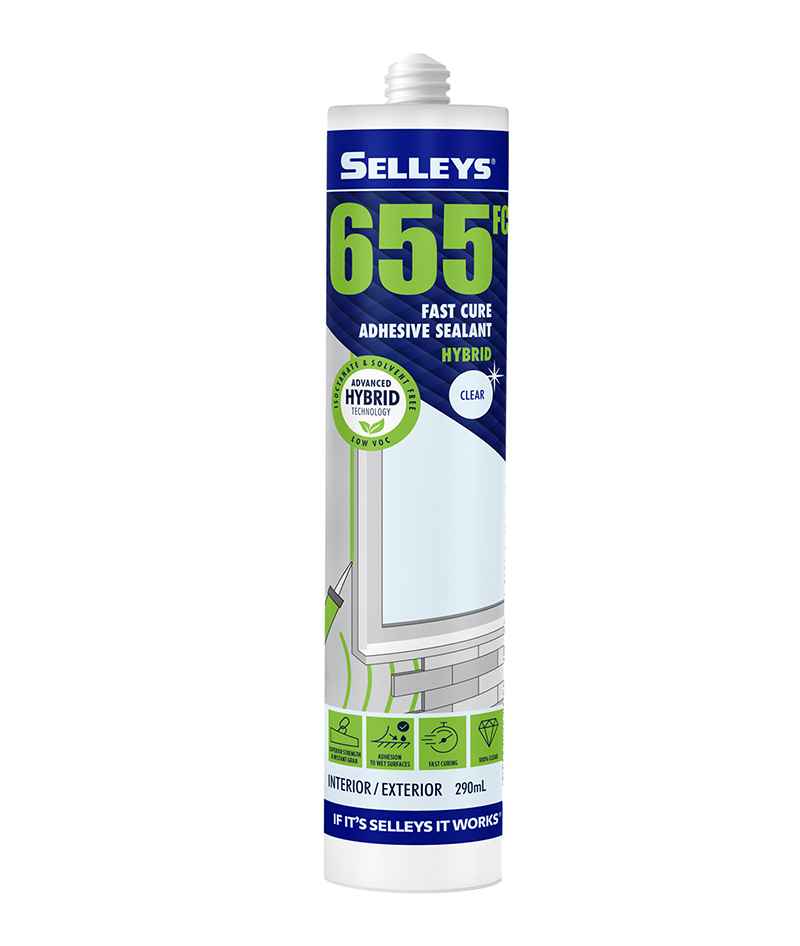
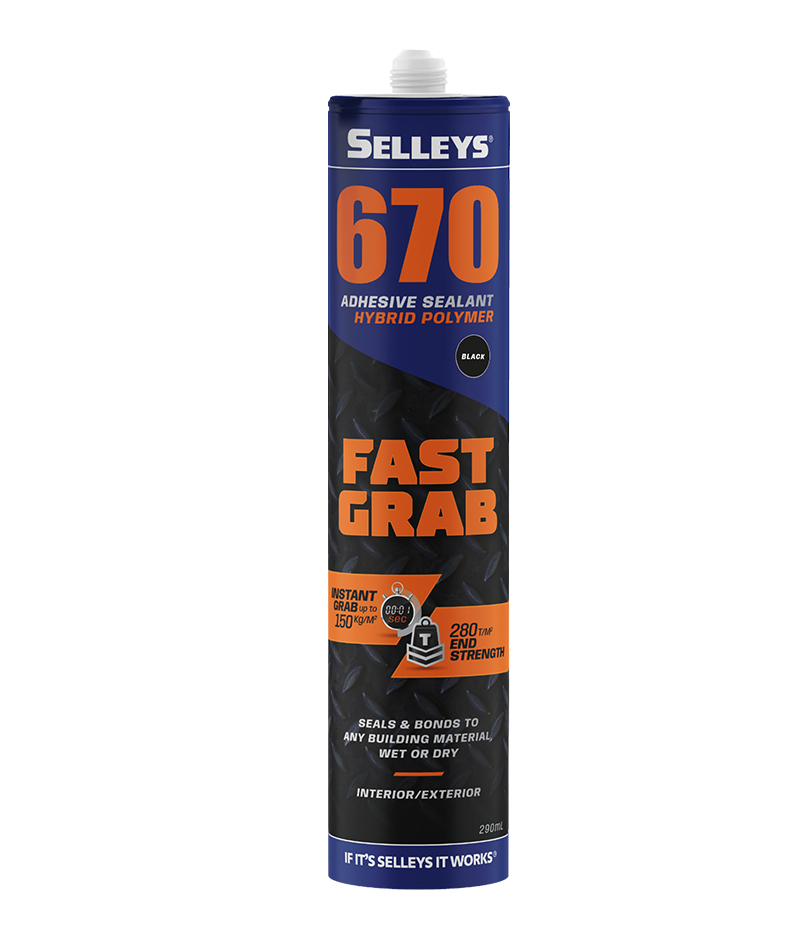
It has excellent adhesion on common building materials such as concrete, masonry, brick, ceramic tile, metals, soft wood, hardwood and some plastics, with no shrinkage or bubble formation during curing. It is also pick resistant — worth knowing for joints at ground level in public areas. For related products see Selleys 655 FC and Selleys 670 Fast Grab.
How to apply it
The directions below should only be used as a guide — the installer should apply all local standards and requirements, and best practices when installing.
As a sealant
- Ensure the surface is clean, dry and free from oil, grease, release agents, dust and loose material.
- Install a backing rod to the correct depth and apply masking tape as required.
- Cut the end of the sausage and insert it into a Selleys sausage gun.
- Extrude the sealant into the joint so that it is in full contact with the sides. Avoid overlapping the sealant, which entraps air.
- Smooth the sealant with a spatula, forcing it into the joint for better contact with the sides. Do this within the 20-minute skin time.
- Paint with water-based paints after curing. If solvent-based paints are used, prime first with a water-based primer.
As an adhesive
- Ensure surfaces are clean, dry and free from oil, grease, release agents, dust and loose material.
- Apply in lines or beads on the prepared surfaces, then firmly press the parts together.
- If necessary, use a suitable fixing until the adhesive has cured. With a cure rate of 2.5mm per day, a bonded joint needs support for longer than most people expect.
On priming: 650 FC generally has good adhesion properties without priming to the common building materials indicated. In some instances a primer may be required, and a pre-test to ensure suitable adhesion is recommended.
Limitations — where it should NOT be used
- Do not apply if air or substrate surface temperature is below 5°C.
- Requires atmospheric moisture to cure.
- Not recommended for continuous submersion or below water line use.
- Do not apply in the presence of curing silicone or polyurethane sealants, as cure may be affected.
- Avoid contact with solvent cleaners during cure, as cure will be affected.
- Do not use for structural glazing.
- Avoid air entrapment while applying as a sealant.
- May affect drying of alkyd and oil-based paints.
- White sealant may yellow slightly with age and exposure to the sun.
- Not suitable for Teflon, polyethylene, polypropylene or bitumen.
- Do not store product above 35°C.
The fourth point is one that catches trades working alongside each other. If another crew is running silicone or polyurethane in the same enclosed space, the vapour can interfere with this product's cure. Sequence the work, or ventilate.
Safety: the product is classified as HAZARDOUS. Wear gloves and safety glasses when using it. It is not classified as Dangerous Goods. Refer to the Safety Data Sheet for detailed information.
Clean up and storage
Spills and tools can be cleaned up with mineral turps before the product cures. Cured product can only be removed mechanically.
Store unopened sausages below 30°C in a cool dry place away from direct sunlight; unopened, they can be stored for 12 months from the date of manufacture. Opened sausages may skin and form a lump near the opening — discard any lumps or skin, and the remaining product can be used.
Hazard classification
The page already notes that the product is classified as hazardous and that gloves and safety glasses are required. This is what that classification actually says. Under Safe Work Australia GHS 7, with the signal word Warning:
- Eye irritation — Category 2A. H319: causes serious eye irritation.
- Sensitisation — skin — Category 1. H317: may cause an allergic skin reaction.
It is not classified as Dangerous Goods by the criteria of the Australian Code for the Transport of Dangerous Goods by Road & Rail or New Zealand NZS5433 — which is the second half of the safety line already on this page, and the two statements are not in conflict. "Hazardous" is a workplace health classification about what the product does to a person; "Dangerous Goods" is a transport classification about what it does in a crash or a fire. A product can be one without the other, and this one is.
H317 is the reason the glove instruction is not decorative. Skin sensitisation is not irritation: a sensitiser can teach the immune system to react to it, generally permanently once that has happened, and afterwards much smaller exposures will trigger it. It is acquired through repeated casual contact, not through one bad incident. This page tells you to force the sealant into the joint with a spatula inside the 20-minute skin window — use the spatula, and keep the gloves on for the whole run rather than just the first sausage. A day of trafficable floor joints is a lot of beads.
H319 pairs with the working position. Sealing a floor joint means kneeling over the work with your face above the nozzle, and a 600mL sausage in a gun delivers more product under more pressure than a cartridge does. Safety glasses, as the page already says. The safety data sheet's own eye first aid is to rinse cautiously with water for several minutes, remove contact lenses if present and easy to do, and keep rinsing — then seek medical advice if the irritation persists.
The ventilation point on this page is worth re-reading in this light. It already warns that another crew running silicone or polyurethane in the same enclosed space can interfere with this product's cure, and tells you to sequence the work or ventilate. The safety data sheet asks for the same ventilation for a different reason — it recommends a respirator meeting AS/NZS 1715 and AS/NZS 1716 where an inhalation risk exists. One action, two reasons to take it.
Protection
- Gloves — wear protective gloves. This is the control for H317.
- Eye protection — safety glasses or eye/face protection.
- Ventilation — natural ventilation is adequate under normal use conditions; ventilate properly in enclosed spaces. Where an inhalation risk remains, use a respirator to AS/NZS 1715 and AS/NZS 1716.
- Avoid breathing dust, fume, gas, mist, vapours or spray.
- Wash hands, face and all exposed skin thoroughly after handling.
First aid
| Exposure | What to do |
|---|---|
| Eyes | Rinse cautiously with water for several minutes. Remove contact lenses if present and easy to do, then continue rinsing. If eye irritation persists, seek medical advice or attention. |
| Skin | Wash the affected area with plenty of soap and water. If a skin reaction occurs, seek medical advice. |
| Inhalation | Move to fresh air and keep at rest. Seek medical advice if effects persist. |
| Swallowed | Rinse the mouth with water. Do NOT induce vomiting. Seek medical advice. |
If poisoning occurs, contact a doctor or the Poisons Information Centre — 131 126 in Australia, 0800 764 766 in New Zealand — with the container to hand. Selleys emergency line: 1800 220 770 in Australia, 0800 220 770 in New Zealand.
Common questions about Selleys 650 FC
How fast is "fast cure"?
It skins in 20 minutes at 23°C and 50% relative humidity, and cures at 2.5mm per 24 hours. Bond strength on timber is quoted at 7 days cure.
How long do I have to tool the bead?
Twenty minutes, at 23°C and 50% relative humidity.
Can I use it on a car park deck or a path?
Yes. Indoor and outdoor pedestrian and traffic areas, including parking decks and car parks, are listed uses, as are movement and connection joints in floors.
How much joint movement will it take?
±20%.
Can I paint it?
Yes, once cured, with water-based paints. If you are using solvent-based paints, prime first with a water-based primer. Note that the product may affect the drying of alkyd and oil-based paints.
Do I need a primer for adhesion?
Generally not — it has broad primerless adhesion to the common building materials listed. In some instances a primer may be required, and a pre-test is recommended.
What joint dimensions should I use?
Minimum 6mm width and depth. Up to 12mm wide, use a 1:1 width to depth ratio; above 12mm, use 2:1.
Do I need a backing rod?
Yes — always install a suitable diameter polyethylene or polyurethane foam rod. The sealant must adhere to the sides of the joint only, not the back.
How hot can it get?
Service temperature is −40°C to +70°C, with brief points at 100°C.
What is the coldest I can apply it?
Do not apply if air or substrate surface temperature is below 5°C. The stated application range is 5–35°C.
Can it be submerged?
No — it is not recommended for continuous submersion or below water line use.
Will it stick to plastic?
Some plastics, yes — but not Teflon, polyethylene, polypropylene or bitumen.
Can I use it for structural glazing?
No.
Will the white stay white?
White sealant may yellow slightly with age and exposure to the sun.
What sizes and colours are available?
A 300mL cartridge or a 600mL sausage, in grey, black and white.
My opened sausage has a lump in the nozzle end — is it ruined?
No. Opened sausages may skin and form a lump near the opening. Discard any lumps or skin, and the remaining product can be used.
How do I clean up?
Mineral turps before the product cures. Cured product can only be removed mechanically.
What is Selleys 650FC Fast Cure Adhesive Sealant made from?
Selleys 650FC Fast Cure Adhesive Sealant is based on Silane Modified Polymer technology, making it a premium fast cure multipurpose high modulus flexible adhesive and sealant.
What colours does Selleys 650FC come in?
Selleys 650FC is available in Grey, Black, and White.
How long does Selleys 650FC take to cure?
The TDS v1.1 (16 January 2023) lists 20-minute skin time and cure of at least 2.5 mm per 24 hours at 23°C/50% RH. The retail page gives 24 hours to full strength, but the TDS does not establish a universal 24-hour full cure. Joint depth and conditions matter.
Can Selleys 650FC be painted?
After curing, the TDS allows water-based paint. Apply a water-based primer before solvent-based paint; confirm compatibility.
What materials is Selleys 650FC suitable for?
Selleys 650FC is suitable for soft wood and hardwood, metal, concrete, ceramic tile, masonry, and brick.
What materials should Selleys 650FC not be used on?
Not for PE, PP, PTFE or bitumen, continuous submersion, below-waterline use or structural glazing. Check the full TDS limitations.
What is the recommended application temperature for Selleys 650FC?
Selleys 650FC should be applied at temperatures between 5°C and 35°C.
What service temperature range can Selleys 650FC withstand once cured?
The TDS gives −40°C to +70°C with brief excursions to 100°C. The retail page says −20°C to 100°C without separating continuous and brief exposure. Confirm the applicable rating for temperature-critical work.
How is Selleys 650FC applied?
Follow the TDS joint geometry, clean-surface and backing-rod instructions. Support bonded components until cured. The TDS specifies mineral turps for uncured residue and mechanical removal after cure; the retail page’s damp-cloth and fixed 24-hour directions are not equivalent.
Is Selleys 650FC suitable for indoor and outdoor use?
Yes, Selleys 650FC is suitable for both indoor and outdoor use.
How much joint movement can Selleys 650FC accommodate?
According to the knowledge base, Selleys 650FC can accommodate ±20% joint movement, allowing flexibility in expanding and contracting joints.
What pack sizes is Selleys 650FC available in?
According to the knowledge base, Selleys 650FC is available in 300mL cartridges and 600mL sausages, in White, Grey, and Black.
Images on This Page
-
https://www.selleys.com.au/media/cseezadf/selleys-logo-tagline_752x360.png?rmode=boxpad&ranchor=center&width=188&height=90&format=webp&quality=90
Selleys: Adhesives | Sealants | Putty Fillers | Glues | Cleaning Products - Australia
-
https://www.selleys.com.au/images/productpagev2/loading.gif
(no alt text)
-
https://www.selleys.com.au/media/f11lbk3m/650fc-white-300ml_usp.png?rmode=max&ranchor=center&width=440&height=440&format=png
https://www.selleys.com.au/media/f11lbk3m/650fc-white-300ml_usp.png?rmode=max&ranchor=center&width=440&height=440&format=png
-
https://www.selleys.com.au/media/mqrlktjy/650fc-white-300ml_front-ds.png?rmode=max&ranchor=center&width=440&height=440&format=png
https://www.selleys.com.au/media/mqrlktjy/650fc-white-300ml_front-ds.png?rmode=max&ranchor=center&width=440&height=440&format=png
-
https://www.selleys.com.au/media/3mbip44o/650fc-white-300ml_back-ds.png?rmode=max&ranchor=center&width=440&height=440&format=png
https://www.selleys.com.au/media/3mbip44o/650fc-white-300ml_back-ds.png?rmode=max&ranchor=center&width=440&height=440&format=png
-
https://www.selleys.com.au/media/dxqbifnk/selleys-650fc-ls.png?rmode=max&ranchor=center&width=440&height=440&format=png
https://www.selleys.com.au/media/dxqbifnk/selleys-650fc-ls.png?rmode=max&ranchor=center&width=440&height=440&format=png
-
https://www.selleys.com.au/media/ebfh1shz/selleys-650-series-300ml_range.png?rmode=max&ranchor=center&width=440&height=440&format=png
https://www.selleys.com.au/media/ebfh1shz/selleys-650-series-300ml_range.png?rmode=max&ranchor=center&width=440&height=440&format=png
-
https://img.youtube.com/vi/PGRZWc-72VI/0.jpg?rmode=max&ranchor=center&width=440&height=440&format=jpg
https://img.youtube.com/vi/PGRZWc-72VI/0.jpg?rmode=max&ranchor=center&width=440&height=440&format=jpg
-
https://img.youtube.com/vi/C_TdEXVeT_0/0.jpg?rmode=max&ranchor=center&width=440&height=440&format=jpg
https://img.youtube.com/vi/C_TdEXVeT_0/0.jpg?rmode=max&ranchor=center&width=440&height=440&format=jpg
-
https://www.selleys.com.au/images/productpagev2/pdp-share-icon.png
Share
-
https://www.selleys.com.au/media/surfflyf/630-black.jpg
Selleys 630 Low Modulus Multipurpose Elastic Joint Sealant
-
https://www.selleys.com.au/media/kzmfnrni/635-clear.jpg
Selleys 635 Multipurpose Elastic Joint Sealant
-
https://www.selleys.com.au/media/zz1e4v0a/650fc-white.jpg
Selleys 650 FC Fast Cure Adhesive Sealant
-
https://www.selleys.com.au/media/c52cidrg/655fc-clear.jpg
Selleys 655 FC Fast Cure Adhesive Sealant
-
https://www.selleys.com.au/media/deljyraj/670-fast-grab-black.jpg
Selleys 670 Fast Grab Adhesive Sealant
-
https://www.selleys.com.au/media/x2pbu0ca/675-crystal-fix-clear.jpg
Selleys 675 Crystal Fix Adhesive Sealant
-
https://www.selleys.com.au/media/zgymnqai/selleys-600-series-banner-v2.jpg?rmode=crop&ranchor=center&width=614&height=353&format=webp&quality=90
About Selleys 600 Series