Manufacturer source check
Manufacturer sources checked 24 September 2026.
- Cure Time: The TDS does not establish a universal 24-hour full cure. Paint timing is separate: about 60 minutes for gloss/sheen/low sheen and 180 minutes for flat/ceiling, with 24–48 hours before oil-based paint. These timings require gaps no larger than 5 mm deep and 10 mm wide, above 10°C, and a sufficiently dry surface.
- Paintability: The TDS does not establish a universal 24-hour full cure. Paint timing is separate: about 60 minutes for gloss/sheen/low sheen and 180 minutes for flat/ceiling, with 24–48 hours before oil-based paint. These timings require gaps no larger than 5 mm deep and 10 mm wide, above 10°C, and a sufficiently dry surface.
- Limitations: For gaps and cracks in damp rooms, such as skirting, cabinets, cornices and inside frames. The TDS directs users to Wet Area Silicone for waterproof seals around baths, sinks and showers; this filler is not a substitute for those seals.
- Directions for Use: Clean and dry the surfaces; gun filler into the gap and smooth with a wet gloved finger or spatula. Follow the paint-specific timings and conditions in the TDS; clean wet excess with a damp cloth.
- Application Temperature: TDS minimum 5°C; the early-paint conditions require above 10°C. Retail 5–35°C and service −20–70°C are not confirmed by this TDS.
What is Selleys No More Gaps Bathroom & Kitchen, and where should you use it?
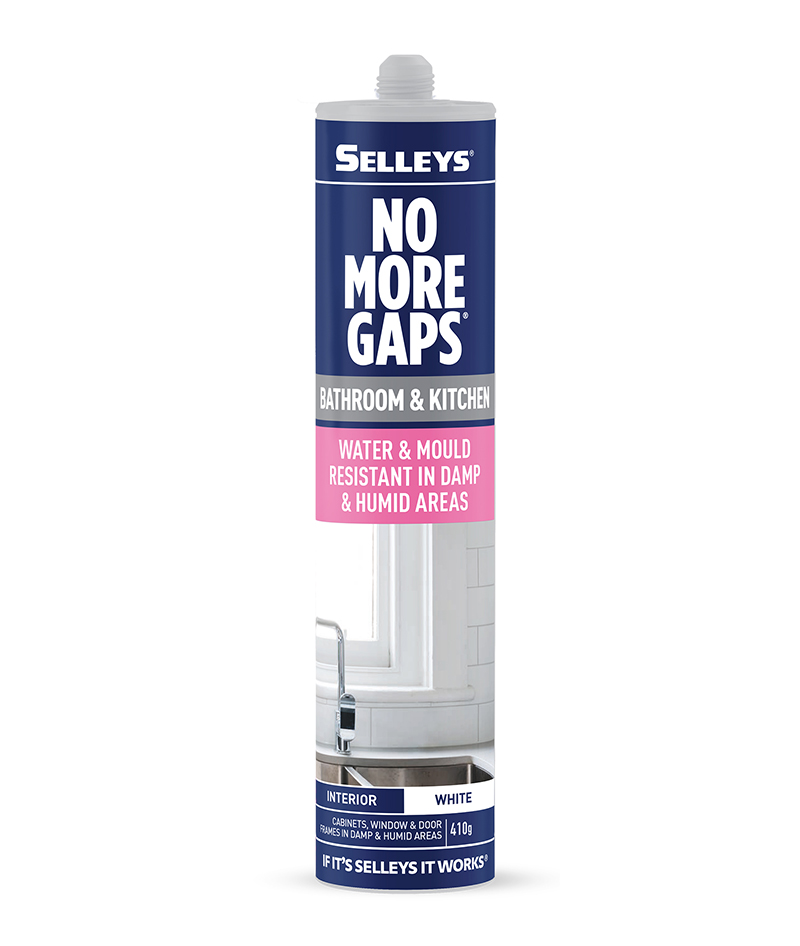
Selleys No More Gaps Bathroom & Kitchen is a water-based flexible gap filler formulated for damp and humid areas. It is designed for filling gaps and cracks around skirting boards, cabinets, cornices, and inside window and door frames in rooms that get wet — and it carries a fungicide to protect against unsightly mould growth.
The distinction that matters most before you buy is between a water resistant filler and a waterproof sealant, because they are not the same product and this is the first. The technical data sheet states it plainly: for gaps around baths, sinks and showers, use Selleys Wet Area Silicone Sealant to create a waterproof seal. No More Gaps Bathroom & Kitchen is for the joinery and trim in the room, not the wet junctions themselves.
Technical specification
| Property | Typical result |
|---|---|
| Technology | Water based |
| Colour | White |
| Appearance | Smooth paste |
| Application temperature | At least 5°C |
| Skin time | 20 minutes |
| Density | 1.5 |
| Joint movement capability | ±25% |
| Elongation (ASTM D412) | >200% |
| Shore A hardness (ASTM D2240) | 25 |
| Paint over time (gloss, sheen, low sheen) | 60 minutes |
| Paint over time (flat, ceiling) | 180 minutes |
| Packaging | 410 gram cartridge, white |
Indicative data only, not intended for the preparation of specifications. Paint over times depend on conditions.
What the key numbers mean in practice
Joint movement capability of ±25% is high for a paintable filler, and it is the number that keeps a bathroom skirting joint from cracking open. It means the cured filler tolerates the joint widening or narrowing by a quarter of its width. Bathrooms and kitchens cycle through heat and humidity daily, so that flexibility is doing real work — but it only helps if the product is in the joint with some depth to it, rather than smeared across the face of it.
The paint over times are the numbers most people get wrong. Gloss, sheen and low sheen paints can go on after 60 minutes; flat and ceiling paints need 180 minutes. The reason for the difference is worth knowing: flat and ceiling paints are highly filled, meaning they contain less binder than other paints, so the dried paint film does not flex as much when the sealant dries beneath it. Give a low-binder paint the same hour you would give a gloss and the paint film is what cracks, not the filler.
Oil-based paints are different again — allow 24 to 48 hours before painting over with an oil-based paint.
The other lever on paint cracking is gap size. To avoid paint cracking, apply to gaps no larger than 5mm deep and 10mm wide, at temperatures above 10°C, allow the sealant to dry before painting over, and avoid applying the paint too thickly. A bigger gap holds more material, more material shrinks more as it dries, and a thin paint film over a shrinking bead is what cracks.
Skin time of 20 minutes sets your tooling window. Smoothing the bead has to happen while it is still open, so run a length you can finish rather than the whole room at once.
Where to use it
The product is suitable for materials such as ceramics, glass, aluminium, plasterboard, wood, particle board and cement sheeting. Typical applications are gaps and cracks around:
- Skirting boards
- Cabinets
- Cornices
- Inside window and door frames
— in damp and humid areas. It may be applied to damp surfaces, but the product and surface must then be allowed to dry.
How to apply it
- Ensure the surfaces are clean, dry and free from dust or grease.
- Cut the nozzle at a 45° angle, cut the cartridge tip and fit the nozzle.
- Insert the cartridge into a caulking gun.
- Apply with the caulking gun, pushing the product into the gap or joint rather than laying it on the surface.
- Smooth with a wet gloved finger or spatula. Do this within the 20 minute skin time.
- Allow the surface to skin before painting — approximately 1 hour, then the paint over times above apply.
A tip worth using: when you first apply the product, extrude a small amount onto a piece of scrap material to make sure you have a smooth, continuous flow before you start on the visible joint.
Limitations — where it should not be used
- Not for creating a waterproof seal around baths, sinks and showers. Use Selleys Wet Area Silicone Sealant for those joints. This is the manufacturer's own stated limitation and it overrides any general "ideal around sinks and taps" impression.
- Not suitable for outdoor use or constant moisture exposure, per the product page. It is a damp-and-humid-area filler, not a weatherproofing or immersion product.
- Not for use on polyethylene, polypropylene or Teflon, per the product page.
- Do not apply below 5°C, and keep to gaps no larger than 5mm deep and 10mm wide at temperatures above 10°C if you intend to paint over it.
Clean up
While the product is wet, clean up using a damp cloth. Once it is dry, clean up using a scraper.
Warnings, first aid and shipping information are on the product's Safety Data Sheet, available through the Selleys website.
Hazard classification
Classified as hazardous under Safe Work Australia GHS 7, with the signal word Warning.
- Skin sensitisation — Category 1. H317: may cause an allergic skin reaction.
Not classified as Dangerous Goods by the criteria of the Australian Code for the Transport of Dangerous Goods by Road & Rail or of New Zealand NZS 5433, so no dangerous goods class applies.
What is in it
| Chemical entity | CAS number | Proportion (w/w) |
|---|---|---|
| 2-Octyl-2H-isothiazol-3-one (OIT) | 26530-20-1 | Up to 0.5% |
| 1,2-Benzisothiazol-3(2H)-one (BIT) | 2634-33-5 | <0.05% |
| 2-Methyl-2H-isothiazol-3-one (MIT) | 2682-20-4 | <0.05% |
| Non-hazardous or below reporting limits | — | Balance |
That table explains the fungicide sentence at the top of this page. OIT is present at up to half a percent — roughly ten times the concentration of the two preservatives below it, which are there in trace amounts to stop the filler spoiling in the cartridge. A dose that much larger is not an in-can preservative; it is the mould protection the product is sold for, formulated to keep working in the finished bead in a wet room.
It is also the most likely reason this filler carries a classification that the plain interior filler in the same range does not. Isothiazolinones are a well-recognised class of skin sensitisers, and the fungicidal version of a product is often the one that picks up an H317 where the ordinary version has none. The safety data sheet does not attribute the classification to a single ingredient, so treat that as the likely explanation rather than a sourced one — but the pattern across the No More Gaps range is consistent with it.
Sensitisation is not irritation, and the difference is what makes it worth taking seriously. Irritation is a local reaction that settles once contact stops. Sensitisation is the immune system learning to react to the material: once acquired it is generally permanent, it can afterwards be triggered by exposures far smaller than the one that caused it, and it tends to worsen with each subsequent contact rather than fade. It develops from repeated, unremarkable contact — and the safety data sheet notes that effects may be delayed, so a reaction the following day still belongs to today's work.
Step five of the directions on this page already says to smooth the bead with a wet gloved finger or a spatula. The safety data sheet is the reason that word "gloved" is in the instruction. Twenty minutes of skin time means you tool every bead while it is still open and still wet, and a bathroom refit is a great many beads.
Protection
- Gloves — nitrile rubber is suitable for intermittent contact. Selleys notes that glove construction and local conditions vary, so the final assessment is the user's.
- Eye protection — safety glasses.
- Overalls and safety shoes where the job warrants them.
- Wash hands before smoking, eating, drinking or using the toilet, and wash contaminated clothing and protective equipment before storing or reusing it.
First aid
| Exposure | What to do |
|---|---|
| Skin or hair | Effects may be delayed. Remove contaminated clothing and flush the skin and hair with running water. If swelling, redness, blistering or irritation develops, seek medical assistance — it may be an allergic reaction rather than simple irritation. |
| Eyes | Wash out immediately with water. In any case of eye contamination it is a sensible precaution to get medical advice. |
| Inhalation | Move the person away from the exposure without putting yourself at risk. Loosen tight clothing, let them rest comfortably and keep them warm until fully recovered. Seek medical advice if effects persist. |
| Swallowed | Rinse the mouth with water. Do not induce vomiting. Give a glass of water to drink. Give nothing by mouth to an unconscious person. If vomiting occurs, give more water and seek medical advice. |
If poisoning occurs, contact a doctor or the Poisons Information Centre — 131 126 in Australia, 0800 764 766 in New Zealand — with the container to hand. Selleys emergency line: 1800 220 770 in Australia, 0800 220 770 in New Zealand.
What is Selleys No More Gaps Bathroom & Kitchen designed to do?
For gaps and cracks in damp rooms, such as skirting, cabinets, cornices and inside frames. The TDS directs users to Wet Area Silicone for waterproof seals around baths, sinks and showers; this filler is not a substitute for those seals.
What colour is Selleys No More Gaps Bathroom & Kitchen and what size does it come in?
It is white in colour and comes in a 410g cartridge.
What technology is used in No More Gaps Bathroom & Kitchen?
It uses acrylic-based (water-based acrylic) technology.
How long does No More Gaps Bathroom & Kitchen take to cure, and can it be painted?
The TDS does not establish a universal 24-hour full cure. Paint timing is separate: about 60 minutes for gloss/sheen/low sheen and 180 minutes for flat/ceiling, with 24–48 hours before oil-based paint. These timings require gaps no larger than 5 mm deep and 10 mm wide, above 10°C, and a sufficiently dry surface.
Is No More Gaps Bathroom & Kitchen suitable for outdoor use?
No, it is not suitable for outdoor use or constant moisture exposure and is intended for indoor use only.
What materials should not be used with No More Gaps Bathroom & Kitchen?
It should not be used on polyethylene, polypropylene, or Teflon®.
What surfaces/materials is No More Gaps Bathroom & Kitchen suitable for?
According to the page, it is suitable for tiles, ceramics, timber, and plasterboard. The knowledge base adds that it is also compatible with glass, aluminium, wood, particle board, and cement sheeting.
What is the recommended application temperature and service temperature range for this product?
TDS minimum 5°C; the early-paint conditions require above 10°C. Retail 5–35°C and service −20–70°C are not confirmed by this TDS.
What are the directions for using No More Gaps Bathroom & Kitchen?
Clean and dry the surfaces; gun filler into the gap and smooth with a wet gloved finger or spatula. Follow the paint-specific timings and conditions in the TDS; clean wet excess with a damp cloth.
What areas around the home is No More Gaps Bathroom & Kitchen commonly used for, according to the knowledge base?
For gaps and cracks in damp rooms, such as skirting, cabinets, cornices and inside frames. The TDS directs users to Wet Area Silicone for waterproof seals around baths, sinks and showers; this filler is not a substitute for those seals.
Images on This Page
-
https://www.selleys.com.au/media/cseezadf/selleys-logo-tagline_752x360.png?rmode=boxpad&ranchor=center&width=188&height=90&format=webp&quality=90
Selleys: Adhesives | Sealants | Putty Fillers | Glues | Cleaning Products - Australia
-
https://www.selleys.com.au/images/productpagev2/loading.gif
(no alt text)
-
https://www.selleys.com.au/media/lznnmkwn/nmg-bathroom-kitchen-410g_front.jpg?rmode=max&ranchor=center&width=440&height=440&format=jpg
https://www.selleys.com.au/media/lznnmkwn/nmg-bathroom-kitchen-410g_front.jpg?rmode=max&ranchor=center&width=440&height=440&format=jpg
-
https://www.selleys.com.au/media/l2idcjf4/nmg-bathroom-kitchen-410g_back.jpg?rmode=max&ranchor=center&width=440&height=440&format=jpg
https://www.selleys.com.au/media/l2idcjf4/nmg-bathroom-kitchen-410g_back.jpg?rmode=max&ranchor=center&width=440&height=440&format=jpg
-
https://www.selleys.com.au/media/vgndadim/nmg-bathroom-kitchen-410g_usp.jpg?rmode=max&ranchor=center&width=440&height=440&format=jpg
https://www.selleys.com.au/media/vgndadim/nmg-bathroom-kitchen-410g_usp.jpg?rmode=max&ranchor=center&width=440&height=440&format=jpg
-
https://www.selleys.com.au/media/rkhgvqxc/nmg-bathroom-kitchen_range.jpg?rmode=max&ranchor=center&width=440&height=440&format=jpg
https://www.selleys.com.au/media/rkhgvqxc/nmg-bathroom-kitchen_range.jpg?rmode=max&ranchor=center&width=440&height=440&format=jpg
-
https://img.youtube.com/vi/DvbK2Sh2oto/0.jpg?rmode=max&ranchor=center&width=440&height=440&format=jpg
https://img.youtube.com/vi/DvbK2Sh2oto/0.jpg?rmode=max&ranchor=center&width=440&height=440&format=jpg
-
https://www.selleys.com.au/images/productpagev2/pdp-share-icon.png
Share
-
https://www.selleys.com.au/media/2cvfafft/nmg-interior-interior-fast-dry.jpg
No More Gaps Interior Fast Dry
-
https://www.selleys.com.au/media/kl5buih3/nmg-exterior.jpg
No More Gaps Exterior
-
https://www.selleys.com.au/media/zateuucz/nmg-interior-kitchen-bathroom.jpg
No More Gaps Kitchen & Bathroom
-
https://www.selleys.com.au/media/lldlndgs/nmg-interior-timber-floors.jpg
No More Gaps Timber Floors
-
https://www.selleys.com.au/media/cegeahng/nmg-interior-coloured-gaps.jpg
No More Gaps Coloured Gaps
-
https://www.selleys.com.au/media/hveltww1/nmg-interior-bricks-mortar.jpg
No More Gaps Bricks & Mortar
-
https://www.selleys.com.au/media/5e4hnj22/nmg-interior-interior-multipurpose.jpg
No More Gaps Interior Multipurpose
-
https://www.selleys.com.au/media/35hfwmv0/nmbg-expanding-foam.jpg
No More Big Gaps Expanding Foam
-
https://www.selleys.com.au/media/a0gpbwbz/carousel-image-2.jpg?rmode=crop&ranchor=center&width=524&height=350&format=webp&quality=90
/media/a0gpbwbz/carousel-image-2.jpg
-
https://www.selleys.com.au/media/h50b31x5/carousel-image-3.jpg?rmode=crop&ranchor=center&width=524&height=350&format=webp&quality=90
/media/h50b31x5/carousel-image-3.jpg
-
https://www.selleys.com.au/media/ttdjmcgp/carousel-image-1.jpg?rmode=crop&ranchor=center&width=524&height=350&format=webp&quality=90
/media/ttdjmcgp/carousel-image-1.jpg
-
https://www.selleys.com.au/media/n51b00gp/carousel-image-4.jpg?rmode=crop&ranchor=center&width=524&height=350&format=webp&quality=90
/media/n51b00gp/carousel-image-4.jpg
-
https://www.selleys.com.au/media/kxcg2qlk/about-no-more-gaps.jpg?rmode=crop&ranchor=center&width=614&height=353&format=webp&quality=90
About No More Gaps