Manufacturer source check
Manufacturer sources checked 24 September 2026.
- Cure Time: Protect from water for 24 hours so the filler can strengthen. This is not a universal full-cure time; drying depends on joint dimensions and conditions.
- Paintability: TDS: paint after surface skinning, approximately 30 minutes, with gaps at most 5 mm deep and 10 mm wide above 10°C. Allow longer for flat/ceiling paints and 24–48 hours for oil-based paint. Always finish with a suitable exterior paint.
- Application Temperature: The TDS table says 5–40°C but its limitations prohibit storage or application below 10°C; the retail table says 5–35°C. Do not rely on the lower 5°C figure without manufacturer confirmation.
- Directions for Use: Clean and dry the joint; apply filler with a gun, smooth with a wet spatula and wipe wet excess away. Follow the TDS painting conditions and protect from water for 24 hours.
What is Selleys No More Gaps Exterior, and where should you use it?
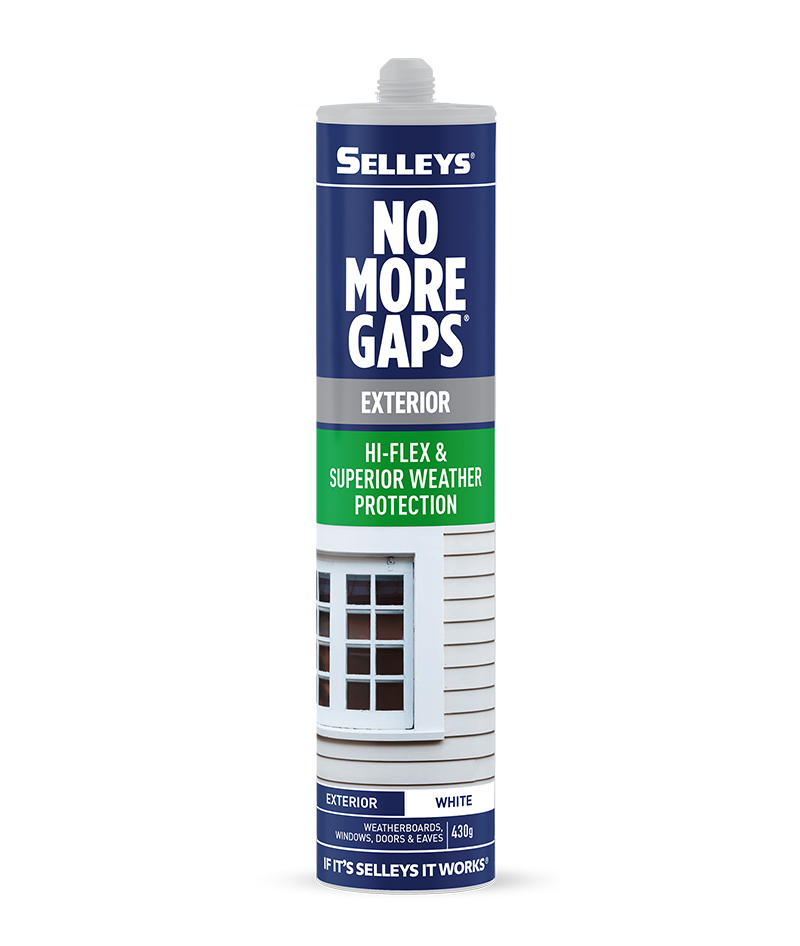
Selleys No More Gaps Exterior is a water-based flexible gap filler built for outside work — gaps and cracks around and between weatherboards, eaves, and exterior windows and doors. It uses a polymer system formulated for flexibility in exterior applications, and a titanium compound to protect against UV and weather damage.
The thing to settle before you buy is that this is a filler that expects to be painted. Selleys' own advice is to apply a coat of acrylic paint to bare exterior surfaces and let it dry before applying the product, and then to always paint over with a quality exterior paint. Treated that way it is a durable exterior joint; left bare on raw timber it is not being used as designed.
Technical specification
| Property | Typical result |
|---|---|
| Technology | Water-based |
| Colour | White |
| Density | 1.45 ± 0.05 |
| Application temperature | The TDS table says 5–40°C but its limitations prohibit storage or application below 10°C; the retail table says 5–35°C. Do not rely on the lower 5°C figure without manufacturer confirmation. |
| Skin time | 30 ± 5 minutes |
| Tack-free time | 45 ± 5 minutes |
| Tensile strength | 0.6 ± 0.05 MPa |
| Shore A hardness | >40 |
| Elongation at break (ASTM D412) | 500% |
| Modulus at 100% elongation | 0.5 ± 0.1 |
| Movement capability (ISO 9046) | ±25% |
| Maximum gap size | Width 10mm, depth 5mm |
| Packaging | 430 g cartridge, white |
Indicative data only, not intended for the preparation of specifications.
What the key numbers mean in practice
Movement capability of ±25% and elongation at break of 500% are the numbers that matter on a weatherboard wall. Timber cladding moves with heat and moisture through the year, and a joint that stretches a quarter of its width without failing is what keeps the crack from reopening every summer. Selleys is honest about the edge of that envelope: in harsh conditions, joints between boards may expand beyond the product's movement capability, and in that case the fix is to re-apply the product and paint over it again.
The maximum gap size of 10mm wide by 5mm deep is a limitation, not a suggestion, and it exists because of paint. More material in the joint means more shrinkage as it dries, and a paint film over a shrinking bead is what cracks. The same guidance appears in the tips: to avoid paint cracking, apply to gaps no larger than 5mm deep and 10mm wide, at temperatures above 10°C, allow the sealant to dry before painting over, and avoid applying the paint too thickly.
Skin time of 30 minutes, tack-free at 45 minutes gives you a workable tooling window — smooth the bead well inside the half hour. Painting follows a different clock again: allow the surface to skin prior to painting, approximately 30 minutes, but allow 24 to 48 hours before painting with oil-based paints. Flat and ceiling paints need longer drying times than gloss because they are highly filled and contain less binder, so the paint film flexes less as the sealant dries beneath it.
Finally, protect the joint from water for 24 hours after application to allow the product to strengthen. It is water-based; rain on an immature bead undoes the work.
Where to use it
Suitable for use on:
- Timber weatherboard
- Synthetic weatherboard
- FC (fibre cement) sheet
- Brick
- Masonry
- Aluminium
Typical locations are gaps and cracks around and between weatherboards, eaves, and exterior windows and doors. For new weatherboard, check the board manufacturer's instructions before using this product.
How to apply it
Surface preparation: the surface must be clean, dry and free from dust, grease, flaking or powdery paint, and old or crumbling caulk. On bare exterior surfaces, apply a coat of acrylic paint and let it dry before applying the filler.
- Ensure surfaces are clean, dry and free from dust or grease.
- Cut the nozzle at a 45° angle, cut the cartridge tip, fit the nozzle and insert the cartridge into a caulking gun.
- Apply with the caulking gun, pushing the product into the gap or joint.
- Smooth out with a wet spatula, making sure sufficient product remains in the joint. It is easy to tool a bead so hard that most of it ends up on the cloth.
- Clean up wet product with a damp cloth immediately.
- Allow the surface to skin prior to painting — approximately 30 minutes. Allow 24 to 48 hours before painting with oil-based paints.
- Protect from water for 24 hours to allow the product to strengthen.
- Always paint over with a quality exterior paint.
Limitations — where it should not be used
- Maximum gap size: 10mm wide, 5mm deep. Larger gaps risk paint cracking over the bead.
- Not for sealing around bathtubs, kitchen sinks and similar. Use No More Gaps Bathroom & Kitchen for those.
- Use the appropriate Selleys silicone sealant where excessive joint movement occurs, or for areas prone to frequent water immersion. The product page makes the same point: not suitable for constant immersion in water.
- Not to be stored or applied below 10°C.
- Not recommended for polyethylene, polypropylene or Teflon, per the product page.
Note that the technical data sheet gives an application temperature range of 5 to 40°C in its data table while its limitations section says not to store or apply below 10°C. On a cold morning, work to the stricter figure — 10°C — which is also the temperature the paint-cracking guidance is written around.
Clean up and storage
Clean excess caulk off with water, using a damp cloth, before it dries. Cured caulk will need to be cut out; remaining caulk can be softened with acetone and then removed.
Store in a cool, dry, well-ventilated place out of direct sunlight, away from foodstuffs, and not below 10°C.
Hazard classification
Classified as hazardous under Safe Work Australia GHS 7, with the signal word Warning.
- Skin sensitisation — Category 1. H317: may cause an allergic skin reaction.
That is the whole of it. The safety data sheet records the product as not corrosive or irritating to eyes, not corrosive or irritating to skin, not a respiratory sensitiser, not an aspiration hazard, and not classified as a mutagen, a carcinogen or a reproductive toxicant. It is also not hazardous on acute exposure by any route: inhalation LC50 above 5.0 mg/L for dust, dermal LD50 above 2,000 mg/kg body weight, and ingestion LD50 above 2,000 mg/kg body weight.
Not classified as Dangerous Goods by the criteria of the Australian Code for the Transport of Dangerous Goods by Road & Rail, New Zealand NZS 5433, the IMDG Code for sea transport, or the IATA Dangerous Goods Regulations for air transport. In New Zealand it sits under HSNO Group Standard HSR002670 — Surface Coatings and Colourants (Subsidiary Hazard) Group Standard 2020.
The composition table is not reproduced here: the section 3 detail is not available in the knowledge base for this product, and guessing it from a sibling filler would be worse than leaving it out. The classification above is from this product's own safety data sheet.
Skin sensitisation is a different thing from irritation, and the difference is the reason a single classification is worth this much text. Irritation is a local reaction that settles once contact stops. Sensitisation is the immune system learning to react to the material: once acquired it is generally permanent, it can afterwards be set off by exposures far smaller than the one that caused it, and it tends to worsen with each subsequent contact rather than fade. It develops from repeated ordinary contact, not from one dramatic exposure. The sheet also warns that effects may be delayed — a rash that turns up the next morning still belongs to yesterday's work.
Two things about exterior work make that pattern more likely here than on an interior job. The first is scale: weatherboards, eaves and the perimeter of every window and door is a long run of bead, and the step in the directions above that says to smooth with a wet gloved finger is repeated a great many times over a day. The second is that the gloves come off faster outdoors — on a ladder, in the heat, with a rag in the other hand. The glove in that instruction is not a suggestion about neatness.
Note also the acute toxicity line: this product is not acutely poisonous by any route. The hazard it does carry is entirely about repetition. That is an easy hazard to dismiss precisely because nothing happens the first time.
Protection
- Gloves — nitrile rubber is suitable for intermittent contact. Selleys notes that glove construction and local conditions vary, so the final assessment is the user's.
- Eye protection — safety glasses.
- Overalls and safety shoes where the job warrants them.
- Wash hands before smoking, eating, drinking or using the toilet, and wash contaminated clothing and protective equipment before storing or reusing it.
First aid
| Exposure | What to do |
|---|---|
| Skin or hair | Effects may be delayed. Remove contaminated clothing and flush the skin and hair with running water. If swelling, redness, blistering or irritation develops, seek medical assistance — it may be an allergic reaction rather than simple irritation. |
| Eyes | Wash out immediately with water. In any case of eye contamination it is a sensible precaution to get medical advice. |
| Inhalation | Move the person away from the exposure without putting yourself at risk. Loosen tight clothing, let them rest comfortably and keep them warm, at rest until fully recovered. Seek medical advice if effects persist. |
| Swallowed | Rinse the mouth with water. Do not induce vomiting. Give a glass of water to drink. Give nothing by mouth to an unconscious person. If vomiting occurs, give more water and seek medical advice. |
Store the cartridge upright and closed, in a cool, dry, well-ventilated place out of direct sunlight, away from foodstuffs and away from oxidising agents. Check the store regularly for spills.
If poisoning occurs, contact a doctor or the Poisons Information Centre — 131 126 in Australia, 0800 764 766 in New Zealand — with the container to hand. Selleys emergency line: 1800 220 770 in Australia, 0800 220 770 in New Zealand.
What is Selleys No More Gaps Exterior?
Selleys No More Gaps Exterior is a flexible gap filler designed for exterior surfaces, using acrylic-based technology (water-based) to provide a high strength, flexible bond with a professional finish.
What colour is Selleys No More Gaps Exterior?
Selleys No More Gaps Exterior is white in colour.
How long does Selleys No More Gaps Exterior take to cure?
Protect from water for 24 hours so the filler can strengthen. This is not a universal full-cure time; drying depends on joint dimensions and conditions.
Can Selleys No More Gaps Exterior be painted?
TDS: paint after surface skinning, approximately 30 minutes, with gaps at most 5 mm deep and 10 mm wide above 10°C. Allow longer for flat/ceiling paints and 24–48 hours for oil-based paint. Always finish with a suitable exterior paint.
What materials is Selleys No More Gaps Exterior suitable for?
Selleys No More Gaps Exterior is suitable for timber, plasterboard, masonry, and brick. According to knowledge-base details, it can also be used on timber weatherboard, synthetic weatherboard, FC sheet, and aluminium.
What are the application and service temperature ranges for Selleys No More Gaps Exterior?
The TDS table says 5–40°C but its limitations prohibit storage or application below 10°C; the retail table says 5–35°C. Do not rely on the lower 5°C figure without manufacturer confirmation.
Is Selleys No More Gaps Exterior suitable for constant water immersion?
No, Selleys No More Gaps Exterior is not suitable for constant immersion in water and has low water resistance.
Are there any materials Selleys No More Gaps Exterior should not be used on?
Selleys No More Gaps Exterior is not recommended for use on polyethylene, polypropylene, or Teflon®.
What are the directions for using Selleys No More Gaps Exterior?
Clean and dry the joint; apply filler with a gun, smooth with a wet spatula and wipe wet excess away. Follow the TDS painting conditions and protect from water for 24 hours.
What specific areas is Selleys No More Gaps Exterior ideal for filling gaps around?
According to the knowledge-base details, Selleys No More Gaps Exterior is ideal for filling gaps and cracks around weatherboards, at eaves, around exterior windows and doors, and between tongue and groove boards and weatherboards.
Images on This Page
-
https://www.selleys.com.au/media/cseezadf/selleys-logo-tagline_752x360.png?rmode=boxpad&ranchor=center&width=188&height=90&format=webp&quality=90
Selleys: Adhesives | Sealants | Putty Fillers | Glues | Cleaning Products - Australia
-
https://www.selleys.com.au/images/productpagev2/loading.gif
(no alt text)
-
https://www.selleys.com.au/media/gzymegjx/nmg-exterior-130g_usp.png?rmode=max&ranchor=center&width=440&height=440&format=png
https://www.selleys.com.au/media/gzymegjx/nmg-exterior-130g_usp.png?rmode=max&ranchor=center&width=440&height=440&format=png
-
https://www.selleys.com.au/media/ft0fpbu1/nmg-exterior-130g_front.png?rmode=max&ranchor=center&width=440&height=440&format=png
https://www.selleys.com.au/media/ft0fpbu1/nmg-exterior-130g_front.png?rmode=max&ranchor=center&width=440&height=440&format=png
-
https://www.selleys.com.au/media/g4inpt0e/no-more-gaps-exterior-white-130g_back.jpg?rmode=max&ranchor=center&width=440&height=440&format=jpg
https://www.selleys.com.au/media/g4inpt0e/no-more-gaps-exterior-white-130g_back.jpg?rmode=max&ranchor=center&width=440&height=440&format=jpg
-
https://www.selleys.com.au/media/z4cca5xa/nmg-exterior_range.png?rmode=max&ranchor=center&width=440&height=440&format=png
https://www.selleys.com.au/media/z4cca5xa/nmg-exterior_range.png?rmode=max&ranchor=center&width=440&height=440&format=png
-
https://www.selleys.com.au/media/42wjjbgh/nmg-ext-pic-1.jpg?rmode=max&ranchor=center&width=440&height=440&format=jpg
https://www.selleys.com.au/media/42wjjbgh/nmg-ext-pic-1.jpg?rmode=max&ranchor=center&width=440&height=440&format=jpg
-
https://www.selleys.com.au/media/gbbmn5ot/nmg-ext-pic-3.jpg?rmode=max&ranchor=center&width=440&height=440&format=jpg
https://www.selleys.com.au/media/gbbmn5ot/nmg-ext-pic-3.jpg?rmode=max&ranchor=center&width=440&height=440&format=jpg
-
https://www.selleys.com.au/media/2tmjhgfd/nmg-ext-pic-2.jpg?rmode=max&ranchor=center&width=440&height=440&format=jpg
https://www.selleys.com.au/media/2tmjhgfd/nmg-ext-pic-2.jpg?rmode=max&ranchor=center&width=440&height=440&format=jpg
-
https://www.selleys.com.au/media/2n0lcndn/nmg-ext-pic-4.jpg?rmode=max&ranchor=center&width=440&height=440&format=jpg
https://www.selleys.com.au/media/2n0lcndn/nmg-ext-pic-4.jpg?rmode=max&ranchor=center&width=440&height=440&format=jpg
-
https://img.youtube.com/vi/U6SeM8FiyWE/0.jpg?rmode=max&ranchor=center&width=440&height=440&format=jpg
https://img.youtube.com/vi/U6SeM8FiyWE/0.jpg?rmode=max&ranchor=center&width=440&height=440&format=jpg
-
https://www.selleys.com.au/images/productpagev2/pdp-share-icon.png
Share
-
https://www.selleys.com.au/media/2cvfafft/nmg-interior-interior-fast-dry.jpg
No More Gaps Interior Fast Dry
-
https://www.selleys.com.au/media/kl5buih3/nmg-exterior.jpg
No More Gaps Exterior
-
https://www.selleys.com.au/media/zateuucz/nmg-interior-kitchen-bathroom.jpg
No More Gaps Kitchen & Bathroom
-
https://www.selleys.com.au/media/lldlndgs/nmg-interior-timber-floors.jpg
No More Gaps Timber Floors
-
https://www.selleys.com.au/media/cegeahng/nmg-interior-coloured-gaps.jpg
No More Gaps Coloured Gaps
-
https://www.selleys.com.au/media/hveltww1/nmg-interior-bricks-mortar.jpg
No More Gaps Bricks & Mortar
-
https://www.selleys.com.au/media/5e4hnj22/nmg-interior-interior-multipurpose.jpg
No More Gaps Interior Multipurpose
-
https://www.selleys.com.au/media/35hfwmv0/nmbg-expanding-foam.jpg
No More Big Gaps Expanding Foam
-
https://www.selleys.com.au/media/a0gpbwbz/carousel-image-2.jpg?rmode=crop&ranchor=center&width=524&height=350&format=webp&quality=90
/media/a0gpbwbz/carousel-image-2.jpg
-
https://www.selleys.com.au/media/h50b31x5/carousel-image-3.jpg?rmode=crop&ranchor=center&width=524&height=350&format=webp&quality=90
/media/h50b31x5/carousel-image-3.jpg
-
https://www.selleys.com.au/media/ttdjmcgp/carousel-image-1.jpg?rmode=crop&ranchor=center&width=524&height=350&format=webp&quality=90
/media/ttdjmcgp/carousel-image-1.jpg
-
https://www.selleys.com.au/media/n51b00gp/carousel-image-4.jpg?rmode=crop&ranchor=center&width=524&height=350&format=webp&quality=90
/media/n51b00gp/carousel-image-4.jpg
-
https://www.selleys.com.au/media/kxcg2qlk/about-no-more-gaps.jpg?rmode=crop&ranchor=center&width=614&height=353&format=webp&quality=90
About No More Gaps