Manufacturer source check
The technical information below is from No More Gaps Interior Colours TDS v3.0, 2 August 2021, the earlier name used in this article. Confirm its applicability to the supplied Coloured Gaps cartridge. The Interior Colours TDS v3.0 (2 August 2021) reports 4 mm in 24 hours and 8 mm in 72 hours at 23°C/50% RH. The retail page’s flat 24-hour full-strength statement is not valid for every joint depth or condition. The Interior Colours TDS specifies application at 5–40°C, whereas the retail page says 5–35°C and service at −20–70°C. This TDS does not confirm that service range; confirm the current cartridge instructions for temperature-critical use.
What is Selleys No More Gaps Coloured Gaps, and where should you use it?
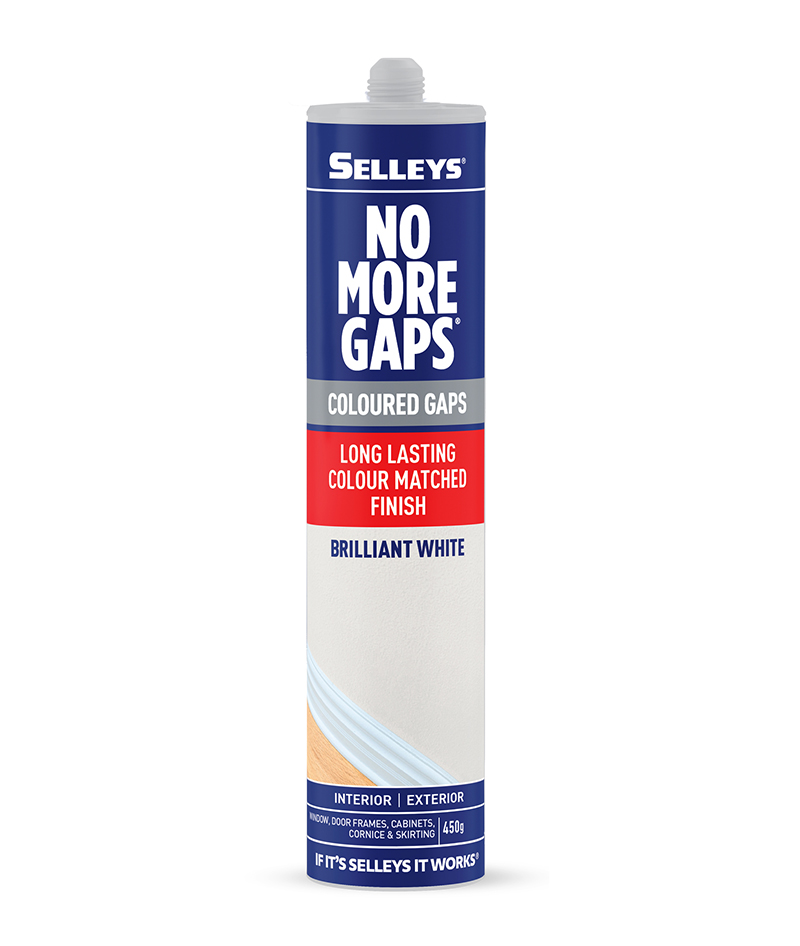
Selleys No More Gaps Coloured Gaps — named No More Gaps Interior Colours on its technical data sheet — is a water-based flexible gap filler supplied in a range of colours so that a filled gap needs no painting afterwards. It is made for interior wall joints, cabinets and splashbacks where a colour match is what you are after.
The reason to choose it over a white filler is simple: on a joint you were never going to paint — a dark skirting, a coloured splashback, a stained trim — a white bead is the repair you can see from the doorway. The colour range exists to remove that step. If you are painting, the product can still be painted with both water- and oil-based paints.
Technical specification
| Property | Typical result |
|---|---|
| Technology | Water-based |
| Application temperature | 5°C to 40°C |
| Tooling time | 2 minutes |
| Skin time | 3 minutes |
| Tack-free time | 18 minutes |
| Cure rate | 4mm in 24 hours; 8mm in 72 hours |
| Elongation | >350% |
| Movement capability (ISO 9046) | ±20% |
| Packaging | 450 g cartridge |
All data measured at 23°C and 50% relative humidity. Indicative data only, not intended for the preparation of specifications.
Colours
Baked Earth, Black, Brilliant White, Brown, Cedar, Charcoal, Coffee, Cream, Hog Bristle® Half (Dulux), Ivory, Light Grey, Natural White™ (Dulux), Timeless Grey (Dulux) and Tranquil Retreat (Dulux).
What the key numbers mean in practice
Tooling time of 2 minutes is the number that governs the job. It is short — much shorter than most fillers — and the directions say to smooth with a wet gloved finger or spatula immediately after application, within 2 minutes. Skin time is 3 minutes. In practice this means you cannot run a bead down a whole wall and then go back to tool it. Work in short lengths you can apply and smooth inside two minutes, and keep moving.
The same clock applies to masking. The method here is to tape the area either side of the gap first and then remove the tape before the product skins — so within about three minutes of applying that section. Tape pulled after skinning drags the edge of the bead with it.
The Interior Colours TDS v3.0 (2 August 2021) reports 4 mm in 24 hours and 8 mm in 72 hours at 23°C/50% RH. The retail page’s flat 24-hour full-strength statement is not valid for every joint depth or condition. Do not convert those test values into a guaranteed overnight cure for an unspecified joint.
Movement capability of ±20% with elongation over 350% is what stops the crack coming back. Interior joints move with the building's seasonal expansion and contraction; a filler that stretches with them stays intact where a rigid one splits. Selleys' own description makes the same point — superior flexibility to cope with building movement means the cracks and gaps stay hidden for longer.
Where to use it
Suitable for use on:
- Plasterboard
- Aluminium
- Particle board
- Wood
- Cement sheeting
- Glass
Typical locations are interior wall joints, cabinets and splashbacks, and the product page adds gaps around doors, windows and skirting boards.
How to apply it
Ensure surfaces are clean, dry, and free from dust or grease before you start.
- Tape the area around the gap or joint with painter's tape to ensure a clean finish.
- Cut the nozzle at a 45° angle, cut the cartridge tip, fit the nozzle and insert the cartridge into a caulking gun.
- Apply with the caulking gun, pushing the product into the gap or joint.
- Smooth with a wet, gloved finger or spatula immediately after application — within 2 minutes.
- Remove the tape before the product skins.
Painting over it
If required, the product can be painted with both water- and oil-based paints. Wait at least 30 minutes after application before painting. Wide joints are best left for 48 hours before painting, because some paints shrink during drying, which can cause the paint to crack.
Limitations — where it should not be used
- Not recommended for foot-traffic areas, or for gaps between tongue and groove boards.
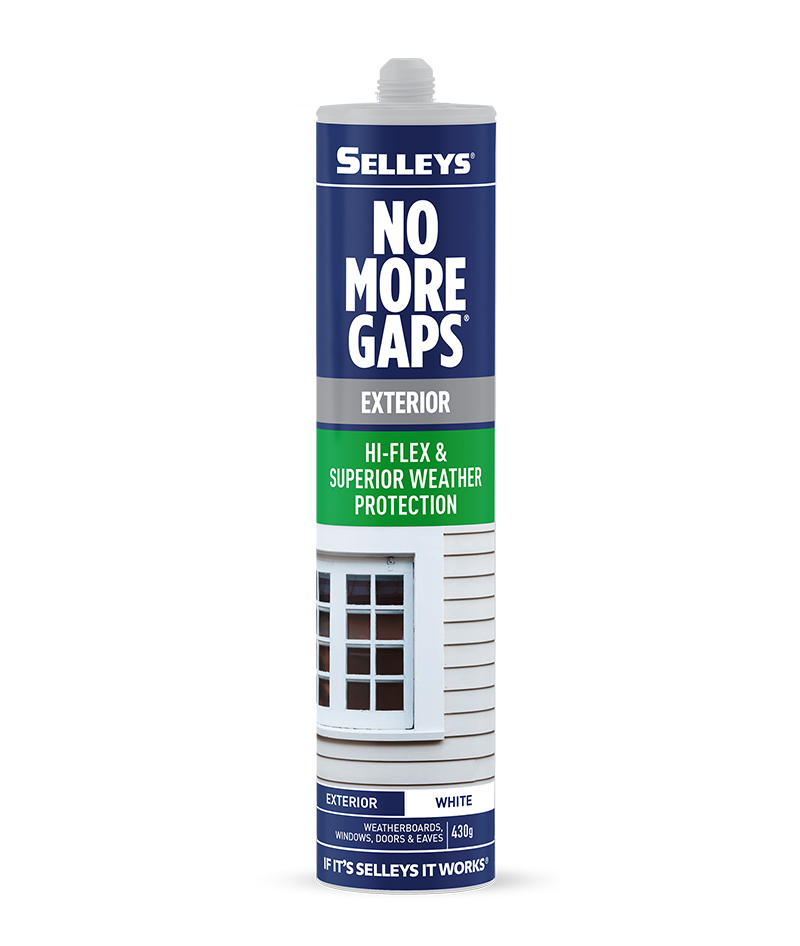
- For gaps between tongue and groove boards, and weatherboards, use No More Gaps Exterior.
- Not for use outdoors or in areas exposed to constant moisture, per the product page.
- Not suitable for polyethylene, polypropylene or Teflon, per the product page.
- Store above 5°C, sealed and out of direct sunlight.
The foot-traffic limitation is the one that catches people out on floors. A coloured filler looks like the obvious answer for a gap at the edge of a timber floor, but this product is not made to be walked on.
Clean up and storage
Clean up wet product using a damp cloth. Dry product should be removed using a scraper. For maximum shelf life, keep the product sealed and stored in a cool place out of direct sunlight, above 5°C.
Hazard classification
Selleys publishes the safety data sheet for this product under a third name again — No More Gaps Interior Colour Matched. The classification below is from that sheet.
Classified as hazardous under Safe Work Australia GHS 7, with the signal word Warning.
- Skin sensitisation — Category 1. H317: may cause an allergic skin reaction.
Not classified as Dangerous Goods by the criteria of the Australian Code for the Transport of Dangerous Goods by Road & Rail or of New Zealand NZS 5433, and not classified as dangerous goods for sea or air transport either.
What is in it
| Chemical entity | CAS number | Proportion (w/w) |
|---|---|---|
| 2-Octyl-2H-isothiazol-3-one (OIT) | 26530-20-1 | <0.08% |
| 1,2-Benzisothiazol-3(2H)-one (BIT) | 2634-33-5 | <0.05% |
| Non-hazardous or below reporting limits | — | Balance |
Everything declared here totals less than a seventh of one percent. OIT and BIT are isothiazolinone preservatives — the additives that keep a water-based filler from spoiling in the cartridge — and that chemical class is the one most often behind an H317 on a product like this. The safety data sheet does not name a single cause, so treat that as the likely explanation rather than a sourced one. What the numbers do show is that a sensitisation classification is not about quantity: a trace of a potent sensitiser classifies a product just as a large quantity of a weak one would.
Sensitisation is a different thing from irritation. Irritation is a local reaction that settles once contact stops. Sensitisation is the immune system learning to react to the material: once acquired it is generally permanent, it can afterwards be triggered by exposures far smaller than the one that caused it, and it tends to worsen with each subsequent contact rather than fade. It develops from repeated, ordinary contact rather than from one dramatic exposure.
The two-minute tooling time is what shapes the exposure on this product. As the directions above set out, you cannot run a bead down a wall and come back to it — you apply a short length, smooth it immediately with a wet gloved finger or a spatula, pull the tape, and start again. Over a room that is a great many separate hand-to-wet-filler contacts in quick succession, more than you would have with a filler that gives you half an hour. The glove in that instruction is not about keeping your hands clean.
There is a second reason it matters here. Because this filler is chosen so the joint needs no painting afterwards, the bead is usually the finished surface — so it gets tooled carefully, and often re-tooled, to get the finish right. Careful tooling is more contact, not less.
Protection
- Gloves — nitrile rubber is suitable for intermittent contact. Selleys notes that glove construction and local conditions vary, so the final assessment is the user's.
- Eye protection — safety glasses.
- Wash hands before smoking, eating, drinking or using the toilet, and wash contaminated clothing and protective equipment before storing or reusing it.
First aid
| Exposure | What to do |
|---|---|
| Skin | Wash with plenty of water and soap. If swelling, redness, blistering or irritation develops — including some hours later — seek medical advice or attention, as it may be an allergic reaction rather than simple irritation. |
| Eyes | Wash out immediately with water. In any case of eye contamination it is a sensible precaution to get medical advice. |
| Inhalation | Move the person away from the exposure without putting yourself at risk. Loosen tight clothing, let them rest comfortably and keep them warm until fully recovered. Seek medical advice if effects persist. |
| Swallowed | Rinse the mouth with water. Do not induce vomiting. Give a glass of water to drink. Give nothing by mouth to an unconscious person. If vomiting occurs, give more water and seek medical advice. |
If poisoning occurs, contact a doctor or the Poisons Information Centre — 131 126 in Australia, 0800 764 766 in New Zealand — with the container to hand. Selleys emergency line: 1800 220 770 in Australia, 0800 220 770 in New Zealand.
Common questions about No More Gaps Coloured Gaps
Do I have to paint over it?
No — that is the point of the colour range. It can be painted with water- or oil-based paints if you want to, but it is designed so a colour-matched joint needs no painting.
What colours are available?
Fourteen: Baked Earth, Black, Brilliant White, Brown, Cedar, Charcoal, Coffee, Cream, Hog Bristle® Half (Dulux), Ivory, Light Grey, Natural White™ (Dulux), Timeless Grey (Dulux) and Tranquil Retreat (Dulux).
How long do I have to smooth the bead?
Two minutes. Tooling time is 2 minutes and skin time is 3 minutes, so work in short sections and tool immediately after applying each one.
When do I pull the masking tape off?
Before the product skins — within about three minutes of applying that section.
How soon can I paint it?
At least 30 minutes after application. Wide joints are best left 48 hours, because some paints shrink as they dry and can crack over a joint that is still curing.
How long does it take to cure?
4mm in 24 hours, and 8mm in 72 hours. Deeper fills take proportionally longer than the surface suggests.
How much movement will it take?
±20% movement capability (ISO 9046), with elongation greater than 350%.
Can I use it on a floor?
No. It is not recommended for foot-traffic areas or for gaps between tongue and groove boards.
Can I use it outside?
No. The product page states it is not for use outdoors or in areas exposed to constant moisture. For gaps between weatherboards, Selleys directs you to No More Gaps Exterior.
What surfaces will it stick to?
Plasterboard, aluminium, particle board, wood, cement sheeting and glass. The product page notes it is not suitable for polyethylene, polypropylene or Teflon.
What temperature can I work in?
Application temperature is 5°C to 40°C, and the product should be stored above 5°C.
How do I clean up?
A damp cloth while it is wet; a scraper once it has dried.
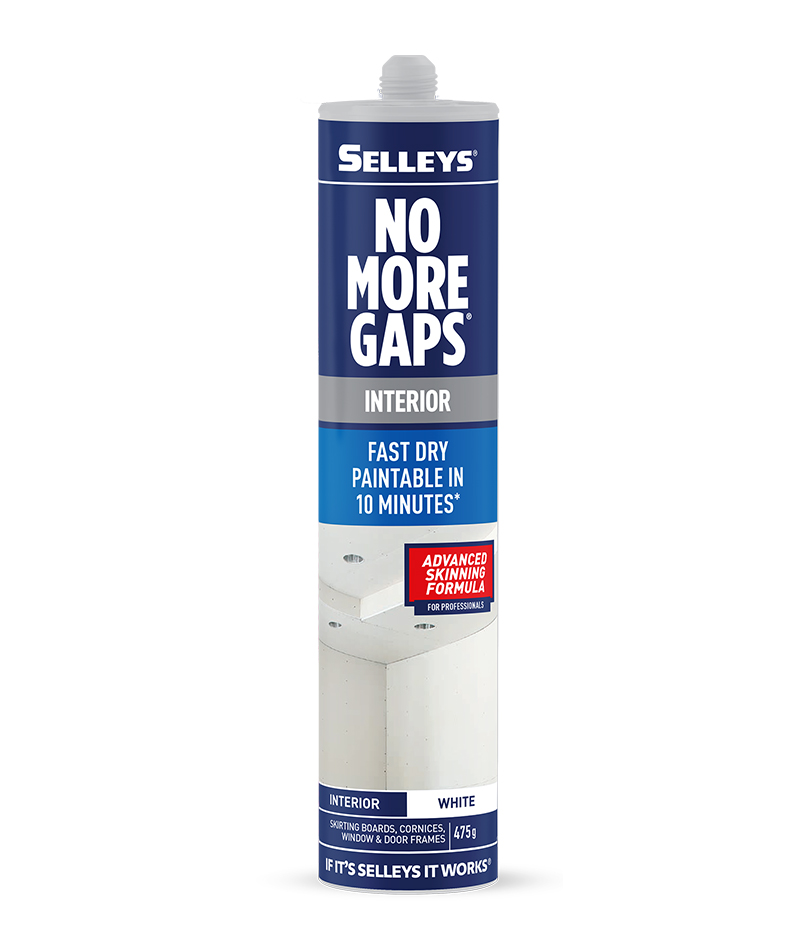
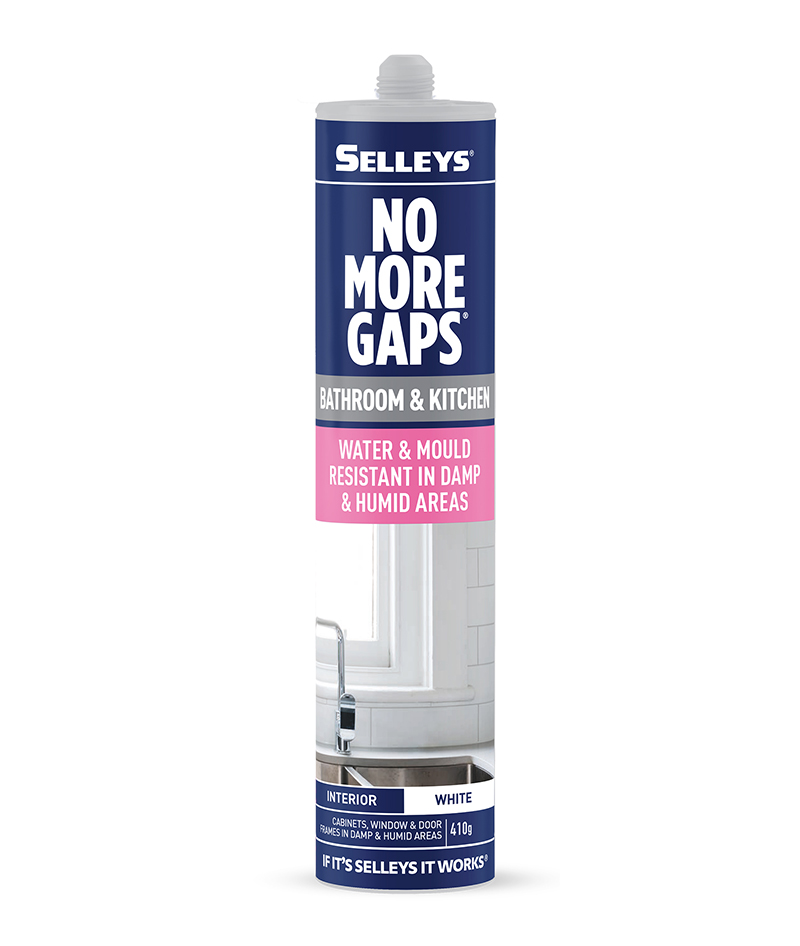
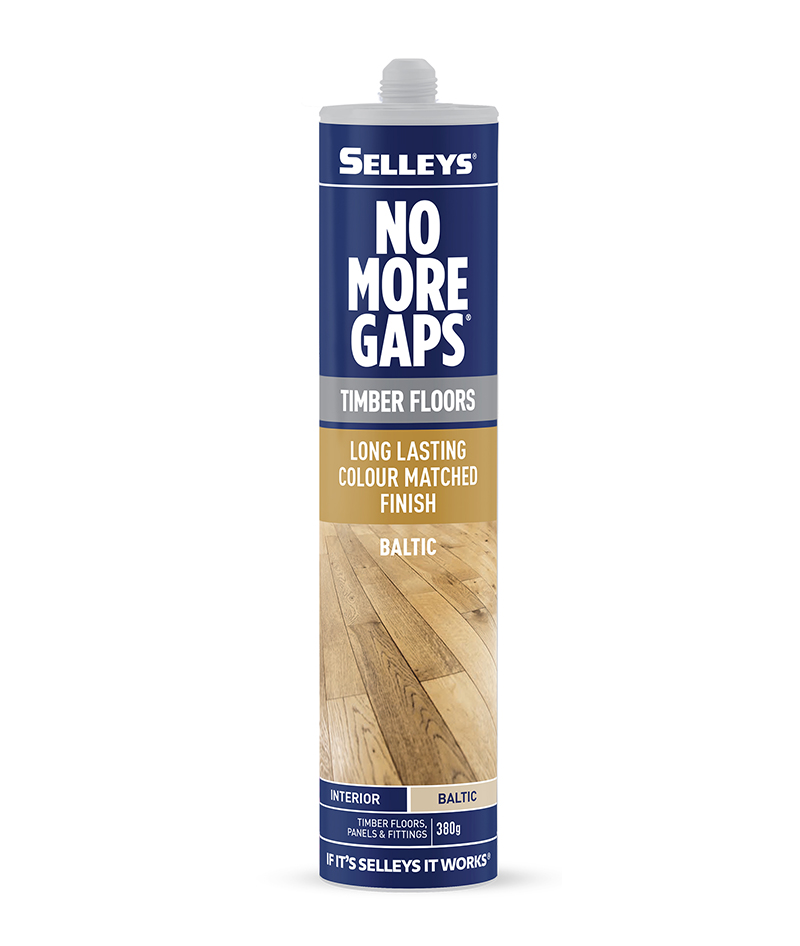
For exterior joints and weatherboards see No More Gaps Exterior; for timber floors see No More Gaps Timber Floors. The full range is under gap fillers.
What is Selleys No More Gaps Coloured Gaps and what size does it come in?
Selleys No More Gaps Coloured Gaps is an acrylic-based gap filler product that comes in a 450g size, available in multiple colours for colour matching in interior applications.
What technology is used in Selleys No More Gaps Coloured Gaps?
Selleys No More Gaps Coloured Gaps uses acrylic-based technology, which is a water-based formulation that is easy to apply and clean up.
How long does it take Selleys No More Gaps Coloured Gaps to cure?
The Interior Colours TDS v3.0 (2 August 2021) reports 4 mm in 24 hours and 8 mm in 72 hours at 23°C/50% RH. The retail page’s flat 24-hour full-strength statement is not valid for every joint depth or condition.
What materials is Selleys No More Gaps Coloured Gaps suitable for?
Selleys No More Gaps Coloured Gaps is suitable for use on timber, plasterboard, drywall, and MDF (medium-density fibreboard).
Can Selleys No More Gaps Coloured Gaps be used outdoors?
No, Selleys No More Gaps Coloured Gaps is not for use outdoors or in areas exposed to constant moisture; it is intended for indoor use only.
Is Selleys No More Gaps Coloured Gaps paintable?
The Interior Colours TDS permits water- or oil-based paint after at least 30 minutes; wide joints are best left 48 hours. These are paint-over times, not full-cure guarantees. The retail page instead says to paint after full cure; confirm the label matching the supplied cartridge.
What materials should not be used with Selleys No More Gaps Coloured Gaps?
Selleys No More Gaps Coloured Gaps is not suitable for use on polyethylene, polypropylene, or Teflon®.
How do you apply Selleys No More Gaps Coloured Gaps?
Use on clean, dry surfaces. Apply into the joint, smooth within two minutes with a wet gloved finger or spatula, and remove masking tape before skinning. Follow the separate paint-over guidance and depth-dependent curing information.
What is the water resistance level of Selleys No More Gaps Coloured Gaps?
Selleys No More Gaps Coloured Gaps has low water resistance, making it unsuitable for permanently wet areas.
What temperature range is recommended for applying and using Selleys No More Gaps Coloured Gaps?
The Interior Colours TDS specifies application at 5–40°C, whereas the retail page says 5–35°C and service at −20–70°C. This TDS does not confirm that service range; confirm the current cartridge instructions for temperature-critical use.
Images on This Page
-
https://www.selleys.com.au/media/cseezadf/selleys-logo-tagline_752x360.png?rmode=boxpad&ranchor=center&width=188&height=90&format=webp&quality=90
Selleys: Adhesives | Sealants | Putty Fillers | Glues | Cleaning Products - Australia
-
https://www.selleys.com.au/images/productpagev2/loading.gif
(no alt text)
-
https://www.selleys.com.au/media/zkhk1q5e/nmg-coloured-gaps-black_usp-ds.jpg?rmode=max&ranchor=center&width=440&height=440&format=jpg
https://www.selleys.com.au/media/zkhk1q5e/nmg-coloured-gaps-black_usp-ds.jpg?rmode=max&ranchor=center&width=440&height=440&format=jpg
-
https://www.selleys.com.au/media/pp2lv0qo/nmg-coloured-gaps-black-450g_front-ds.jpg?rmode=max&ranchor=center&width=440&height=440&format=jpg
https://www.selleys.com.au/media/pp2lv0qo/nmg-coloured-gaps-black-450g_front-ds.jpg?rmode=max&ranchor=center&width=440&height=440&format=jpg
-
https://www.selleys.com.au/media/h0jnmf2s/nmg-coloured-gaps-black-450g_back-ds.jpg?rmode=max&ranchor=center&width=440&height=440&format=jpg
https://www.selleys.com.au/media/h0jnmf2s/nmg-coloured-gaps-black-450g_back-ds.jpg?rmode=max&ranchor=center&width=440&height=440&format=jpg
-
https://www.selleys.com.au/media/hcnnu0uj/nmg-coloured-gaps_range.jpg?rmode=max&ranchor=center&width=440&height=440&format=jpg
https://www.selleys.com.au/media/hcnnu0uj/nmg-coloured-gaps_range.jpg?rmode=max&ranchor=center&width=440&height=440&format=jpg
-
https://img.youtube.com/vi/4cOqfg2nLf4/0.jpg?rmode=max&ranchor=center&width=440&height=440&format=jpg
https://img.youtube.com/vi/4cOqfg2nLf4/0.jpg?rmode=max&ranchor=center&width=440&height=440&format=jpg
-
https://www.selleys.com.au/images/productpagev2/pdp-share-icon.png
Share
-
https://www.selleys.com.au/media/2cvfafft/nmg-interior-interior-fast-dry.jpg
No More Gaps Interior Fast Dry
-
https://www.selleys.com.au/media/kl5buih3/nmg-exterior.jpg
No More Gaps Exterior
-
https://www.selleys.com.au/media/zateuucz/nmg-interior-kitchen-bathroom.jpg
No More Gaps Kitchen & Bathroom
-
https://www.selleys.com.au/media/lldlndgs/nmg-interior-timber-floors.jpg
No More Gaps Timber Floors
-
https://www.selleys.com.au/media/cegeahng/nmg-interior-coloured-gaps.jpg
No More Gaps Coloured Gaps
-
https://www.selleys.com.au/media/hveltww1/nmg-interior-bricks-mortar.jpg
No More Gaps Bricks & Mortar
-
https://www.selleys.com.au/media/5e4hnj22/nmg-interior-interior-multipurpose.jpg
No More Gaps Interior Multipurpose
-
https://www.selleys.com.au/media/35hfwmv0/nmbg-expanding-foam.jpg
No More Big Gaps Expanding Foam
-
https://www.selleys.com.au/media/a0gpbwbz/carousel-image-2.jpg?rmode=crop&ranchor=center&width=524&height=350&format=webp&quality=90
/media/a0gpbwbz/carousel-image-2.jpg
-
https://www.selleys.com.au/media/h50b31x5/carousel-image-3.jpg?rmode=crop&ranchor=center&width=524&height=350&format=webp&quality=90
/media/h50b31x5/carousel-image-3.jpg
-
https://www.selleys.com.au/media/ttdjmcgp/carousel-image-1.jpg?rmode=crop&ranchor=center&width=524&height=350&format=webp&quality=90
/media/ttdjmcgp/carousel-image-1.jpg
-
https://www.selleys.com.au/media/n51b00gp/carousel-image-4.jpg?rmode=crop&ranchor=center&width=524&height=350&format=webp&quality=90
/media/n51b00gp/carousel-image-4.jpg
-
https://www.selleys.com.au/media/kxcg2qlk/about-no-more-gaps.jpg?rmode=crop&ranchor=center&width=614&height=353&format=webp&quality=90
About No More Gaps