Manufacturer source check
The applicable fire rating depends on the tested construction and installation detail. Confirm the required system with the project fire certifier or engineer before application; a headline rating or joint width alone does not establish compliance. AC, PA and XT are not automatically interchangeable because they share an up-to-240-minute headline. See the manufacturer product information and matching certification.
What is Selleys Fireblock PA, and where should you use it?
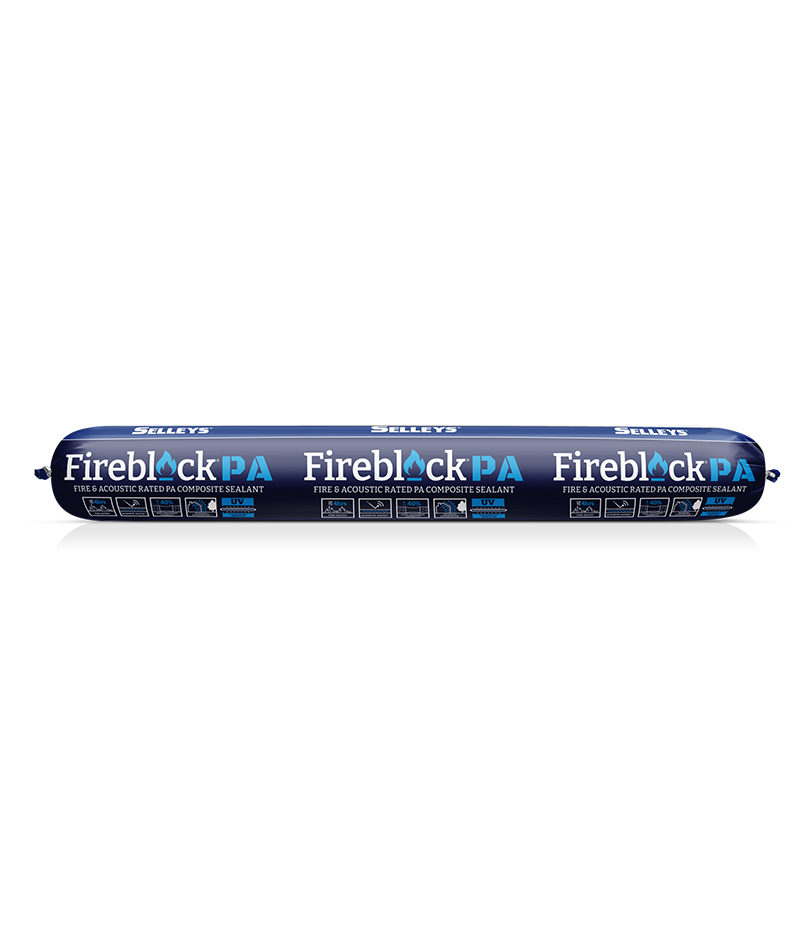
Selleys Fireblock PA is a low toxic, low modulus, non-slumping, Polyurethane Modified Acrylic sealant featuring UV Tracer technology. It has been developed for fire and acoustic rated construction in accordance with AS1530.4-2014 up to 240 minutes, in horizontal and vertical joints up to 40mm wide, in construction joints and service penetrations — without solvents or isocyanates.
Before anything else: prior to application of fire rated products, consult with the project fire certifier or engineer to ensure compliance with certification requirements. A fire rating belongs to a tested system and a specific joint detail, not to the sealant alone.
The number that distinguishes PA from the rest of the range is ±40% joint movement capability — high for a fire rated sealant. If your joint is a genuine movement joint as well as a fire-rated one, that is the reason to choose it.
Key characteristics
- Fire rated up to 240 minutes under AS1530.4-2014
- Acoustic rating Rw 67
- ±40% joint movement capability
- UV tracer included for verification
- Low toxicity and low VOC; solvent free and isocyanate free
- Low modulus and non-slumping
- Suitable for joints up to 40mm wide
What the key characteristics mean in practice
±40% movement capability is high, and it changes what the joint can do. Most fire rated sealants sit around ±20–25%. On a 20mm joint, ±40% is 8mm of movement in each direction rather than 4mm or 5mm — the difference between a detail that survives seasonal building movement and one that tears along an edge.
Low modulus is what makes that movement safe for the substrate. A low-modulus sealant puts less stress back into the joint faces as it stretches, so it moves rather than pulling the surface off masonry, render or board.
Non-slumping matters because the product is rated for horizontal and vertical joints. A sealant that sagged would leave the top of a tall joint starved of material — and in a fire rated joint, a thin spot is a failure point, not a cosmetic issue.
What the acoustic opinion says
Selleys publishes an acoustic opinion for Fireblock PA prepared by Acoustic Logic Pty Ltd, dated 27 March 2024. It continues an earlier opinion from 29 July 2011, and confirms that the change in the sealant's uncured theoretical specific gravity — from 1.526 to a theoretical 1.498 under the new formulation — would produce no measurable difference in performance.
Its conclusion is that Selleys Fireblock PA is suitable for use in wall systems up to Rw 67.
Where to use it
- Construction joints — both horizontal and vertical — up to 40mm wide
- Service penetrations in fire and acoustic rated construction
- Sheltered exterior applications
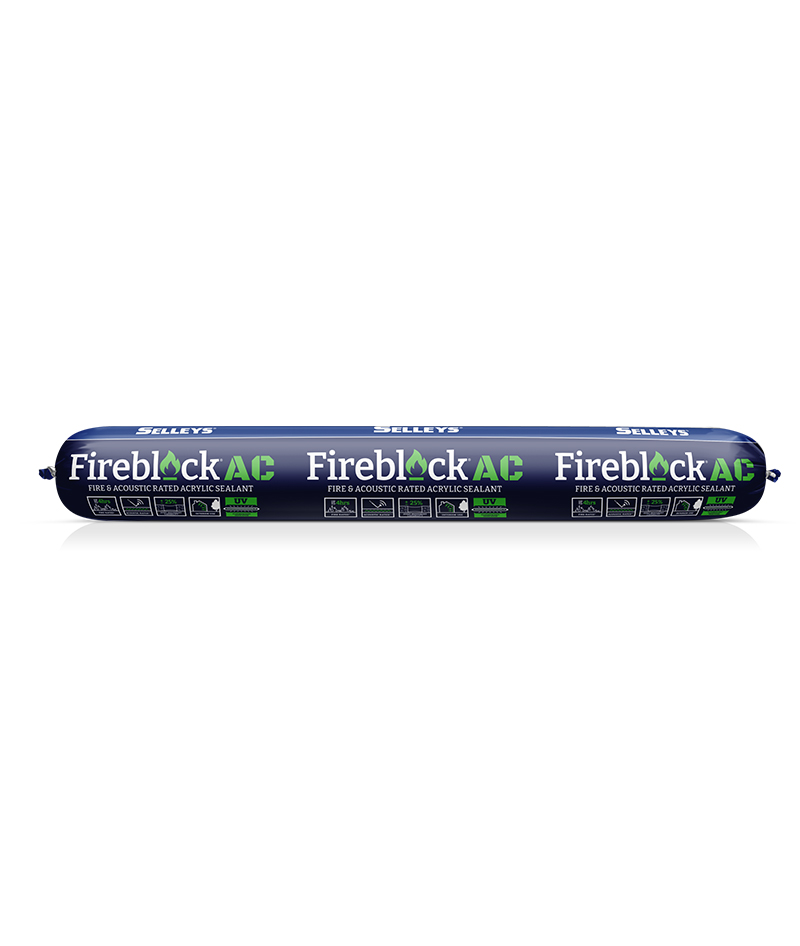
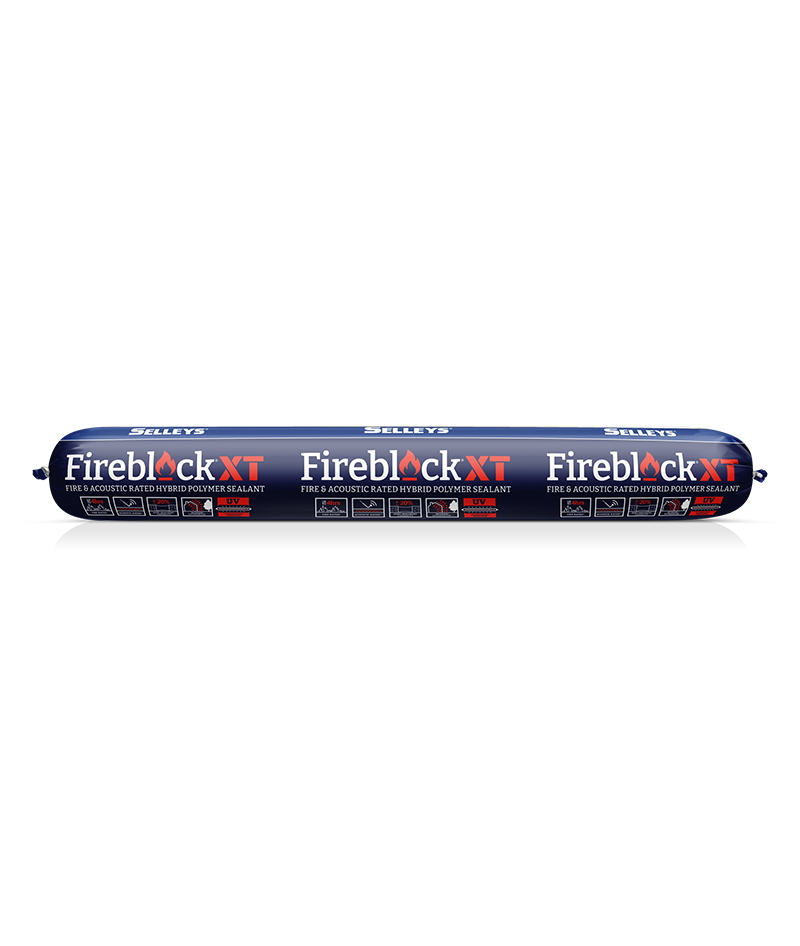
For an acrylic option in the same range see Selleys Fireblock AC, and for an SMP-based one see Selleys Fireblock XT. All three sit in the fire rated sealant range.
How to apply it
- Ensure joint surfaces are clean, dry and sound.
- Fit a backing rod if required to control depth for wider joints. Depth control is not optional on a rated joint — it is part of what was tested.
- Extrude the sealant into the joint, ensuring good adhesion to the sides. Both faces must be wetted out; a bead touching only one side leaves a path straight through the seal.
- Tool off the surface if needed, and allow to cure.
- Paint once cured, with compatible paints.
Limitations — where it should NOT be used
- Not for constantly damp conditions.
- Not suitable for exposure to water immersion or submersion.
- Exterior use is limited to sheltered applications.
- Joints are rated up to 40mm wide.
The damp restriction is the one to check first on a real building. Service penetrations often run through wet areas, plant rooms and risers where condensation is routine, and "sheltered exterior" is a narrower permission than "exterior". If the joint stays damp, this is the wrong product for it.
Hazard classification
Classified as hazardous under Safe Work Australia GHS 7, with the signal word Warning.
- Sensitisation — skin — Category 1. H317: may cause an allergic skin reaction.
That is the only classification it carries. It is not classified as Dangerous Goods by the criteria of the Australian Code for the Transport of Dangerous Goods by Road & Rail or New Zealand NZS5433, and no poison schedule applies.
What is in it
| Chemical entity | CAS number | Proportion (w/w) |
|---|---|---|
| 1,2-Benzisothiazol-3(2H)-one (BIT) | 2634-33-5 | <0.05% |
| 5-Chloro-2-methyl-4-isothiazolin-3-one (CMIT) | 26172-55-4 | <0.05% |
| 2-Methyl-2H-isothiazol-3-one (MIT) | 2682-20-4 | <0.05% |
| Ingredients determined to be non-hazardous or below reporting limits | — | Balance |
Three preservatives, each below 0.05% w/w, and nothing else declared. That is the entire declarable content of a product that this page has already described as low toxic and free of solvents and isocyanates — and the description holds up against the safety data sheet. The three named entities are isothiazolinones, the biocide class used to keep a water-based sealant stable in the tube, and isothiazolinones are the component group most commonly associated with skin-sensitisation classifications in water-based products. The safety data sheet does not name the ingredient responsible for H317, so treat that as the obvious chemical reading rather than a sourced attribution.
The reason a classification driven by three ingredients at one part in two thousand is still worth taking seriously is that sensitisation does not behave like a dose you can feel. It is not irritation. A sensitiser can teach the immune system to react to it; once that has happened it is generally permanent, and afterwards far smaller exposures than the original will trigger it. It builds through repeated ordinary contact. Fire sealing is exactly that kind of work — a floor of service penetrations is dozens of joints in a shift, the product cleans up with water, and wiping a joint with a bare thumb because it washes off is a habit that forms quickly.
For comparison within the range, Fireblock AC carries exactly the same classification — Warning, skin sensitisation Category 1, H317 — from the same preservative group. Choosing between PA and AC is a question of movement capability, exterior suitability and joint width, not of personal protection. The glove requirement does not change.
Protection
- Gloves — nitrile rubber is suitable for intermittent contact. This is the control that matters for an H317 product.
- Eye protection — safety glasses, particularly for overhead penetration seals.
- Ventilation — natural ventilation is adequate under normal use conditions; no occupational exposure limit has been assigned for this material by Safe Work Australia.
- Safety shoes and overalls on site; wash hands before eating, drinking or smoking, and wash contaminated clothing before reuse.
First aid
| Exposure | What to do |
|---|---|
| Eyes | Wash out immediately with water. Seek medical advice in all cases of eye contamination, as a precaution. |
| Skin | Effects may be delayed. Remove contaminated clothing and flush skin and hair with running water. If swelling, redness, blistering or irritation occurs, seek medical assistance immediately. |
| Inhalation | Remove the person from exposure without becoming a casualty yourself. Loosen tight clothing, keep them comfortable, warm and at rest until recovered. Seek medical advice if effects persist. |
| Swallowed | Rinse the mouth with water. Do NOT induce vomiting. Give a glass of water. Never give anything by mouth to an unconscious person. Seek medical advice. |
If poisoning occurs, contact a doctor or the Poisons Information Centre — 131 126 in Australia, 0800 764 766 in New Zealand — with the container to hand. Selleys emergency line: 1800 220 770 in Australia, 0800 220 770 in New Zealand.
Common questions about Selleys Fireblock PA
How long is it fire rated for?
Up to 240 minutes under AS1530.4-2014 for applicable tested systems. The applicable fire rating depends on the tested construction and installation detail. Confirm the required system with the project fire certifier or engineer before application; a headline rating or joint width alone does not establish compliance.
What acoustic rating does it support?
Rw 67. The independent acoustic opinion concludes it is suitable for use in wall systems up to Rw 67.
How much joint movement will it take?
±40% — higher than most fire rated sealants.
What is it made of?
A polyurethane modified acrylic, of the non-slumping type, free of solvents and isocyanates.
What is the maximum joint width?
Up to 40mm.
Can I use it in a vertical joint?
Yes. It is suited to both horizontal and vertical joints, and it is non-slumping.
Can I use it outside?
Only in sheltered exterior applications. It is not for constantly damp areas.
Can it be submerged or get constantly wet?
No. It is not suitable for exposure to water immersion or submersion, and not for constantly damp conditions.
Can I paint over it?
Yes, once cured, with compatible paints.
Do I need a backing rod?
Fit one if required to control depth on wider joints.
What is the UV tracer for?
Verification — it lets a certifier confirm under UV light that the correct product was installed in a joint.
Do I need approval before using it?
Selleys states that prior to application of fire rated products you should consult the project fire certifier or engineer to ensure compliance with certification requirements.
What is Selleys Fireblock PA?
Selleys Fireblock PA is a low toxic, low modulus, non-slumping Polyurethane Modified Acrylic sealant featuring UV Tracer technology, developed for fire and acoustic rated construction without solvents or isocyanates.
What fire rating standard does Selleys Fireblock PA meet, and for how long?
Selleys Fireblock PA is fire and acoustic rated in accordance with AS1530.4-2014 for up to 240 minutes. The applicable fire rating depends on the tested construction and installation detail. Confirm the required system with the project fire certifier or engineer before application; a headline rating or joint width alone does not establish compliance.
What is the maximum joint width Selleys Fireblock PA is designed for?
Selleys Fireblock PA is designed for horizontal and vertical joints up to 40mm wide in construction joints and service penetrations. The applicable fire rating depends on the tested construction and installation detail. Confirm the required system with the project fire certifier or engineer before application; a headline rating or joint width alone does not establish compliance.
What colour is Selleys Fireblock PA?
Selleys Fireblock PA is light grey in colour.
What is the acoustic rating of Selleys Fireblock PA?
Selleys Fireblock PA has an acoustic rating of Rw 67.
What is the joint movement capability of Selleys Fireblock PA?
Selleys Fireblock PA has a joint movement capability of ±40%.
Can Selleys Fireblock PA be used in constantly damp conditions?
No, according to the product's limitations, Selleys Fireblock PA is not for constantly damp conditions and is not suitable for exposure to water immersion or submersion.
What are the directions for using Selleys Fireblock PA?
First ensure joint surfaces are clean, dry, and sound. Then fit a backing rod if required to control depth for wider joints. Extrude the sealant into the joint ensuring good adhesion to the sides. Tool off the surface if needed and allow it to cure. Once cured, it is paintable with compatible paints.
Is Selleys Fireblock PA paintable?
Yes, Selleys Fireblock PA is paintable once cured, using compatible paints.
What technology does Selleys Fireblock PA use?
Selleys Fireblock PA uses Polyurethane Modified Acrylic, non-slumping type technology.
Images on This Page
-
https://www.selleys.com.au/media/cseezadf/selleys-logo-tagline_752x360.png?rmode=boxpad&ranchor=center&width=188&height=90&format=webp&quality=90
Selleys: Adhesives | Sealants | Putty Fillers | Glues | Cleaning Products - Australia
-
https://www.selleys.com.au/images/productpagev2/loading.gif
(no alt text)
-
https://www.selleys.com.au/media/qnwoccd0/fireblock-pa-600ml_usp.jpg?rmode=max&ranchor=center&width=440&height=440&format=jpg
https://www.selleys.com.au/media/qnwoccd0/fireblock-pa-600ml_usp.jpg?rmode=max&ranchor=center&width=440&height=440&format=jpg
-
https://www.selleys.com.au/media/jlmnq1d4/selleys-fireblock-pa-fire-sealant-600ml-sausage-front-v2.png?rmode=max&ranchor=center&width=440&height=440&format=png
https://www.selleys.com.au/media/jlmnq1d4/selleys-fireblock-pa-fire-sealant-600ml-sausage-front-v2.png?rmode=max&ranchor=center&width=440&height=440&format=png
-
https://www.selleys.com.au/media/bwojoadw/selleys-fireblock-pa-600ml_bop.png?rmode=max&ranchor=center&width=440&height=440&format=png
https://www.selleys.com.au/media/bwojoadw/selleys-fireblock-pa-600ml_bop.png?rmode=max&ranchor=center&width=440&height=440&format=png
-
https://www.selleys.com.au/media/ohjpnjkg/fireblock-range.jpg?rmode=max&ranchor=center&width=440&height=440&format=jpg
https://www.selleys.com.au/media/ohjpnjkg/fireblock-range.jpg?rmode=max&ranchor=center&width=440&height=440&format=jpg
-
https://img.youtube.com/vi/NUADFidvRiY/0.jpg?rmode=max&ranchor=center&width=440&height=440&format=jpg
https://img.youtube.com/vi/NUADFidvRiY/0.jpg?rmode=max&ranchor=center&width=440&height=440&format=jpg
-
https://www.selleys.com.au/images/productpagev2/pdp-share-icon.png
Share
-
https://www.selleys.com.au/media/3tepvecv/new-product-fireblock-ac.jpg
Selleys Fireblock AC
-
https://www.selleys.com.au/media/xurfou3o/new-product-fireblock-pa.jpg
Selleys Fireblock PA
-
https://www.selleys.com.au/media/i3glbhrh/new-product-fireblock-xt.jpg
Selleys Fireblock XT
-
https://www.selleys.com.au/media/rrjd1104/carousel-2.jpg?rmode=crop&ranchor=center&width=524&height=350&format=webp&quality=90
/media/rrjd1104/carousel-2.jpg
-
https://www.selleys.com.au/media/2ogj0ti5/carousel-3.jpg?rmode=crop&ranchor=center&width=524&height=350&format=webp&quality=90
/media/2ogj0ti5/carousel-3.jpg
-
https://www.selleys.com.au/media/piupmsmt/carousel-4.jpg?rmode=crop&ranchor=center&width=524&height=350&format=webp&quality=90
/media/piupmsmt/carousel-4.jpg
-
https://www.selleys.com.au/media/px1flt5y/carousel-1.jpg?rmode=crop&ranchor=center&width=524&height=350&format=webp&quality=90
/media/px1flt5y/carousel-1.jpg