
Product
Product Facts
- Product Name
- Selleys Fireblock XT
- Brand
- Selleys
- Category
- Home & Building Materials > Sealants & Adhesives
Selleys ProSeries Acryseal is an acrylic fire and acoustic rated sealant for perimeter and penetration seals in fire rated construction.
| Variant | Price | Availability |
|---|---|---|
| SelleysProSeriesAcryseal |
Selleys Fireblock XT
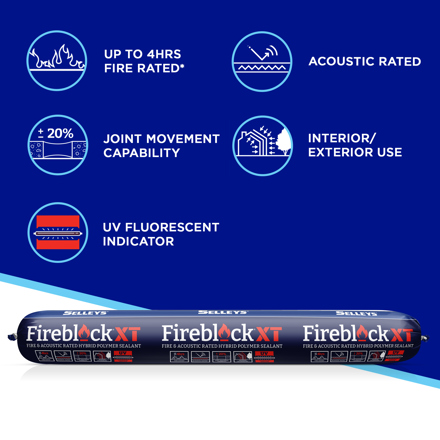
An intumescent SMP sealant for internal and external non-trafficable control joints in concrete, masonry, AAC and brick fire-rated construction. It also provides acoustic sealing between the listed building materials as part of a suitable design.
Check the pack details below, then find a retailer near you. Range and availability vary by store.
Product details
| Technology | High performance SMP (Silyl Modified-Polymer) sealant with UV Tracer |
|---|
Selleys Fireblock XT: technical details
| Property | Typical Result | ||||
|---|---|---|---|---|---|
| Technology | Moisture curing silyl-modified | ||||
| polymer (SMP) | |||||
| Colour | Grey | ||||
| Density | 1.5 | ||||
| Application Temperature | 5 to 40 °C | ||||
| Tooling Time | 30min approx. | ||||
| (25°C) | |||||
| Skin Time (23°C, 50% R.H.) | 50 mins approx.. | ||||
| Cure rate | 2 – 3mm per day | ||||
| (23°C, 50% R.H.) | |||||
| Tensile Strength (DIN 53504) | 1.2MPa | ||||
| Shore A Hardness | 30 - 35 | ||||
| (DIN 53505) | |||||
| Elongation at Break (ASTM D412) | 300% approx.. | ||||
| Modulus at 100% | 0.67 MPa | ||||
| Elongation | |||||
| (ASTM D412) | |||||
| Movement Capability (ISO 9047) | ± 20% | ||||
| Acoustic Rating | Up to 60 Rw | ||||
| Fire Rating (AS1530.4-2014) | Up to 4 hrs | ||||
| VOC Content | 15 g/L | ||||
| Indicative data only, not intended for preparation of specifications | |||||
| Packaging | Size | Colour | ||||||
|---|---|---|---|---|---|---|---|---|
| Sausage | 600ml | Grey | ||||||
| Joint Size (mm) | Metres per cartridge | ||||
|---|---|---|---|---|---|
| 6 x 6 | 7.9 | ||||
| 8 x 8 | 4.5 | ||||
| 10 x 10 | 2.9 | ||||
| 12 x 12 | 2.0 | ||||
| 15 x 7.5 | 2.5 | ||||
| 20 x 10 | 1.4 | ||||
| 30 x 15 | 0.6 | ||||
| 40 x 20 | 0.4 | ||||
Technical data sheet · 07/01/2025
Choose the right Fireblock and tested system
An intumescent SMP sealant for internal and external non-trafficable control joints in concrete, masonry, AAC and brick fire-rated construction. It also provides acoustic sealing between the listed building materials as part of a suitable design.
Before application, consult the project fire certifier or engineer. The required fire performance depends on the tested construction, substrates, joint geometry and installation. Use the relevant assessment and approved project detail; a fire-rating claim is not a blanket approval for every joint or penetration.
Source: Technical data sheet, page 1.
Prepare and apply
- Remove oil, grease, release agents, dust and loose particles. Prepare porous surfaces by grinding, brushing, wiping or using oil-free compressed air; remove concrete laitance. Remove scale, rust and oxides from non-porous surfaces. Where a suitable solvent is used for degreasing, remove any residue and follow its own safety instructions.
- Cut the sausage tip, load the caulking gun and fit a nozzle cut to suit the joint.
- Install the backing material required by the approved joint detail to control depth and avoid adhesion to the back of the joint.
- Extrude smoothly so the sealant wets both joint faces fully.
- The TDS application section specifies joint widths of 20–40 mm for fire-rated work, with a minimum depth of 10 mm, or half the width for joints wider than 20 mm. Confirm these dimensions against the tested system and the project requirements before installation.
Source: Technical data sheet, page 2.
Cure and painting windows
XT cures through atmospheric moisture. The TDS gives a typical thick-skin time of 24 hours and full cure of about 7 days, depending on humidity, temperature and joint size. Dry or cool conditions slow curing.
For painting, the TDS permits water-based paint after the product skins, typically 60–90 minutes, and says to paint within 12 hours of application. Allow longer before painting in colder weather. Test paint compatibility first; solvent-based paints require a water-based paint coat first.
Source: Technical data sheet, page 2.
Limitations, cleanup and storage
Do not use for permanent water immersion, below-waterline applications, polyethylene, polypropylene or PTFE.
Uncured sealant on tools and equipment can be removed with mineral turpentine; remove cured material mechanically. Follow the SDS for skin exposure and protective equipment.
Store below 28°C. The TDS states a shelf life of 12 months from manufacture.
Source: Technical data sheet, page 2.
Safety before you start
Check the product name on your pack against the Australian SDS below before use.
FIREBLOCK XT
SDS signal word: Warning.
- Causes serious eye irritation. (H319)
Handling: Avoid eye contact and repeated or prolonged skin contact. Avoid inhalation of dust.
Protective equipment and ventilation
Wear safety shoes, overalls, gloves, safety glasses. Available information suggests that gloves made from nitrile rubber should be suitable for intermittent contact. However, due to variations in glove construction and local conditions, the user should make a final assessment. Always wash hands before smoking, eating, drinking or using the toilet. Wash contaminated clothing and other protective equipment before storing or re-using.
Ventilation: Ensure ventilation is adequate to maintain air concentrations below Exposure Standards. Use only in well ventilated areas. Avoid generating and inhaling dusts. Use with local exhaust ventilation or while wearing dust mask. Vapour heavier than air - prevent concentration in hollows or sumps. Do NOT enter confined spaces where vapour may have collected.
Australian safety data sheet · issued 24 April 2024 · sections 2, 7 and 8. Read the full SDS for first aid, spill response, incompatibilities and disposal.
FIREBLOCK XT: storage and product data
Store between jobs
Store in a cool, dry, well-ventilated place and out of direct sunlight. Store away from foodstuffs. Store away from incompatible materials described in Section 10. Store away from sources of heat and/or ignition. Keep container standing upright. Keep containers closed when not in use - check regularly for spills.
| Form | Paste |
|---|---|
| Colour | Grey |
| Odour | Characteristic |
| Solubility | Insoluble in water, soluble in organic solvents |
| Specific Gravity | 1.5 |
| Relative Vapour Density (air=1) | >1 |
| Vapour Pressure | N Av |
| Flash Point (°C) | N App |
| Explosion/Flammability Limits | N App |
| Autoignition Temperature (°C) | N Av |
| Melting Point/Range (°C) | N Av |
| Boiling Point/Range (°C) | N Av |
| pH | N App |
| Viscosity | >14 mm²/s @ 40 °C |
| Total VOC (g/Litre) | N Av |
Others in this range
Alongside this product:
Browse from here
Where this page sits:
- Fire Rated Sealants
- Selleys Sealants: Silicone & Waterproof Solutions
- Adhesives, Fillers, Sealants & More
- All Products
- Discover Selleys Product Brands
- Find a product
Elsewhere in this category
Nearby products and groups:
- 650 FC Fast Cure Adhesive Sealant
- 655 FC Fast Cure Adhesive Sealant
- 670 Fast Grab Adhesive Sealant
- 675 Crystal Fix Adhesive Sealant
- All Clear
- Auto Fix Auto Sealant
- Auto Fix Instant Gasket
- Auto Fix Instant Gasket High Temperature Sealant
- Auto Fix Marine Sealant
- Auto Fix Windscreen Sealant
- Auto Sealants
- Brick & Concrete Silicone
- Construction Sealants
- Fix & Go Bathroom & Kitchen
Typical values describe the material in this safety data sheet. They are not application instructions or performance guarantees. N Av means not available; N App means not applicable.
Ingredients disclosed in the SDS
CHEMICAL ENTITY CAS NO PROPORTION
Benzotriazole derivative 104810-48-2 <1 % (w/w)
Calcium oxide 1305-78-8 <1 % (w/w)
Hydroxyphenylbenzotriazole derivative 104810-47-1 <1 % (w/w)
Silicic acid (H4SiO4), tetraethyl ester, reaction products with
bis(acetyloxy)dioctylstannane
93925-43-0 <1 % (w/w)
N-[3-(Trimethoxysilyl)propyl]ethylenediamine 1760-24-3 <1 % (w/w)
Trimethoxyvinylsilane 2768-02-7 <1 % (w/w)
Ingredients determined to be non-hazardous or below reporting limits Balance
____________
100%
These are the ingredients disclosed for hazard communication, not the complete formulation. Use the application instructions to decide suitability for your project.
First aid from the matching SDS
If poisoning occurs, contact a doctor or Poisons Information Centre (Phone Australia 131 126, New Zealand 0800 764 766).
Inhalation: Remove victim from exposure - avoid becoming a casualty. Remove contaminated clothing and loosen remaining clothing. Allow patient to assume most comfortable position and keep warm. Keep at rest until fully recovered. Seek medical advice if effects persist.
Skin Contact: If skin or hair contact occurs, remove contaminated clothing and flush skin and hair with running water. If swelling, redness, blistering or irritation occurs seek medical assistance.
Eye contact: If in eyes, hold eyelids apart and flush the eyes continuously with running water. Continue flushing until advised to stop by the Poisons Information Centre or a Doctor; or for at least 15 minutes and transport to Doctor or Hospital.
Ingestion: Rinse mouth with water. If swallowed, do NOT induce vomiting. Give a glass of water to drink. Never give anything by the mouth to an unconscious patient. If vomiting occurs give further water. Seek medical advice.
PPE for First Aiders: Wear safety shoes, overalls, gloves, safety glasses. Available information suggests that gloves made from nitrile rubber should be suitable for intermittent contact. However, due to variations in glove construction and local conditions, the user should make a final assessment. Always wash hands before smoking, eating, drinking or using the toilet. Wash contaminated clothing and other protective equipment before storing or re-using.
Notes to physician: Treat symptomatically.
Disposal
Persons conducting disposal, recycling or reclamation activities should ensure that appropriate personal protection equipment is used, see "Section 8. Exposure Controls and Personal Protection" of this SDS. If possible material and its container should be recycled. If material or container cannot be recycled, dispose in accordance with local, regional, national and international Regulations.
Australian SDS · sections 1, 3, 4, 7, 9 and 13 · 24 April 2024
Technical and safety documents
The technical data sheet covers application and performance conditions. The safety data sheet covers hazards and safe handling. Use both alongside the pack instructions.
- Acoustic assessment — Selleys Fireblock XT
- VOC test certificate — Selleys Fireblock XT
- Technical data sheet — Selleys Fireblock XT · 07/01/2025
- Australian SDS — FIREBLOCK XT · 24 April 2024
Need a hand choosing the right document or checking your application? Contact our team with the product name, pack code, surfaces and intended use.
Can a 10 mm joint achieve the listed fire rating?
Do not assume so. The TDS fire-rated instructions specify 20–40 mm width and the assessed system governs the installation.
Does one bead provide Rw 60?
No. The acoustic opinion distinguishes single and double beads, 15 mm depth and gap-area fractions. Obtain the full opinion and project advice.
How much does a 600 mL sausage cover?
The TDS table is labelled per cartridge despite listing a 600 mL sausage. Confirm its pack basis with our team before using the figures to order material.
When can I paint?
The painting instructions allow water-based paint after skinning, stated as 60–90 minutes, longer in cold weather, and within 12 hours of application. Test compatibility; apply water-based paint before solvent-based paint.
How do I choose the right Fireblock and tested system?
An intumescent SMP sealant for internal and external non-trafficable control joints in concrete, masonry, AAC and brick fire-rated construction. It also provides acoustic sealing between the listed building materials as part of a suitable design. Before application, consult the project fire certifier or engineer. The required fire performance depends on the tested construction, substrates, joint geometry and installation.
How do I prepare and apply?
Remove oil, grease, release agents, dust and loose particles. Prepare porous surfaces by grinding, brushing, wiping or using oil-free compressed air; remove concrete laitance. Remove scale, rust and oxides from non-porous surfaces. Where a suitable solvent is used for degreasing, remove any residue and follow its own safety instructions; Cut the sausage tip, load the caulking gun and fit a nozzle cut to suit the joint; Install the backing material required by the approved joint detail to control depth and avoid adhesion to the back of the joint; Extrude smoothly so the sealant wets both joint faces fully.
What should I know about cure and painting windows?
XT cures through atmospheric moisture. The TDS gives a typical thick-skin time of 24 hours and full cure of about 7 days, depending on humidity, temperature and joint size. Dry or cool conditions slow curing. For painting, the TDS permits water-based paint after the product skins, typically 60–90 minutes, and says to paint within 12 hours of application.
What should I know about limitations, cleanup and storage?
Do not use for permanent water immersion, below-waterline applications, polyethylene, polypropylene or PTFE. Uncured sealant on tools and equipment can be removed with mineral turpentine; remove cured material mechanically. Follow the SDS for skin exposure and protective equipment. Store below 28°C. The TDS states a shelf life of 12 months from manufacture.
What should I know about safety before I start?
Check the product name on your pack against the Australian SDS below before use. Handling: Avoid eye contact and repeated or prolonged skin contact. Avoid inhalation of dust. Wear safety shoes, overalls, gloves, safety glasses. Available information suggests that gloves made from nitrile rubber should be suitable for intermittent contact.
Which technical and safety documents are available?
The technical data sheet covers application and performance conditions. The safety data sheet covers hazards and safe handling. Use both alongside the pack instructions. Need a hand choosing the right document or checking your application? Contact our team with the product name, pack code, surfaces and intended use.
What should I know about FIREBLOCK XT?
Store in a cool, dry, well-ventilated place and out of direct sunlight. Store away from foodstuffs. Store away from incompatible materials described in Section 10. Store away from sources of heat and/or ignition. Keep container standing upright. Keep containers closed when not in use - check regularly for spills.
What are its physical and chemical properties?
Form: Paste; Colour: Grey; Odour: Characteristic; pH: N App; Viscosity: 14 mm²/s @ 40 °C; Specific Gravity: 1.5; Density: 1.5; Solubility: Insoluble in water, soluble in organic solvents; Boiling Point/Range (°C): N Av; Melting Point/Range (°C): N Av; Vapour Pressure: N Av; Relative Vapour Density (air=1): 1.