Manufacturer source check
Safety classification checked against the Australian SDS v5.0, 3 June 2024. Its four hazard codes are H225, H315, H319 and H336; the missing drowsiness/dizziness warning has been restored.
What is Selleys Liquid Nails Clear, and where should you use it?
Selleys Liquid Nails Clear is a high strength construction adhesive that dries clear. It blends into the surface rather than leaving a visible white bead, which reduces unsightly mess and makes it the Liquid Nails to choose where a fine finish matters — bonding glass, working on tiles, or making a joint that will be looked at rather than hidden behind a panel.
It gives a strong, permanent bond, is waterproof and weather resistant, and is suitable for both indoor and outdoor use. It is designed to meet AS 2329-1999 construction adhesive standards.
The timing figure to plan around is 7 days to full strength. That is a long cure by household standards, and it means this is a product for jobs you can leave alone rather than jobs you need finished today.
Specification
| Property | Value |
|---|---|
| Type | High strength construction adhesive, dries clear |
| Full strength | 7 days |
| Paintable | Yes, when fully cured |
| Application temperature | 5°C to 35°C |
| Service temperature | −20°C to 100°C |
| Water resistance | Waterproof and weather resistant — not for constant water immersion |
| Standard | Designed to meet AS 2329-1999 construction adhesive standards |
What the key numbers mean in practice
The 5°C to 35°C application range is the constraint most people ignore. It rules out a lot of real Australian working conditions: a garage on a cold winter morning can sit below 5°C, and a north-facing wall or a shed in mid-summer will run well past 35°C by mid-morning. Check the surface temperature, not just the air temperature — a dark surface in the sun is much hotter than the day is. If you are outside the range, wait for a better part of the day.
The service range of −20°C to 100°C is far wider, which tells you the constraint is about getting the adhesive on and cured, not about where the finished joint can live.
Seven days to full strength does not mean seven days of doing nothing. It means the joint keeps gaining strength for a week, so anything that will carry real load should not be loaded until then. Support the work in the meantime rather than testing it early.
The one technique that decides whether the joint holds
Selleys gives a specific and unusually useful instruction for this product. When applying to one surface, use enough adhesive that some extrudes out when the surfaces are brought together, then wipe off the excess if necessary.
The reasoning is worth spelling out, because it runs against the instinct to use adhesive sparingly. If no glue is visible at the edge of the joint, you may not have made sufficient contact between the surfaces — and the result is a weak joint. The squeeze-out is your only visible evidence that the adhesive actually bridged the gap between the two faces rather than sitting in a bead that never touched the second surface.
On a clear adhesive this is easier to live with than on a white one, because the squeeze-out is far less visible in the first place. Still wipe it off before it sets, using mineral turps.
Where to use it
- Glass — including bonding glass to other surfaces
- Tiles
- Transparent materials, where a crystal-clear finish is wanted
- Indoor and outdoor construction bonding generally
How to apply it
- Clean the surfaces to be bonded, making sure they are dry and free from dust or oils.
- Cut the cartridge tip and attach the nozzle.
- Apply the adhesive in a continuous line or bead to one surface — enough that some will squeeze out when the joint closes.
- Press the materials together and ensure firm bonding. Check for squeeze-out along the joint.
- Wipe off any excess before it sets, using mineral turps.
- Allow it to cure fully for 7 days for maximum bond strength.
Limitations — where it should NOT be used
- Not suitable for polyethylene, polypropylene or Teflon®. These plastics need a dedicated product — see Selleys All Plastics.
- Not suitable for bonding clear plastics or acrylics. This one catches people out, because a clear adhesive looks like the obvious choice for a clear plastic. It is not. Acrylic sheet, polycarbonate glazing and clear plastic panels are outside what this product is rated for.
- Not for use in applications exposed to constant water immersion. Waterproof and weather resistant covers rain and splashing; it does not cover a permanently submerged joint.
- Do not apply outside 5°C to 35°C.
Clean up
Clean up excess adhesive before it sets, using mineral turps. Once cured, a construction adhesive has to be removed mechanically, and on glass or tile that is a far more delicate job than a wipe at the time.
Hazard classification
Classified as hazardous under Safe Work Australia GHS 7, with the signal word Danger.
- Flammable liquids — Category 2. H225: highly flammable liquid and vapour.
- Skin corrosion/irritation — Category 2. H315: causes skin irritation.
- Eye damage/irritation — Category 2A. H319: causes serious eye irritation.
- Specific target organ toxicity, single exposure — Category 3, narcotic effects. H336: may cause drowsiness or dizziness.
It is Dangerous Goods Class 3, flammable liquid: UN 1133, proper shipping name ADHESIVES, across road, rail, marine and air transport.
What is in it
| Chemical entity | CAS number | Proportion (w/w) |
|---|---|---|
| Cyclohexane | 110-82-7 | 10–30% |
| Naphtha, petroleum, hydrotreated light | 64742-49-0 | 10–30% |
| Benzotriazole derivative | 104810-48-2 | <1% |
| Hydroxyphenylbenzotriazole derivative | 104810-47-1 | <1% |
| Non-hazardous or below reporting limits | — | Balance |
Between a fifth and three fifths of this cartridge is hydrocarbon solvent, and that is what a Category 2 flammable classification means in practice: the vapour forms an ignitable mixture at ordinary room temperature, without anything having to warm up first. Hydrocarbon vapour is also heavier than air, so it sinks and collects in the low points of a room — subfloors, stairwells, service cavities — rather than dispersing upwards. Pilot lights, a fan heater on the floor, a grinder throwing sparks, are all real ignition sources for a job with several beads of this open at once.
The Australian SDS v5.0, 3 June 2024, includes H336: may cause drowsiness or dizziness. The previous statement that Liquid Nails Clear had no narcotic-effects classification was incorrect. Avoid inhaling vapour and follow the SDS exposure controls.
The seven-day cure the page describes is the solvent leaving the bond line. For a thin bead on an exposed joint that is quick. For a thick bead pressed between two sheets of glass or tile, the solvent has almost nowhere to go, and it keeps coming out slowly for as long as the cure takes. A room that has just had a lot of this adhesive applied should be ventilated for longer than the afternoon you worked in it.
Protection
- Eye protection — safety glasses.
- Gloves — nitrile rubber is indicated for intermittent contact; make your own final assessment for your conditions and glove construction.
- Clothing — overalls and safety shoes. Wash contaminated clothing and protective equipment before storing or reusing.
- Ventilation and respiratory protection — use adequate ventilation and follow SDS section 8. Where an inhalation risk exists, the SDS specifies an organic-vapour/particulate respirator meeting AS/NZS 1715 and AS/NZS 1716. Do not enter confined spaces where vapour may have collected.
- Ignition sources — keep away from heat, sparks, open flame and hot surfaces. Extinguish pilot lights in the work area.
- Keep away from food and drink. Do not eat, drink or smoke while using it, and wash hands beforehand.
First aid
| Exposure | What to do |
|---|---|
| Eyes | Irrigate immediately with copious water for 15 minutes, holding the eyelids open. Remove contaminated clothing and wash the skin. Seek medical assistance urgently and transport to a hospital or medical centre. |
| Skin | Remove contaminated clothing immediately and flush skin and hair with running water, continuing until told to stop by the Poisons Information Centre or a doctor, or for 15 minutes. For gross contamination, drench with water, remove clothing and keep flushing with plenty of water and soap. Cover any burn with a clean dry dressing; do NOT break blisters. Seek medical assistance if swelling, redness, blistering or irritation occurs. |
| Inhalation | Move the person to fresh air without becoming a casualty yourself. Loosen tight clothing, let them rest comfortably and keep them warm until fully recovered. Seek medical advice if effects persist. |
| Swallowed | Rinse the mouth with water. Do NOT induce vomiting. Give a glass of water. Never give anything by mouth to an unconscious person. Seek medical advice. |
If poisoning occurs, contact a doctor or the Poisons Information Centre — 131 126 in Australia, 0800 764 766 in New Zealand — with the container to hand. Selleys emergency line: 1800 220 770 in Australia, 0800 220 770 in New Zealand.
Common questions about Selleys Liquid Nails Clear
How long does it take to reach full strength?
7 days. Support the joint and avoid loading it before then.
Can I paint over it?
Yes, once it is fully cured.
Will it stick to glass?
Yes — glass is a primary use, including bonding glass to other surfaces.
Can I use it on acrylic or clear plastic?
No. It is not suitable for bonding clear plastics or acrylics, despite drying clear itself.
Will it stick to plastic at all?
Not to polyethylene, polypropylene or Teflon®, and not to clear plastics or acrylics.
Can I use it outside?
Yes. It is waterproof and weather resistant and suitable for indoor and outdoor use — but not where it will be under constant water immersion.
What temperature can I apply it at?
Between 5°C and 35°C. Once cured, the joint tolerates −20°C to 100°C.
How much adhesive should I use?
Enough that some extrudes out when you press the surfaces together. If no glue is visible, you may not have made sufficient contact, and the joint may be weak.
What if I get excess on the surface?
Wipe it off with mineral turps before it sets.
Does it meet a construction standard?
It is described as designed to meet AS 2329-1999 construction adhesive standards.
Can I use it on mirrors?
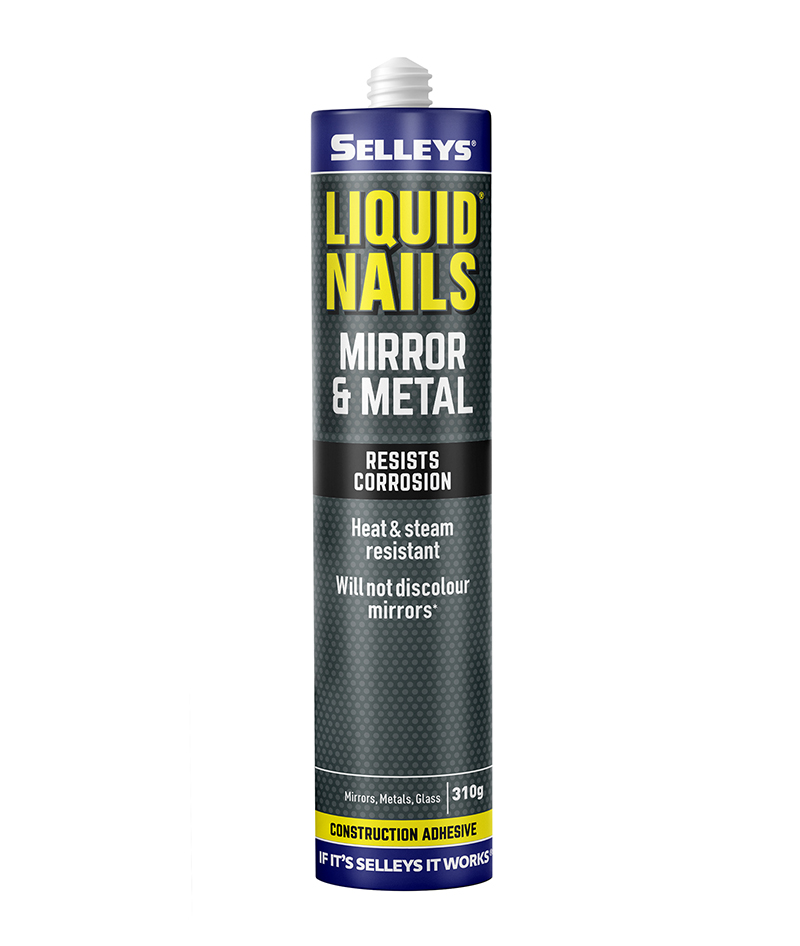
Mirrors are not listed among this product's uses. Selleys makes a dedicated product for that work — see Liquid Nails Mirror & Metal — and a mirror's silvered backing is not something to experiment on.
What should I use if I do not need a clear finish?
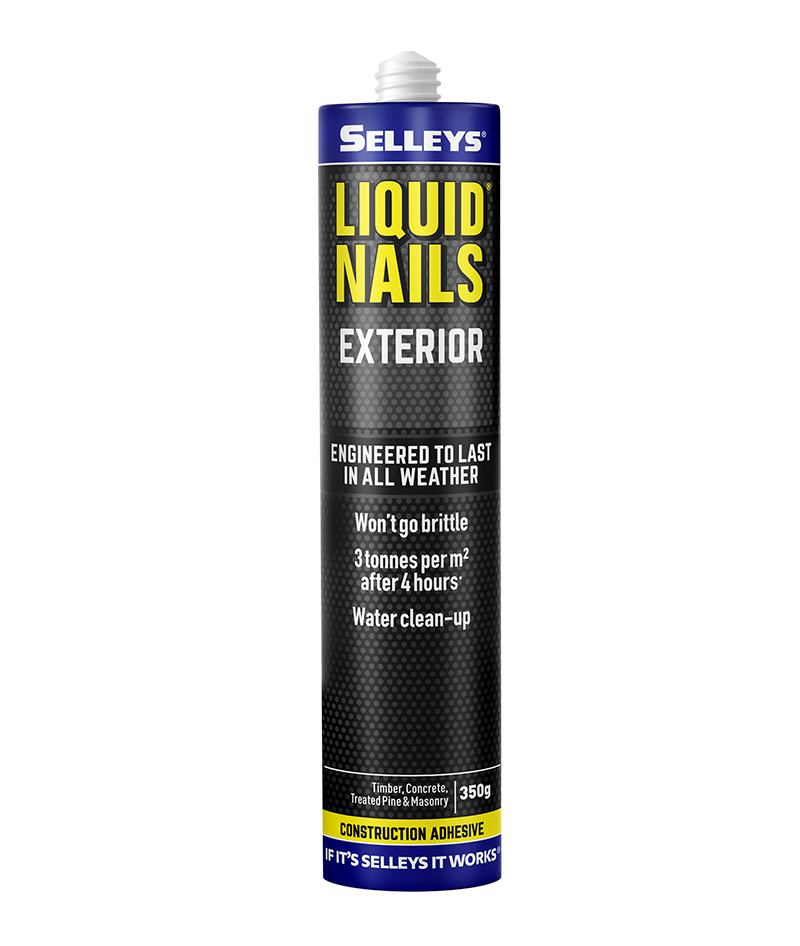
Liquid Nails Construction Adhesive is the general-purpose option, and Liquid Nails Exterior is built for all-weather outdoor bonding.
What is Selleys Liquid Nails Clear used for?
Selleys Liquid Nails Clear is a solvent-based construction adhesive that provides a clear, high-strength bond for transparent or visible bonding applications, suitable for materials like glass, tiles, timber, and plasterboard.
What sizes does Selleys Liquid Nails Clear come in?
Selleys Liquid Nails Clear is available in 80g (product code 9300697115706) and 250g (product code 9300697115645) sizes.
How long does Selleys Liquid Nails Clear take to cure to full strength?
Selleys Liquid Nails Clear achieves full strength after 7 days of curing.
What materials should not be bonded with Selleys Liquid Nails Clear?
Selleys Liquid Nails Clear is not suitable for polyethylene, polypropylene, or Teflon®, and it is not suitable for bonding clear plastics or acrylics. It should also not be used in applications exposed to constant water immersion.
Is Selleys Liquid Nails Clear paintable?
Yes, Selleys Liquid Nails Clear is paintable once it is fully cured.
What is the application temperature range for Selleys Liquid Nails Clear?
Selleys Liquid Nails Clear should be applied at temperatures between 5°C and 35°C.
What is the service temperature range for Selleys Liquid Nails Clear once cured?
Once cured, Selleys Liquid Nails Clear can withstand service temperatures ranging from -20°C to 100°C.
How do you apply Selleys Liquid Nails Clear?
To apply, clean the surfaces to be bonded ensuring they are dry and free from dust or oils, cut the cartridge tip and attach the nozzle, apply the adhesive in a continuous line or bead to one surface, press the materials together for firm bonding, and allow it to cure fully for 7 days for maximum bond strength.
How do you clean up excess Selleys Liquid Nails Clear before it sets?
Excess Selleys Liquid Nails Clear should be cleaned up before it sets using mineral turps.
Can Selleys Liquid Nails Clear be used indoors and outdoors?
Yes, Selleys Liquid Nails Clear is suitable for both indoor and outdoor use.
What hazard statements apply to Liquid Nails Clear?
The Australian SDS v5.0 (3 June 2024) uses Danger and lists H225, H315, H319 and H336: highly flammable liquid/vapour, skin irritation, serious eye irritation and possible drowsiness or dizziness. Follow the full SDS and cartridge label.
Images on This Page
-
https://www.selleys.com.au/media/cseezadf/selleys-logo-tagline_752x360.png?rmode=boxpad&ranchor=center&width=188&height=90&format=webp&quality=90
Selleys: Adhesives | Sealants | Putty Fillers | Glues | Cleaning Products - Australia
-
https://www.selleys.com.au/images/productpagev2/loading.gif
(no alt text)
-
https://www.selleys.com.au/media/lqkcadwj/ln-clear-250g_usp.jpg?rmode=max&ranchor=center&width=440&height=440&format=webp&quality=90
https://www.selleys.com.au/media/lqkcadwj/ln-clear-250g_usp.jpg?rmode=max&ranchor=center&width=800&height=800&format=webp&quality=90
-
https://www.selleys.com.au/media/ol2lgrad/ln-clear-new-look.jpg?rmode=max&ranchor=center&width=440&height=440&format=webp&quality=90
https://www.selleys.com.au/media/ol2lgrad/ln-clear-new-look.jpg?rmode=max&ranchor=center&width=800&height=800&format=webp&quality=90
-
https://www.selleys.com.au/media/ghtpbkk5/ln-clear-250g-cartridge_front.jpg?rmode=max&ranchor=center&width=440&height=440&format=webp&quality=90
https://www.selleys.com.au/media/ghtpbkk5/ln-clear-250g-cartridge_front.jpg?rmode=max&ranchor=center&width=800&height=800&format=webp&quality=90
-
https://www.selleys.com.au/media/qtwhpcnc/ln-clear-250g-cartridge_back.jpg?rmode=max&ranchor=center&width=440&height=440&format=webp&quality=90
https://www.selleys.com.au/media/qtwhpcnc/ln-clear-250g-cartridge_back.jpg?rmode=max&ranchor=center&width=800&height=800&format=webp&quality=90
-
https://www.selleys.com.au/media/v04kmv5r/selleys-liquid-nails-range-shot.png?rmode=max&ranchor=center&width=440&height=440&format=webp&quality=90
https://www.selleys.com.au/media/v04kmv5r/selleys-liquid-nails-range-shot.png?rmode=max&ranchor=center&width=800&height=800&format=webp&quality=90
-
https://www.selleys.com.au/images/productpagev2/pdp-share-icon.png
Share
-
https://www.selleys.com.au/media/xwfj4vgd/ln-construction-adhesive.jpg
Liquid Nails Construction Adhesive
-
https://www.selleys.com.au/media/0yjpfagv/ln-fast.jpg
Liquid Nails Fast Grab
-
https://www.selleys.com.au/media/vqql3dn0/ln-heavy-duty.jpg
Liquid Nails Heavy Duty
-
https://www.selleys.com.au/media/mgqnpcuz/ln-landscape.jpg
Liquid Nails Landscape
-
https://www.selleys.com.au/media/tp3pnb2f/ln-mirror-metal.jpg
Liquid Nails Mirror & Metal
-
https://www.selleys.com.au/media/4rlb3jns/ln-rapid-cure.jpg
Liquid Nails Rapid Cure
-
https://www.selleys.com.au/media/jeyktnic/ln-extreme-grab.jpg
Liquid Nails Extreme Grab
-
https://www.selleys.com.au/media/0gmbrtku/ln-exterior.jpg
Liquid Nails Exterior
-
https://www.selleys.com.au/media/cbblla3l/d7da48d64e7c677f17c23efbe8695d38dc36d225.jpg?rmode=crop&ranchor=center&width=524&height=350&format=webp&quality=90
/media/cbblla3l/d7da48d64e7c677f17c23efbe8695d38dc36d225.jpg
-
https://www.selleys.com.au/media/hsfels15/db9d55bd3617f31d27df2749e0d457a5c7b2f25b.jpg?rmode=crop&ranchor=center&width=524&height=350&format=webp&quality=90
/media/hsfels15/db9d55bd3617f31d27df2749e0d457a5c7b2f25b.jpg
-
https://www.selleys.com.au/media/dtkhvo45/4173f8a994aa2fc47a67a8465757dc698057be06.jpg?rmode=crop&ranchor=center&width=524&height=350&format=webp&quality=90
/media/dtkhvo45/4173f8a994aa2fc47a67a8465757dc698057be06.jpg
-
https://www.selleys.com.au/media/cklbfgv1/601c6a32cdd1940b86ed627419d422d420a64132.jpg?rmode=crop&ranchor=center&width=524&height=350&format=webp&quality=90
/media/cklbfgv1/601c6a32cdd1940b86ed627419d422d420a64132.jpg
-
https://www.selleys.com.au/media/hjjjkqpc/selleys-liquid-nails-banner.jpg?rmode=crop&ranchor=center&width=614&height=353&format=webp&quality=90
About Liquid Nails