Manufacturer source check
The 2023 TDS v1.0 states white, application at 5–40°C, service up to 70°C and painting after 24 hours. The retail page states beige, 5–35°C, service up to 100°C and painting after full cure. These source differences remain unresolved; confirm the applicable cartridge and instructions with Selleys for colour, temperature or paint-critical work.
What is Selleys Liquid Nails Exterior, and where should you use it?
Selleys Liquid Nails Exterior is a high-performance construction adhesive designed specifically for outdoor use. It withstands heat, water and UV, retains high strength even in extreme weather, and is made in Australia. It complies with AS 2329-1999.
Two features set it apart from the general-purpose Liquid Nails products. It has no sag or stringing, which matters when you are working overhead or on a vertical face and do not want the bead drooping or trailing. And it is rated for wet and dry timber — an outdoor adhesive that only worked on bone-dry timber would be of limited use on a job that has just been rained on.
It is ideal for decking, cladding and fencing. The limitation to check before you buy: it is not for roofing.
Specifications and source differences
The 2023 TDS v1.0 states white, application at 5–40°C, service up to 70°C and painting after 24 hours. The retail page states beige, 5–35°C, service up to 100°C and painting after full cure. These source differences remain unresolved; confirm the applicable cartridge and instructions with Selleys for colour, temperature or paint-critical work.
The 2023 TDS v1.0 describes a self-crosslinking acrylic supplied in a 350 g cartridge. Its 3 tonnes/m² after four hours claim is for timber. Temporary supports normally remain for at least four hours on porous surfaces, longer in cold or humid conditions or on less-porous materials. It describes a strong bond at 24 hours. The retail page’s seven-day full-strength statement is not a universal load-release rule.
The TDS lists Colorbond among its uses but also excludes metal generally. Confirm that specific substrate and coating with Selleys before bonding it.
VOC content
Selleys publishes a VOC Content Test Certificate for this product. Tested in March 2023 by FORAY Laboratories (NATA accreditation 1231) using ASTM D3960 and ASTM D2369, the sample returned 33 grams per litre as VOC content per material, against the Green Building Council of Australia's Green Star limit of 50 grams per litre for General Purpose Adhesives and Sealants. The certificate records that it meets the GBCA VOC content requirement. The certificate was issued 31 March 2023 and expires 31 March 2028.
If you are working on a project with a Green Star VOC requirement, this is the Liquid Nails product with a certificate that says yes.
Where to use it
- Decking
- Cladding
- Fencing
- Wet and dry timber, including LOSP treated timber
- All-weather exterior bonding generally
Application and limitations
Follow the current cartridge instructions and the matching TDS. Remove dust, grease and pooled water; assemble the bead pattern promptly and use sufficient supports. The TDS gives a four-hour minimum support period for porous materials, with longer periods in adverse conditions. Keep mechanical fixings for structural work.
Do not use for roofing, permanent immersion, tightly clamped joinery or as the sole structural fixing. The TDS excludes PE, PP, PTFE, rubber, marble and synthetic engineered timber, and gives conflicting general-metal versus Colorbond guidance. Pre-test compatible plastics and obtain confirmation for disputed applications.
Remove wet adhesive with water and soap; remove hardened residue mechanically.
Hazard classification
Classified as hazardous under Safe Work Australia GHS 7, with the signal word Warning.
- Sensitisation, skin — Category 1. H317: may cause an allergic skin reaction.
- Eye damage/irritation — Category 2A. H319: causes serious eye irritation.
Liquid Nails Exterior is not classified as Dangerous Goods under the Australian Code for the Transport of Dangerous Goods by Road & Rail or New Zealand NZS5433. It carries no flammability classification.
What is in it
| Chemical entity | CAS number | Proportion (w/w) |
|---|---|---|
| [3-(2,3-Epoxypropoxy)propyl]diethoxymethylsilane | 2897-60-1 | <1% |
| Benzotriazole derivative | 104810-48-2 | <1% |
| Hydroxyphenylbenzotriazole derivative | 104810-47-1 | <1% |
| 1,2-Benzisothiazol-3(2H)-one (BIT) | 2634-33-5 | <0.05% |
| 2-Methyl-2H-isothiazol-3-one (MIT) | 2682-20-4 | <0.05% |
| 5-Chloro-2-methyl-4-isothiazolin-3-one (CMIT) | 26172-55-4 | <0.05% |
| 2-Octyl-2H-isothiazol-3-one (OIT) | 26530-20-1 | <0.05% |
| Non-hazardous or below reporting limits | — | Balance |
A non-Dangerous-Goods classification does not mean the product is non-hazardous or suitable for unrestricted storage. Follow the current SDS and label for handling and storage.
The four isothiazolinones — BIT, MIT, CMIT and OIT — are preservatives, present at trace levels to stop a water-based product spoiling in the cartridge. They are also, as a chemical class, among the most frequently identified causes of allergic contact dermatitis, and that is very likely where the product's Category 1 skin sensitisation classification comes from. The safety data sheet does not attribute the classification to any particular ingredient, so treat that link as inference from the composition.
The important point is that a sensitiser at 0.05% is still a sensitiser. Concentration governs how quickly you become sensitised, not whether you can. And sensitisation is not irritation: it is the immune system learning to react to a substance, it is generally permanent once acquired, and afterwards a far smaller exposure — a smear you would not previously have noticed — is enough to set off a reaction. It builds from repeated casual contact, which on a decking, cladding or fencing job means a full day of pressing boards home and wiping fingers on a rag.
That is the whole argument for gloves on a product that has nothing frightening on its ingredient list. Nothing here will burn you today. The risk is cumulative and it is permanent.
Protection
- Gloves — nitrile rubber is indicated for intermittent contact; make your own final assessment for your conditions and glove construction. This is the main control against the sensitisation hazard.
- Eye protection — eye and face protection; the eye classification is Category 2A.
- Clothing — overalls and safety shoes. Wash contaminated clothing and protective equipment before storing or reusing.
- Ventilation — natural ventilation is adequate under normal use conditions.
- Storage — cool, dry and well ventilated, out of direct sunlight, away from foodstuffs, incompatible materials and sources of heat or ignition. Keep containers upright and closed, and check regularly for spills.
- Wash hands before eating, drinking, smoking or using the toilet.
First aid
| Exposure | What to do |
|---|---|
| Eyes | Hold the eyelids apart and flush continuously with running water — until told to stop by the Poisons Information Centre or a doctor, or for at least 15 minutes — then go to a doctor or hospital. |
| Skin | Effects may be delayed. Remove contaminated clothing and flush skin and hair with running water. If swelling, redness, blistering or irritation occurs, seek medical assistance. |
| Inhalation | Move the person to fresh air without becoming a casualty yourself. Loosen tight clothing, let them rest comfortably and keep them warm until fully recovered. Seek medical advice if effects persist. |
| Swallowed | Rinse the mouth with water. Do NOT induce vomiting. Give a glass of water. Never give anything by mouth to an unconscious person. Seek medical advice. |
If poisoning occurs, contact a doctor or the Poisons Information Centre — 131 126 in Australia, 0800 764 766 in New Zealand — with the container to hand. Selleys emergency line: 1800 220 770 in Australia, 0800 220 770 in New Zealand.
Common questions about Selleys Liquid Nails Exterior
How long before the joint is strong enough to work on?
The TDS’s early-strength claim is for timber after four hours. The retail page states seven days to full strength, but neither figure is a safe design load for every joint.
Can I use it on wet timber?
It is rated for wet and dry timber, which is unusual for a construction adhesive. The directions still call for surfaces to be clean and dry, so treat that as tolerance for damp rather than for standing water.
Can I use it on treated pine?
LOSP treated timber is listed on the product page as suitable.
Can I use it on a roof?
No. It is not for roofing.
Can I paint over it?
Yes, when fully cured.
What colour does it dry?
Source conflict: the 2023 TDS v1.0 says white; the retail page says beige. Confirm the supplied cartridge.
Will it sag on a vertical joint?
No sag or stringing is one of its stated features, which is what makes it workable on vertical and overhead runs.
What temperature can I apply it at?
The TDS states application at 5–40°C and service up to 70°C; the retail page states 5–35°C and up to 100°C. Confirm the applicable instructions before temperature-critical use.
Do I need to brace the job?
Use sufficient supports and follow the matching label/TDS. Four hours is only a minimum support period on porous substrates; allow longer when conditions require.
Does it meet a construction standard?
Yes, it complies with AS 2329-1999.
Is it low-VOC?
Its tested VOC content is 33 grams per litre, which meets the Green Building Council of Australia's 50 grams per litre requirement.
Will it stick to plastic?
Not to polyethylene, polypropylene or Teflon®.
What should I use if I need instant grab instead?
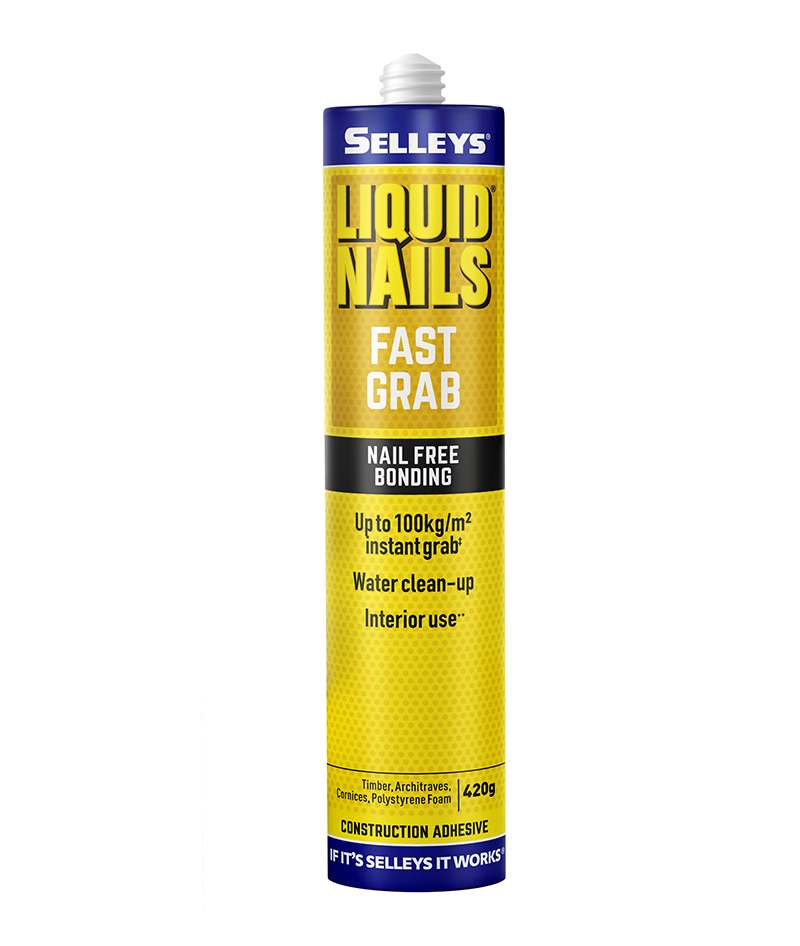
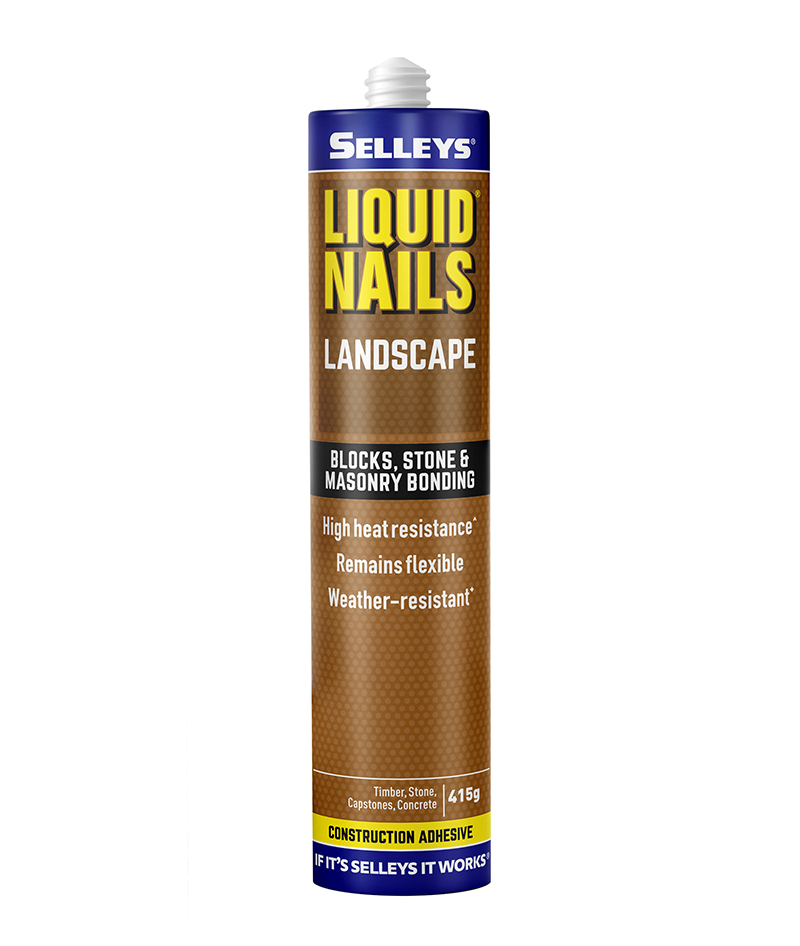
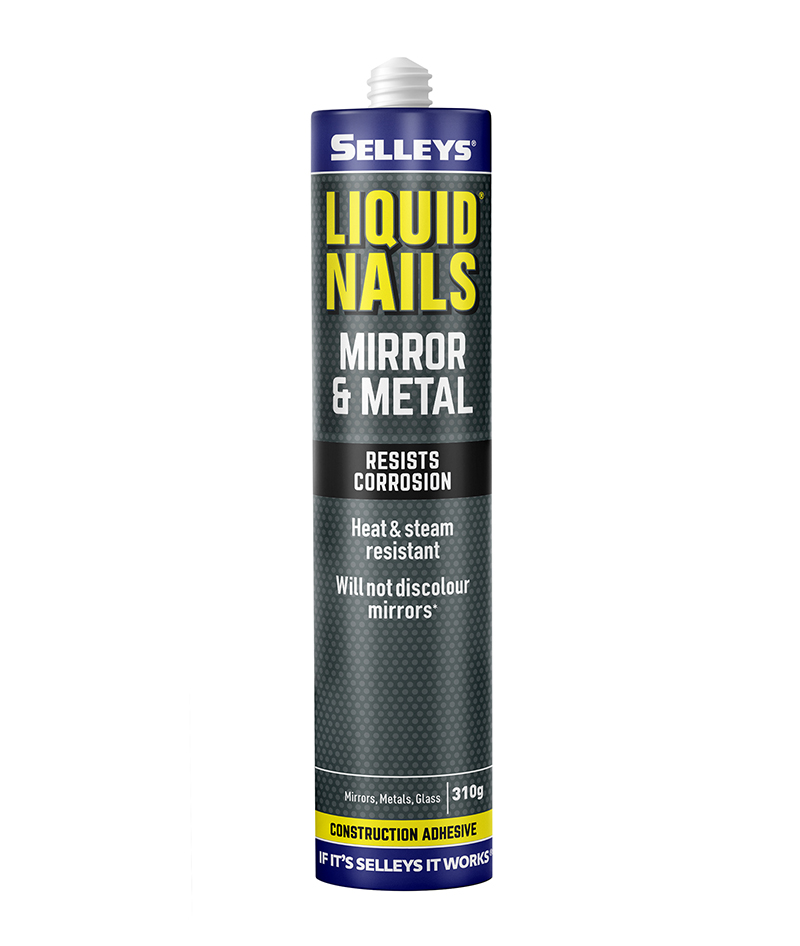
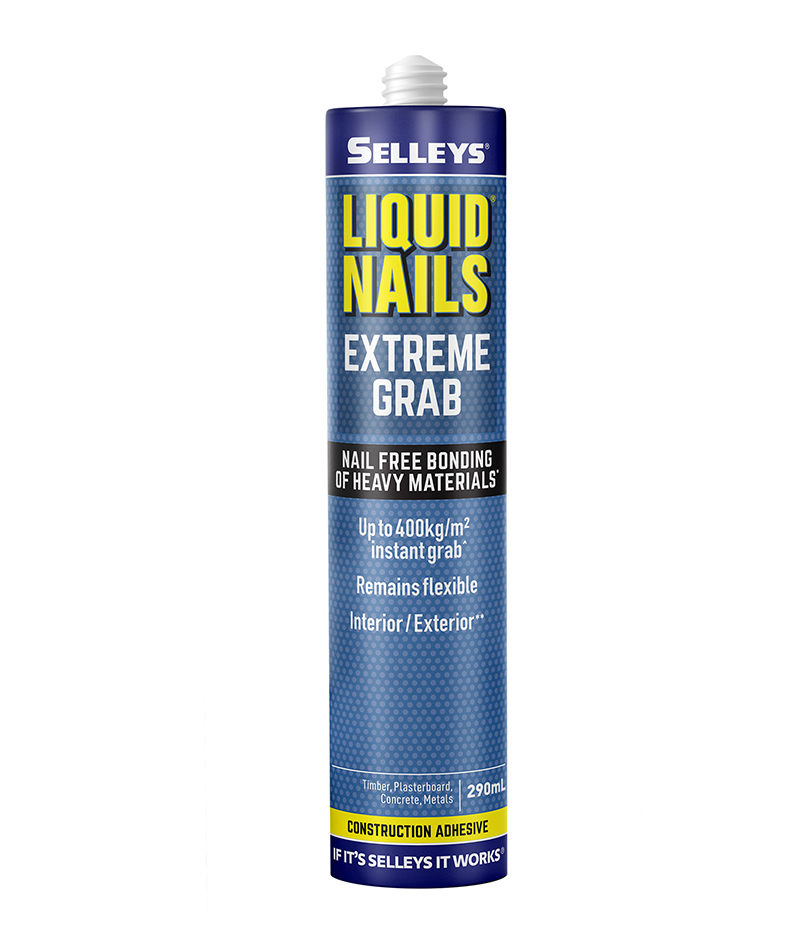
Liquid Nails Extreme Grab is the instant-hold option for vertical work. For landscaping jobs specifically, see Liquid Nails Landscape.
What is Selleys Liquid Nails Exterior?
Selleys Liquid Nails Exterior is a high-performance construction adhesive specifically designed for outdoor use that can withstand heat, water and UV exposure.
What colour does Liquid Nails Exterior turn once it cures?
Source conflict: 2023 TDS v1.0 says white; the retail page says beige. Confirm the colour on the supplied cartridge.
What type of adhesive technology does Liquid Nails Exterior use?
The 2023 TDS v1.0 identifies self-crosslinking acrylic and describes a solvent-free formulation with water cleanup.
How strong is the bond after just 4 hours?
The 2023 TDS claims 3 tonnes/m² after four hours on timber. This is a test claim, not a safe working-load rating for any individual joint.
How long does Liquid Nails Exterior take to reach full bond strength?
The retail page says seven days. The TDS gives a strong bond at 24 hours and conditional support removal after at least four hours on porous surfaces, with longer times in adverse conditions. These milestones are different; confirm readiness for the actual job.
Can Liquid Nails Exterior be painted?
The TDS states after 24 hours; the retail page states once fully cured. Confirm the matching product instructions and paint system if these differ.
What materials can Liquid Nails Exterior be used to bond?
The TDS lists timber and wood panels, masonry/concrete, tiles/ceramics, Perspex, PVC and Colorbond. It also excludes metal generally, so obtain Selleys confirmation for Colorbond or other metal assemblies. Pre-test permitted plastics.
Are there any materials or applications Liquid Nails Exterior should not be used for?
No roofing, permanent immersion or sole structural fixing. The TDS also excludes PE, PP, PTFE, metal generally, rubber, marble and synthetic engineered timber, and discourages tightly clamped joinery. Its Colorbond listing conflicts with its general metal exclusion.
What is the maximum service temperature Liquid Nails Exterior can withstand?
The 2023 TDS specifies up to 70°C; the retail page says 100°C. Do not treat 100°C as a confirmed rating for the supplied formulation without Selleys confirmation.
What is the recommended application temperature range for Liquid Nails Exterior?
The TDS specifies 5–40°C; the retail page gives 5–35°C. Confirm which instructions apply to the supplied cartridge.
What are the directions for using Liquid Nails Exterior?
Remove dust, grease and pooled water, apply the specified bead pattern, assemble promptly and support the joint. The TDS gives a minimum four-hour support period for porous surfaces, longer in cold or humid conditions or on less-porous substrates. Use mechanical fixings for structural work. Wet residue cleans with water and soap.
Images on This Page
-
https://www.selleys.com.au/media/cseezadf/selleys-logo-tagline_752x360.png?rmode=boxpad&ranchor=center&width=188&height=90&format=webp&quality=90
Selleys: Adhesives | Sealants | Putty Fillers | Glues | Cleaning Products - Australia
-
https://www.selleys.com.au/images/productpagev2/loading.gif
(no alt text)
-
https://www.selleys.com.au/media/vvrhwpus/ln-exterior-350g_usp.jpg?rmode=max&ranchor=center&width=440&height=440&format=webp&quality=90
https://www.selleys.com.au/media/vvrhwpus/ln-exterior-350g_usp.jpg?rmode=max&ranchor=center&width=800&height=800&format=webp&quality=90
-
https://www.selleys.com.au/media/tlbpelqo/ln-exterior-350ml-cartridge_fop.png?rmode=max&ranchor=center&width=440&height=440&format=webp&quality=90
https://www.selleys.com.au/media/tlbpelqo/ln-exterior-350ml-cartridge_fop.png?rmode=max&ranchor=center&width=800&height=800&format=webp&quality=90
-
https://www.selleys.com.au/media/runhkzd4/ln-exterior-350ml-cartridge_bop.png?rmode=max&ranchor=center&width=440&height=440&format=webp&quality=90
https://www.selleys.com.au/media/runhkzd4/ln-exterior-350ml-cartridge_bop.png?rmode=max&ranchor=center&width=800&height=800&format=webp&quality=90
-
https://www.selleys.com.au/media/hryithsx/ln-exterior-350g_new-look.jpg?rmode=max&ranchor=center&width=440&height=440&format=webp&quality=90
https://www.selleys.com.au/media/hryithsx/ln-exterior-350g_new-look.jpg?rmode=max&ranchor=center&width=800&height=800&format=webp&quality=90
-
https://www.selleys.com.au/media/v04kmv5r/selleys-liquid-nails-range-shot.png?rmode=max&ranchor=center&width=440&height=440&format=webp&quality=90
https://www.selleys.com.au/media/v04kmv5r/selleys-liquid-nails-range-shot.png?rmode=max&ranchor=center&width=800&height=800&format=webp&quality=90
-
https://www.selleys.com.au/media/dtlbyksf/ln-exterior-350g_lifestyle.png?rmode=max&ranchor=center&width=440&height=440&format=webp&quality=90
https://www.selleys.com.au/media/dtlbyksf/ln-exterior-350g_lifestyle.png?rmode=max&ranchor=center&width=800&height=800&format=webp&quality=90
-
https://img.youtube.com/vi/gFJiS4V40C8/0.jpg?rmode=max&ranchor=center&width=440&height=440&format=webp&quality=90
https://img.youtube.com/vi/gFJiS4V40C8/0.jpg?rmode=max&ranchor=center&width=440&height=440&format=webp&quality=90
-
https://www.selleys.com.au/images/productpagev2/pdp-share-icon.png
Share
-
https://www.selleys.com.au/media/xwfj4vgd/ln-construction-adhesive.jpg
Liquid Nails Construction Adhesive
-
https://www.selleys.com.au/media/0yjpfagv/ln-fast.jpg
Liquid Nails Fast Grab
-
https://www.selleys.com.au/media/vqql3dn0/ln-heavy-duty.jpg
Liquid Nails Heavy Duty
-
https://www.selleys.com.au/media/mgqnpcuz/ln-landscape.jpg
Liquid Nails Landscape
-
https://www.selleys.com.au/media/tp3pnb2f/ln-mirror-metal.jpg
Liquid Nails Mirror & Metal
-
https://www.selleys.com.au/media/4rlb3jns/ln-rapid-cure.jpg
Liquid Nails Rapid Cure
-
https://www.selleys.com.au/media/jeyktnic/ln-extreme-grab.jpg
Liquid Nails Extreme Grab
-
https://www.selleys.com.au/media/0odk5pu3/ln-clear.jpg
Liquid Nails Clear
-
https://www.selleys.com.au/media/cbblla3l/d7da48d64e7c677f17c23efbe8695d38dc36d225.jpg?rmode=crop&ranchor=center&width=524&height=350&format=webp&quality=90
/media/cbblla3l/d7da48d64e7c677f17c23efbe8695d38dc36d225.jpg
-
https://www.selleys.com.au/media/hsfels15/db9d55bd3617f31d27df2749e0d457a5c7b2f25b.jpg?rmode=crop&ranchor=center&width=524&height=350&format=webp&quality=90
/media/hsfels15/db9d55bd3617f31d27df2749e0d457a5c7b2f25b.jpg
-
https://www.selleys.com.au/media/dtkhvo45/4173f8a994aa2fc47a67a8465757dc698057be06.jpg?rmode=crop&ranchor=center&width=524&height=350&format=webp&quality=90
/media/dtkhvo45/4173f8a994aa2fc47a67a8465757dc698057be06.jpg
-
https://www.selleys.com.au/media/cklbfgv1/601c6a32cdd1940b86ed627419d422d420a64132.jpg?rmode=crop&ranchor=center&width=524&height=350&format=webp&quality=90
/media/cklbfgv1/601c6a32cdd1940b86ed627419d422d420a64132.jpg
-
https://www.selleys.com.au/media/hjjjkqpc/selleys-liquid-nails-banner.jpg?rmode=crop&ranchor=center&width=614&height=353&format=webp&quality=90
About Liquid Nails
-
https://www.facebook.com/tr?id=2753205814974506&ev=PageView&noscript=1
(no alt text)