
Product
Product Facts
- Product Name
- Liquid Nails Heavy Duty
- Brand
- Selleys
- Category
- Home & Garden > Adhesives & Sealants
Liquid Nails Heavy Duty
Get an extra strong bond for your toughest jobs with Selleys Liquid Nails Heavy Duty. Perfect for metal, wood, and more.
Check the pack details below, then find a retailer near you. Range and availability vary by store.
Product details
| Colour | Beige |
|---|---|
| Technology | Solvent-based |
Liquid Nails Heavy Duty: technical details
| Packaging | Size | Colour | ||||||
|---|---|---|---|---|---|---|---|---|
| Cartridge | 350 grams | Brown | ||||||
| Property | Typical Result | ||||
|---|---|---|---|---|---|
| Technology | Solvent based | ||||
| Colour | Brown | ||||
| Density | 1.21 | ||||
| Cure Time* | 8 hours | ||||
| Indicative data only, not intended for preparation of specifications | |||||
What it does
- Interior and exterior
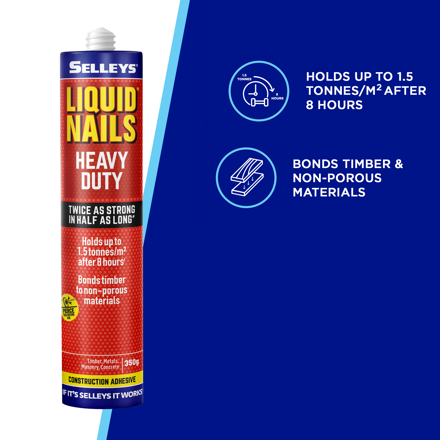
- Twice as strong in half as long (when compared to Selleys Liquid Nails Original)
- Water resistant
- Paintable
- Easily extrudable at low temperatures
Conditions and compatibility
- *Usually mechanical fasteners are only required for 8 hours on porous surfaces and a strong bond achieved in 24 hours and continues to strengthen for 2-3 days. Cure for 7 days. Expect longer times for thicker applications
- **Pre-test plastics to determine compatibility
- Water resistant not waterproof
- Do not use as the sole bonding agent for structural bonding
- Not for mirrors or metals that may be heated by direct sunlight
- Avoid use in tightly clamped joints
Technical data sheet · 1/12/2021
Where to use it
Liquid Nails Heavy Duty is suitable for use on timber, MDF, plasterboard, masonry, concrete, particle board, metals, rubber, glass, tiles, ceramic, and plastics**
Source: Technical data sheet, page 1.
Prepare the surface
Ensure surfaces are free from oil, grease, and dust. Wipe off any pooled water from wet timber.
Source: Technical data sheet, page 1.
How to apply
- Cut cartridge tip, pierce foil, fit nozzle, and cut to desired opening (5mm).
- Apply bead along length of joist,stud or batten. On broad flat surfaces apply beads every 40cm.
- Position pieces and press firmly together. Fix with sufficient nails, screws or clamping to hold load and achieve contact over total bond area. Repositionable for up to 20 minutes after fitting.
- Allow adhesive to set (minimum 8 hours*) before removing any temporary fasteners or clamping. Use with mechanical fasteners in high stress application Contact Bond Method:
- For immediate bond apply to one surface only, press together and pull apart. Allow surfaces to dry out for 2-4 minutes, before firmly re-joining. Flooring:
- Use in conjunction with manufacturer’s installation requirements. To eliminate squeaks in tongue and groove flooring, apply a bead of Liquid Nails Heavy Duty into groove of each board when installing.
Source: Technical data sheet, page 1.
Clean up
Uncured product may be removed with mineral turpentine. Cured product can be removed by scraping or sanding.
Source: Technical data sheet, page 1.
Where not to use it
- *Usually mechanical fasteners are only required for 8 hours on porous surfaces and a strong bond achieved in 24 hours and continues to strengthen for 2-3 days. Cure for 7 days. Expect longer times for thicker applications
- **Pre-test plastics to determine compatibility
- Water resistant not waterproof
- Do not use as the sole bonding agent for structural bonding
- Not for mirrors or metals that may be heated by direct sunlight
- Avoid use in tightly clamped joints
Source: Technical data sheet, page 1.
Safety before you start
Check the product name on your pack against the Australian SDS below before use.
SELLEYS LIQUID NAILS HEAVY DUTY
SDS signal word: Danger.
- Highly flammable liquid and vapour. (H225)
- Causes skin irritation. (H315)
- Causes serious eye irritation. (H319)
- May cause drowsiness or dizziness. (H336)
Handling: Avoid eye contact and skin contact. Avoid inhalation of dust.
Protective equipment and ventilation
Wear safety shoes, overalls, gloves, safety glasses, respirator. Use with adequate ventilation. If inhalation risk exists wear organic vapour/particulate respirator meeting the requirements of AS/NZS 1715 and AS/NZS 1716. Available information suggests that gloves made from nitrile rubber should be suitable for intermittent contact. However, due to variations in glove construction and local conditions, the user should make a final assessment. Always wash hands before smoking, eating, drinking or using the toilet. Wash contaminated clothing and other protective equipment before storing or re-using.
Ventilation: Ensure ventilation is adequate to maintain air concentrations below Exposure Standards. Use only in well ventilated areas. Avoid generating and inhaling dusts. Use with local exhaust ventilation or while wearing dust mask. Vapour heavier than air - prevent concentration in hollows or sumps. Do NOT enter confined spaces where vapour may have collected. When using this material, use explosive dust handling controls to minimise airborne dust and eliminate all ignition sources. Keep away from heat, hot surfaces, sparks and flame; prevent the build-up of static charges with appropriate earthing of equipment and personnel.
Australian safety data sheet · issued 12 April 2024 · sections 2, 7 and 8. Read the full SDS for first aid, spill response, incompatibilities and disposal.
Storage precautions
Store in a cool, dry, well-ventilated place and out of direct sunlight. Store away from foodstuffs. Store away from incompatible materials described in Section 10. Store away from sources of heat and/or ignition. Store locked up. Keep container standing upright. Keep containers closed when not in use - check regularly for spills.
SELLEYS LIQUID NAILS HEAVY DUTY: storage and product data
| Pack named in this SDS | Product code | Barcode |
|---|---|---|
| Liquid Nails Heavy Duty 350g Triple Pack | 100173 | 9300697124852 |
| Liquid Nails Heavy Duty Twin Pack NZ | 100315 | 9414302111189 |
| Liquid Nails Heavy Duty Triple Pack 375g | 100336 | 9414302111219 |
Store between jobs
Store in a cool, dry, well-ventilated place and out of direct sunlight. Store away from foodstuffs. Store away from incompatible materials described in Section 10. Store away from sources of heat and/or ignition. Store locked up. Keep container standing upright. Keep containers closed when not in use - check regularly for spills.
This material is classified as a Class 3 Flammable Liquid as per the criteria of the "Australian Code for the Transport of Dangerous Goods by Road & Rail" and/or the "New Zealand NZS5433: Transport of Dangerous Goods on Land" and must be stored in accordance with the relevant regulations.
This product is a "Manufactured Product" as defined in the ADG Code.
| Form | Paste |
|---|---|
| Colour | Brown |
| Odour | Solvent |
| Solubility | Insoluble in water |
| Specific Gravity | 1.19 |
| Relative Vapour Density (air=1) | >1 |
| Vapour Pressure | N Av |
| Flash Point (°C) | -12 |
| Explosion/Flammability Limits | N Av |
| Autoignition Temperature (°C) | N Av |
| Melting Point/Range (°C) | N Av |
| Boiling Point/Range (°C) | N Av |
| pH | N App |
| Viscosity | >100s (6mm jet cup) |
| Total VOC (g/Litre) | N Av |
Others in this range
Alongside this product:
- Hold Up
- Liquid Nails Clear
- Liquid Nails Construction Adhesive
- Liquid Nails Exterior
- Liquid Nails Extreme Grab
- Liquid Nails Fast Grab
- Liquid Nails Flex
- Liquid Nails Landscape
- Liquid Nails Mirror & Metal
- Liquid Nails Rapid Cure
- Point Works
- Point Works Accelerant Spray
- Pro Trade Construction Adhesive Fast Grip
- Pro Trade Construction Adhesive Multipurpose
Browse from here
Where this page sits:
Typical values describe the material in this safety data sheet. They are not application instructions or performance guarantees. N Av means not available; N App means not applicable.
Ingredients disclosed in the SDS
CHEMICAL ENTITY CAS NO PROPORTION
Naphtha, petroleum, hydrotreated light 64742-49-0 10 - 30 % (w/w)
Acetic acid, methyl ester 79-20-9 10 - 30 % (w/w)
Acetone 67-64-1 1 - 10 % (w/w)
Phenol, 2,2'-methylenebis[6-(1,1-dimethylethyl)-4-methyl- 119-47-1 <1 % (w/w)
Ingredients determined to be non-hazardous or below reporting limits Balance
____________
100%
These are the ingredients disclosed for hazard communication, not the complete formulation. Use the application instructions to decide suitability for your project.
First aid from the matching SDS
If poisoning occurs, contact a doctor or Poisons Information Centre (Phone Australia 131 126, New Zealand 0800 764 766).
Inhalation: Remove victim from exposure - avoid becoming a casualty. Remove contaminated clothing and loosen remaining clothing. Allow patient to assume most comfortable position and keep warm. Keep at rest until fully recovered. Seek medical advice if effects persist.
Skin Contact: If skin or hair contact occurs, immediately remove contaminated clothing and flush skin and hair with running water. Continue flushing with water until advised to stop by the Poisons Information Centre or a Doctor; or for 15 minutes and transport to Doctor or Hospital. For gross contamination, immediately drench with water and remove clothing. Continue to flush skin and hair with plenty of water (and soap if material is insoluble). For skin burns, cover with a clean, dry dressing until medical help is available. If blistering occurs, do NOT break blisters. If swelling, redness, blistering, or irritation occurs seek medical assistance.
Eye contact: If in eyes, hold eyelids apart and flush the eyes continuously with running water. Continue flushing until advised to stop by the Poisons Information Centre or a Doctor; or for at least 15 minutes and transport to Doctor or Hospital.
Ingestion: Rinse mouth with water. If swallowed, do NOT induce vomiting. Give a glass of water to drink. Never give anything by the mouth to an unconscious patient. If vomiting occurs give further water. Seek medical advice.
PPE for First Aiders: Wear safety shoes, overalls, gloves, safety glasses, respirator. Use with adequate ventilation. If inhalation risk exists wear organic vapour/particulate respirator meeting the requirements of AS/NZS 1715 and AS/NZS 1716. Available information suggests that gloves made from nitrile rubber should be suitable for intermittent contact. However, due to variations in glove construction and local conditions, the user should make a final assessment. Always wash hands before smoking, eating, drinking or using the toilet. Wash contaminated clothing and other protective equipment before storing or re-using.
Notes to physician: Treat symptomatically.
Disposal
Persons conducting disposal, recycling or reclamation activities should ensure that appropriate personal protection equipment is used, see "Section 8. Exposure Controls and Personal Protection" of this SDS. If possible material and its container should be recycled. If material or container cannot be recycled, dispose in accordance with local, regional, national and international Regulations.
Australian SDS · sections 1, 3, 4, 7, 9 and 13 · 12 April 2024
Technical and safety documents
The technical data sheet covers application and performance conditions. The safety data sheet covers hazards and safe handling. Use both alongside the pack instructions.
- Technical data sheet — Liquid Nails Heavy Duty · 1/12/2021
- Australian SDS — SELLEYS LIQUID NAILS HEAVY DUTY · 12 April 2024
Need a hand choosing the right document or checking your application? Contact our team with the product name, pack code, surfaces and intended use.
Can I use it on mirrors or sun-heated metal?
No. The technical sheet excludes mirrors and metals that may be heated by direct sunlight. General metal suitability and an online service-temperature range do not remove that exclusion.
Is it waterproof?
No. It is water resistant, not waterproof, and is not suitable for constant-water exposure.
When can I remove clamps or temporary fasteners?
The technical sheet gives a minimum of eight hours, normally on porous surfaces. This is not full cure. Keep necessary mechanical fixings for high-stress or structural work and do not use adhesive as the sole structural bonding agent.
How long does full cure take?
The technical sheet says seven days, longer for thicker applications, with a strong bond at 24 hours and continued strengthening for two to three days. Our online directions give seven to ten days to full strength. Follow the matching cartridge instructions and conditions; support removal is a different milestone.
How should I apply it?
After confirming pack instructions and following safety precautions, remove oil, grease and dust. Cut the cartridge tip, pierce the foil, fit the nozzle and cut to approximately 5 mm. Apply along joists, studs or battens, or every 40 cm on broad flat surfaces, press firmly together and support the full bond area.
Can I reposition the pieces?
The technical sheet allows repositioning for up to 20 minutes after fitting.
How does the contact-bond method work?
Apply to one surface, press together, pull apart, allow to dry for two to four minutes, then firmly rejoin. An immediate bond is not full cure; maintain the required support and mechanical fixings.
How can I reduce tongue-and-groove flooring squeaks?
Follow the flooring manufacturer’s installation requirements and apply a bead into the groove of each board during installation. Maintain required mechanical fixings.
Can I bond wet timber and what colour is it?
Confirm your exact cartridge with our team before wet-timber or colour-critical work. The technical sheet allows wet timber after pooled water is wiped away, while online directions say dry. The technical sheet and SDS describe brown; the online page says beige.
Can I paint it and remove excess?
Paint only when fully cured. Remove uncured adhesive with mineral turpentine; cured material can be scraped or sanded where suitable for the finish. Follow dust precautions and cleaner safety directions.
Which plastics are excluded?
Pre-test permitted plastics. Our online directions exclude polyethylene, polypropylene and PTFE, and also exclude bitumen. The technical sheet discourages tightly clamped joints and excludes sole structural bonding.
What temperature range applies?
Our online directions list application at 5°C to 35°C and service at −20°C to 100°C. Check your pack or ask our team before temperature-critical use. Do not use on metals heated by direct sunlight.