
Product
Product Facts
- Product Name
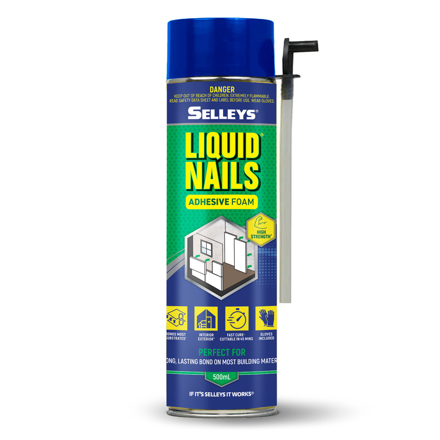
- Selleys Liquid Nails Adhesive Foam
- Brand
- Selleys
- Category
- Home & Garden > Adhesives & Sealants
Selleys Liquid Nails Adhesive Foam
Our single-component polyurethane adhesive foam bonds listed building materials, lightweight panels, skirting, insulation boards and non-load-bearing AAC blocks. It cures with moisture. Prepare the surfaces and check the application limits before using it; follow any requirement for additional mechanical fixings.
Check product range and availability with your retailer.
Product details
Match the exact can. The technical sheet identifies a 500 mL can, item 1170576. The Australian SDS identifies a 500 g pack, code 104348. Those units and codes differ; do not treat them as a verified conversion or assume the documents describe the same pack. Ask our team to confirm the matching documents using the code on your can.
| Technology | Polyurethane |
|---|---|
| Colour | Orange |
| Pack Size | 500mL |
Selleys Liquid Nails Adhesive Foam: technical details
| Product and Technical Information | |||
|---|---|---|---|
| Product Data | Technical Performance | ||
| Technology | Polyurethane | Tack Free Time | 5-10 min |
| Cure Mechanism | Moisture curing | Working Time | Up to 5 mins |
| Coverage (500 mL) | 6.7 m2 wall surface | Cutting Time | Approx. 45 mins |
| Colour | Orange | Thermal Conductivity | 0.034 W/(m.K) |
| Shelf life | 15 months | Sound Reduction Index | 62 dB |
| Canister Temperature | +5 °C to +25 °C | Service Temperature | -50 °C to +90 °C |
| Ambient Temperature | -5 °C to +30 °C | ||
| The table results are based on current product material data, quality test methods, and testing conditions, such as temperature, moisture, and substrate. | |||
| Canister Size | Available colour | Item Code |
|---|---|---|
| 500 mL | Orange | 1170576 |
What it does
- Fast curing
- Easy and ready to use
- Excellent adhesion to most surfaces1
- CFC-free and ozone-safe hydrocarbon propellant
- Interior/Exterior3
- Easy to cut, sand and paint
- High bond strength
- Paintable2
- One can = ~8x construction adhesive (300ml)
- One can = ~1x AAC adhesive (15kg bag)
Conditions and compatibility
- Not for use on polyethylene, polypropylene or PTFE (Teflon®).
- Pre-test adhesion compatibility with substrates before use. Standards & Conformities AS 2329:1999 (E) Mastic Adhesives for Fixing Wallboards AS 2753:2018 Adhesives- For Bonding Gypsum Plaster Linings to Wood and Metal Framing Members
- Do not apply if the ambient or substrate surface temperature is below -5 °C or above +30 °C
- Do not use for applications exceeding the temperature requirements below -50 °C or above +90 °C
- Do not store the expanding foam canister above +50 °C and near heat sources or in direct sunlight.
- Not recommended for continuous submersion or below water line use.
- Expanding foam requires atmospheric moisture to cure. On non-porous substrates or in low-humidity conditions, curing speed slows.
- 3 When used for exterior application, cured foam is reactive to UV-light. It is recommended to use a coloured sealant, filler, or paint over the foam when it is exposed to direct sunlight.
- Selleys® recommends users conduct their own risk assessment before use to determine the product's suitability. A sample should be applied to the intended area to ensure acceptable appearance, finish, and performance on the surface.
Choose the right bonding job
A single-component polyurethane adhesive foam for listed building materials, lightweight panels, skirting, insulation boards and non-load-bearing AAC blocks. Pre-test adhesion. Do not use on polyethylene, polypropylene or PTFE.
Use additional mechanical fixings wherever the building design, codes, standards or regulations require them.
Source: Technical data sheet, page 1.
Prepare the surfaces and can
- Remove existing adhesive, dust, oil, rust and other contamination; the surface must be sound.
- Wear the gloves and eye protection required by the SDS. Read its ventilation, ignition-source and respiratory precautions before using this flammable aerosol.
- Shake the can at least 20 times and fit the straw nozzle without overtightening.
- Mist the surface with clean water to support moisture curing.
- Invert the can and gently operate the straw base to dispense.
Source: Technical data sheet, page 2.
Apply for the intended material
- Wall panels: use continuous beads 30–40 mm from the edges and additional beads at no more than 250 mm centres, depending on panel size and weight. Let the foam react for 2–3 minutes before positioning; press firmly and adjust within the TDS’s stated 5-minute window.
- Skirting: place continuous beads 10–20 mm from the edges, press into full contact and support as needed until sufficiently strong.
- Non-load-bearing blocks: apply two continuous beads about 20–30 mm in diameter to the horizontal and vertical bonding surfaces; align before cure begins.
If you lift an item after positioning, apply fresh adhesive before reinstalling. Cure and handling times depend on the substrate, temperature and humidity.
Source: Technical data sheet, page 2.
Cleanup, reuse and weather exposure
Remove uncured foam from compatible tools and equipment promptly with acetone. Cured foam requires mechanical removal. After use, clean the valve and nozzle as directed; correctly cleaned and stored foam may be reused for up to four weeks.
Use water-based paint. Protect exterior cured foam from sunlight with a suitable coloured sealant, filler or paint. Do not use for continuous submersion or below the waterline.
Source: Technical data sheet, page 3.
Temperature and storage limits
Do not apply below −5°C or above 30°C ambient or substrate temperature. The TDS lists a canister application temperature of 5–25°C. Low humidity and non-porous surfaces slow cure.
Store unopened cans upright at 5–27°C, in a cool, dry place away from sunlight. Never expose the can to temperatures above 50°C or heat sources. The TDS gives 15 months from manufacture for unopened packaging.
Source: Technical data sheet, page 3.
Safety before you start
Check the product name on your pack against the Australian SDS below before use.
LIQUID NAILS FOAM
SDS signal word: Danger.
- Extremely flammable aerosol. (H222)
- Pressurized container: may burst if heated. (H229)
- Harmful if swallowed. (H302)
- Causes skin irritation. (H315)
- May cause an allergic skin reaction. (H317)
- Causes serious eye irritation. (H319)
- Harmful if inhaled. (H332)
- May cause allergy or asthma symptoms or breathing difficulties if inhaled. (H334)
- May cause respiratory irritation. (H335)
- Suspected of causing cancer. (H351)
- Causes damage to organs through prolonged or repeated exposure. (H372)
Handling: Avoid eye contact and skin contact. Avoid inhalation of vapour, mist or aerosols.
Protective equipment and ventilation
Wear safety shoes, overalls, gloves, chemical goggles, respirator. Use with adequate ventilation. If inhalation risk exists wear organic vapour/particulate respirator meeting the requirements of AS/NZS 1715 and AS/NZS 1716. Available information suggests that gloves made from nitrile rubber should be suitable for intermittent contact. However, due to variations in glove construction and local conditions, the user should make a final assessment. Always wash hands before smoking, eating, drinking or using the toilet. Wash contaminated clothing and other protective equipment before storing or re-using.
Ventilation: Ensure ventilation is adequate to maintain air concentrations below Exposure Standards. Use only in well ventilated areas. Use with local exhaust ventilation or while wearing appropriate respirator. Vapour heavier than air - prevent concentration in hollows or sumps. Do NOT enter confined spaces where vapour may have collected. When using this material, use explosive dust handling controls to minimise airborne dust and eliminate all ignition sources. Keep away from heat, hot surfaces, sparks and flame; prevent the build-up of static charges with appropriate earthing of equipment and personnel.
Australian safety data sheet · issued 9 February 2026 · sections 2, 7 and 8. Read the full SDS for first aid, spill response, incompatibilities and disposal.
LIQUID NAILS FOAM: storage and product data
Store between jobs
Store in a cool, dry, well-ventilated place and out of direct sunlight. Store away from foodstuffs. Store away from incompatible materials described in Section 10. Store away from sources of heat and/or ignition. Store locked up. Do not expose to temperatures exceeding 50 °C/122 °F Keep containers closed when not in use - check regularly for leaks.
This material is classified as a Division 2.1 Flammable Gas as per the criteria of the "Australian Code for the Transport of Dangerous Goods by Road & Rail" and/or the "New Zealand NZS5433: Transport of Dangerous Goods on Land" and must be stored in accordance with the relevant regulations.
| Form | Aerosol |
|---|---|
| Colour | Orange |
| Odour | Characteristic |
| Solubility | N Av |
| Specific Gravity | 1.019 |
| Relative Vapour Density (air=1) | >1 |
| Vapour Pressure | <300 kPa @ 50°C |
| Flash Point (°C) | <23 |
| Explosion/Flammability Limits | N Av |
| Autoignition Temperature (°C) | 460 (propellant) |
| Melting/Freezing Point/Range (°C) | N Av |
| Boiling Point/Range (°C) | -42 (propellant) |
| pH | N App |
| Viscosity | N Av |
| Total VOC (g/Litre) | N Av |
Others in this range
Alongside this product:
- Hold Up
- Liquid Nails Clear
- Liquid Nails Construction Adhesive
- Liquid Nails Exterior
- Liquid Nails Extreme Grab
- Liquid Nails Fast Grab
- Liquid Nails Flex
- Liquid Nails Heavy Duty
- Liquid Nails Landscape
- Liquid Nails Mirror & Metal
- Liquid Nails Rapid Cure
- Point Works
- Point Works Accelerant Spray
- Pro Trade Construction Adhesive Fast Grip
Browse from here
Where this page sits:
Typical values describe the material in this safety data sheet. They are not application instructions or performance guarantees. N Av means not available; N App means not applicable.
Ingredients disclosed in the SDS
CHEMICAL ENTITY CAS NO PROPORTION
Diphenylmethane diisocyanate isomers and homologues 9016-87-9 30 - 60 % (w/w)
Reaction products of phosphoryl trichloride and 2-methyloxirane 1244733-77-4 10 - 30 % (w/w)
Dimethyl Ether 115-10-6 1 - 10 % (w/w)
Isobutane 75-28-5 1 - 10 % (w/w)
Propane 74-98-6 1 - 10 % (w/w)
Ingredients determined to be non-hazardous or below reporting limits Balance
____________
100%
These are the ingredients disclosed for hazard communication, not the complete formulation. Use the application instructions to decide suitability for your project.
First aid from the matching SDS
If poisoning occurs, contact a doctor or Poisons Information Centre (Phone Australia 131 126, New Zealand 0800 764 766).
Inhalation: Effects may be delayed. Remove victim from exposure - avoid becoming a casualty. Remove contaminated clothing and loosen remaining clothing. Allow patient to assume most comfortable position and keep warm. Keep at rest until fully recovered. If breathing laboured and patient cyanotic (blue), ensure airways are clear and have a qualified person give oxygen through a facemask. If breathing has stopped apply artificial respiration at once. In the event of cardiac arrest, apply external cardiac massage. Seek immediate medical advice.
Skin Contact: Effects may be delayed. If skin or hair contact occurs, immediately remove contaminated clothing and flush skin and hair with running water. Continue flushing with water until advised to stop by the Poisons Information Centre or a Doctor; or for 15 minutes and transport to Doctor or Hospital. For gross contamination, immediately drench with water and remove clothing. Continue to flush skin and hair with plenty of water (and soap if material is insoluble). For skin burns, cover with a clean, dry dressing until medical help is available. If blistering occurs, do NOT break blisters. If swelling, redness, blistering, or irritation occurs seek medical assistance. Eye Contact: If in eyes, hold eyelids apart and flush the eyes continuously with running water. Continue flushing until advised to stop by the Poisons Information Centre or a Doctor; or for at least 15 minutes and transport to Doctor or Hospital.
Ingestion: Rinse mouth with water. If swallowed, do NOT induce vomiting. Give a glass of water to drink. Never give anything by the mouth to an unconscious patient. If vomiting occurs give further water. Immediately call Poisons Centre or Doctor.
PPE for First Aiders: Wear safety shoes, overalls, gloves, chemical goggles, respirator. Use with adequate ventilation. If inhalation risk exists wear organic vapour/particulate respirator meeting the requirements of AS/NZS 1715 and AS/NZS 1716. Available information suggests that gloves made from nitrile rubber should be suitable for intermittent contact. However, due to variations in glove construction and local conditions, the user should make a final assessment. Always wash hands before smoking, eating, drinking or using the toilet. Wash contaminated clothing and other protective equipment before storing or re-using. Notes to Physician: Treat symptomatically. Effects may be delayed.
Disposal
Persons conducting disposal, recycling or reclamation activities should ensure that appropriate personal protection equipment is used, see "Section 8. Exposure Controls and Personal Protection" of this SDS. If possible material and its container should be recycled. If material or container cannot be recycled, dispose in accordance with local, regional, national and international Regulations.
Australian SDS · sections 1, 3, 4, 7, 9 and 13 · 9 February 2026
Technical and safety documents
Pack check: the September 2026 TDS describes a 500 mL can; the Australian SDS lists Liquid Nails Adhesive Foam 500 g, product code 104348. Confirm the product and pack code against your label with our team if they differ. The Liquid Nails Original SDS is not the foam SDS.
The technical data sheet covers application and performance conditions. The safety data sheet covers hazards and safe handling. Use both alongside the pack instructions.
- Technical data sheet — Selleys Liquid Nails Adhesive Foam
- Australian SDS — LIQUID NAILS FOAM · 9 February 2026
Need a hand choosing the right document or checking your application? Contact our team with the product name, pack code, surfaces and intended use.
Can I bond mirrors with it?
No. Our product page excludes mirrors. Polyethylene, polypropylene and PTFE/Teflon are also excluded.
Can I build load-bearing blockwork with it?
The technical sheet’s block application is for non-load-bearing blocks such as AAC. Use additional mechanical fixings as required by the building design, codes, standards and regulations.
How do I clean non-porous surfaces?
Wipe in one direction with a clean cloth dampened with IPA or white spirit, then immediately use a clean dry cloth. Follow the solvent’s safety instructions and mist the bonding surface with clean water for curing.
What bead pattern should I use for wall panels?
Run continuous beads 30–40mm from panel edges with additional beads at maximum 250mm centres, depending on size and weight. Let them react 2–3 minutes, press the panel in place and adjust for up to five minutes after installation.
Do skirting and blocks use the same pattern?
No. Skirting beads sit 10–20mm from the edges. Non-load-bearing blocks use two 20–30mm-diameter beads on the substrate and each block, on horizontal and vertical bonding faces.
Can I reuse an opened can?
After use, remove the nozzle and thoroughly clean the valve and nozzle with acetone. Correctly cleaned and stored foam may be reused for up to four weeks; replace the straw if necessary.
Does 45 minutes mean fully cured?
No. Approximately 45 minutes is the typical cutting time. Allow excess foam to cure fully before trimming, and retain supports until sufficient strength develops. Temperature, humidity and substrates affect curing.
Can it remain exposed outside?
Cured foam reacts to UV light. Protect foam exposed to direct sunlight with a coloured sealant, filler or paint; use water-based paint. It is not for continuous immersion or below-waterline use.
What temperature limits apply?
Canister 5–25°C for use; ambient and surface −5–30°C; unopened storage 5–27°C; cured service −50–90°C. Never expose the pressurised can above 50°C.
Why does the safety sheet say 500g when the page says 500mL?
The technical sheet and original page identify 500mL; the linked SDS lists 500g and a different code. Do not treat these units or codes as interchangeable; confirm the matching pack and SDS with us before use. Match the SDS reference on your pack and contact our team for the correct sheet if it differs.
Is it safe to use near a flame?
No. It is an extremely flammable aerosol. Remove ignition sources in and near the work area and follow the SDS ventilation, flameproof-equipment, earthing and PPE controls. Do not pierce or burn the can.
What are the key product details?
Match the exact can. The technical sheet identifies a 500 mL can, item 1170576. The Australian SDS identifies a 500 g pack, code 104348. Those units and codes differ; do not treat them as a verified conversion or assume the documents describe the same pack.